Week 43 / 52Positioning & Brand · Crossing the chasm
The Early Fans Love You. The Majority Never Heard the Pitch.
Between the visionaries who try anything and the pragmatists who buy on references lies a chasm. You cross it by winning one beachhead niche completely.
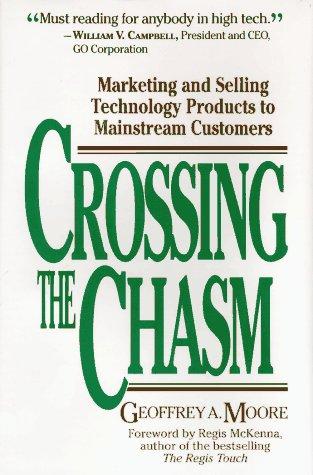
From:Crossing the ChasmAuthor:Geoffrey MooreDate:Jun 21, 2027Pages:~267 pages
Here is a pattern I have watched wreck more good products than bad ones ever did. A company launches something genuinely useful. A small, loud, enthusiastic crowd adopts it fast. They rave. They tinker with it. They forgive the rough edges because they love being first. The founders look at that graph going up and to the right and they assume the rest of the market is right behind. Then growth stalls, quietly, for no reason anyone in the room can point to. The product did not get worse. The team did not stop trying. The market simply stopped showing up.
Geoffrey Moore spent years inside that mystery, consulting with tech companies that lived and died by it, and he found the fault line. The people who bought first, the early adopters, were never buying the same thing as everyone else. They buy on vision. They want to be the ones who saw it coming, and they will put up with missing features and a shaky manual because the story of being early is worth more to them than the product working perfectly. The early majority, the people who make up the actual bulk of any market, buy on references. They ask a colleague who already uses it. They want a case study from someone in their own industry, not a visionary in a different one. Vision buyers and reference buyers are not two points on the same line. They are two different planets, and there is no smooth road between them.
Moore called that gap the chasm, and it is the reason so many products with genuine early love flatline before they ever reach the mainstream. The instinct when growth stalls is to go wider, to chase more segments, to broaden the pitch so it fits more people. Moore's argument is the opposite of that instinct, and it is the whole book in one move: you cross the chasm by going narrower, not wider. You pick one beachhead market, a single niche with a sharp, specific, painful problem, and you win it so completely that the pragmatists in it have no reference left to check other than you. Total domination of one small pond buys you the references that let you take the next pond, and the one after that.
This is the week we build the beachhead. Get something that is not coffee, because this chapter is going to ask you to give up territory you thought you needed, and that argument goes down easier without caffeine doing the arguing for you.
◆ ◆ ◆
◆ Audio Overview
Prefer to listen?
The chapter as a listen: the gap between early believers and the mainstream, and the beachhead that gets you across.
Crossing the Chasm · Audio Overview
0:00/13:33
The Thesis
The early majority does not think like the early adopters who got you started, so growth stalls in the chasm between vision buyers and reference buyers. You cross that chasm not by broadening the pitch but by narrowing it, dominating a single beachhead market with a whole product so completely that the pragmatists there have nowhere else to look. Win one niche all the way, then use it as the reference for the next.
Crossing the Chasm is the citation for go-to-market strategy, product launches, segment strategy, and the specific ache of we have fans but no growth. Reach for it whenever the room wants to expand and the data says narrow first.
◆ ◆ ◆
02The Architecture
Ten frameworks. The chasm, the beachhead, and the whole product.
Framework 01
The Technology Adoption Lifecycle
What it is
A bell curve of five buyer types across any market for a new idea: innovators, early adopters, early majority, late majority, and laggards. Each group adopts for a different reason and needs a different pitch, and each is a meaningfully different size, with the early and late majority making up the bulk of any real market.
Marketing use
Stop treating your buyers as one audience with one message. Map who you are actually selling to on the curve right now, and write the pitch for that group, not for the group you wish you had or the group you started with.
"Per Moore's technology adoption lifecycle, innovators, early adopters, early majority, late majority, and laggards each adopt for a different reason, so one pitch cannot serve all five."
Framework 02
The Chasm
What it is
A gap in the middle of the adoption curve, between the early adopters and the early majority, where many products stall and die. It is not a small gap. It is a difference in psychology, budget, and buying process wide enough that momentum from one side does not carry to the other.
Marketing use
When growth flattens right after an enthusiastic early run, do not assume the product broke. Check whether you have simply run out of visionaries and have not yet earned the trust of pragmatists. That is a different problem with a different fix.
"Per Moore's chasm, momentum built with early adopters does not automatically carry into the early majority, because the two groups buy for different reasons entirely."
Framework 03
Early Adopters vs Pragmatists
What it is
Early adopters are visionaries who buy on the promise of a dramatic advantage and are willing to be the reference case themselves. Pragmatists want proof before they commit, and specifically they want proof from someone in their own world, doing the same job, taking the same risk.
Marketing use
Write two different pitches. Sell the visionary on transformation and the ground floor. Sell the pragmatist on evidence: a named customer in their industry, a specific result, a process that other companies like theirs already trust.
"Per Moore, early adopters buy the vision while pragmatists buy the proof, so the same pitch that won your first customers will not win the next wave."
Framework 04
The Beachhead Market
What it is
A single, tightly defined niche where you commit to winning completely before you touch any other segment. Small enough to dominate quickly, painful enough that the problem is urgent, and connected enough that word travels fast inside it.
Marketing use
Pick one niche and say no to every other segment for now, even the tempting ones. The beachhead is not your biggest opportunity. It is the smallest market you can own outright and use as a launchpad.
"Per Moore's beachhead market, total domination of one small, well-chosen niche is worth more than partial presence across many, because the niche becomes the reference base for everything after it."
Framework 05
The Whole Product
What it is
The core product plus every additional piece, training, integrations, support, documentation, a specific workflow, that the beachhead customer needs to fully solve their problem, not just experience your feature. Pragmatists will not buy a product; they will buy a complete solution.
Marketing use
Map everything your beachhead customer needs beyond the core offer to get the full outcome, then either build it, partner for it, or bundle it. An impressive core feature attached to a missing whole product still reads as a risk to a pragmatist.
"Per Moore's whole product, pragmatists buy the complete solution to their specific problem, not the core feature, so the gaps around the product matter as much as the product itself."
Framework 06
The Bowling Alley
What it is
Once the beachhead is won, expansion does not happen all at once. It happens niche to niche, like bowling pins falling in sequence, where the reference and whole product built for the first niche knock down the next adjacent one.
Marketing use
After dominating the beachhead, look for the next niche that shares enough of the same problem and the same whole product to fall easily, rather than jumping straight to the broadest possible market.
"Per Moore's bowling alley, expansion after the beachhead proceeds niche by niche, with each win's references and whole product knocking down the next adjacent segment."
Framework 07
Positioning for the Pragmatist
What it is
Pragmatists discount enthusiasm and discount your own claims about yourself. What moves them is a reference from a peer, a specific case study in their exact context, and evidence that other companies like theirs have already taken the risk and won.
Marketing use
Build the case study before you need it. Get one credible beachhead customer talking specifically about their result, in their own words, in their own industry language, and put that in front of the next prospect before they ask for it.
"Per Moore, pragmatists are moved by peer references and specific case evidence, not by vision or enthusiasm, so positioning for them means leading with proof."
Framework 08
The Single Point of Attack
What it is
Resources spread across many target markets rarely generate enough force to fully convert any one of them. Concentrating the entire go-to-market effort on one beachhead generates the force needed to actually win it.
Marketing use
Resist the pressure to serve every segment that shows interest. A sales team, a marketing budget, and a product roadmap split five ways rarely wins even one of those five outright. Pick the one point and hit it with everything.
"Per Moore's single point of attack, concentrating go-to-market resources on one beachhead generates enough force to win it outright, where the same resources split five ways win none of them."
Framework 09
Create the Competition Frame
What it is
Pragmatists want to know who else exists in the category and where you stand against them, even in a genuinely new market. A category without a competitive frame reads as unproven; naming an alternative, even an imperfect one, makes the choice legible.
Marketing use
Give the pragmatist a frame: name who you are replacing or beating, whether that is a direct competitor, the status quo, or doing it manually. A market with no named alternative feels riskier than a market with a clear one.
"Per Moore, naming a competitive frame, even against the status quo, makes a new category legible to a pragmatist buyer who is otherwise being asked to evaluate something with no reference point."
Framework 10
The Tornado
What it is
After a beachhead is won and the bowling alley is underway, some markets hit a period of mainstream hypergrowth, where demand outruns any single company's ability to serve it and the game shifts from picking niches to scaling operations as fast as possible.
Marketing use
Recognize the tornado when it arrives and change strategy accordingly. The careful, niche-by-niche discipline that got you across the chasm gives way to a land grab, where speed and distribution matter more than customization.
"Per Moore's tornado, mainstream hypergrowth after the chasm is crossed shifts the strategic question from which niche to win next to how fast the category leader can scale to meet demand."
◆ ◆ ◆
03Lexicon
Named terms a marketer should recognize on sight.
Adoption lifecycle
The five buyer types across a market for anything new. Know which type you are actually pitching.
The chasm
The gap between early adopters and the early majority. Diagnose the stall before you diagnose the product.
Early adopter
A visionary who buys on the promise, before the proof exists. Sell them transformation and the ground floor.
Pragmatist
A buyer who wants proof from a peer before committing. Sell them the reference, not the vision.
Beachhead
One tightly defined niche you commit to winning completely. Pick it, then say no to every other segment for now.
Whole product
Everything beyond the core feature needed to fully solve the niche's problem. Map the gaps before the pragmatist finds them.
Bowling alley
Expansion niche by niche, each one knocking down the next. Look for the adjacent pin, not the whole lane at once.
Point of attack
One beachhead hit with full resources, not five hit with scraps. Concentrate force instead of spreading it.
Reference selling
Winning new pragmatists by showing them a peer who already won. Build the case study before you need it.
The tornado
Mainstream hypergrowth after the chasm is crossed. Shift from niche discipline to scaling speed.
◆ ◆ ◆
04Tactical Recipes
Plays you can run this week.
The Beachhead Pick. List every plausible niche, then choose the smallest one where the problem is most urgent, the buyer group is most reachable, and a win would be most visible to the next niche over.
The Whole-Product Gap. Map what your beachhead customer needs beyond your core feature to get the full outcome. Circle every gap that is currently unbuilt, unpartnered, or undocumented, and close the biggest one first.
The Reference Build. Identify your single best beachhead customer, interview them for a specific, named result, and turn it into a case study written in their own industry's language before you pitch the next prospect.
The Pragmatist Message. Rewrite your homepage or pitch deck to lead with a peer reference and a specific outcome instead of a vision statement. Save the transformation language for the visionaries who are still worth courting separately.
The Point-of-Attack Focus. Audit where your sales, marketing, and roadmap effort actually goes this quarter. If it is split across more than one or two segments, name the one segment you would cut the others to fully fund.
The Competition Frame. Write one sentence naming who or what you beat: a competitor, the status quo, or doing it manually. If a pragmatist cannot place you against something, tighten the sentence until they can.
The Niche Domination Plan. For your chosen beachhead, list what full domination would look like in that niche specifically, not market share overall, but being the default choice every buyer in that niche hears about first.
The Bowling-Alley Map. Once the beachhead is won, list three adjacent niches that share the same core problem and could reuse most of your whole product. Rank them by how much of your existing reference and product transfers.
The Chasm Diagnosis. If growth has stalled after an enthusiastic early run, check whether new inquiries are coming from visionaries or pragmatists. If the well of visionaries has simply run dry, that is the chasm, not a product problem.
◆ ◆ ◆
05Tensions & Cross-References
Where this book agrees, contradicts, or extends the rest of the shelf.
Narrows
Godin (Q4). Godin's smallest viable market and Moore's beachhead are close cousins: both argue that a narrow, sharply defined group beats a broad, vaguely defined one. Godin supplies the why of specificity; Moore supplies the sequence for using that specificity to cross into the mainstream.
Precedes
Ries and Trout (Q2). Positioning gives you the single word or claim you want to own in the prospect's mind. Moore tells you which prospect to own it in first: not the whole market, the beachhead, and the position should be built for the pragmatist inside that niche specifically.
Grounds in
Growth Stack (Q1). The Growth Stack's atomic network, the first dense pocket of users a network effect needs to catch, is the same move as the beachhead applied to consumer products instead of enterprise ones. Win the small dense pocket before chasing the total addressable market.
Diverges from
Blue Ocean Strategy (wk42). Kim and Mauborgne argue for creating a new market where competition is irrelevant. Moore argues for entering an existing category and dominating one segment of it completely. Both can be right: a genuinely new category still needs a beachhead inside it, and a beachhead inside a crowded category can still be positioned as a blue ocean for that one niche.
Pushes back on
The instinct to go wide fast. Nearly every founder's gut reaction to a stalled market is to broaden the pitch and chase more segments at once. Moore's whole argument is that this instinct is exactly backwards, and that going narrower, not wider, is what actually restarts growth.
Sharpens
Jobs to Be Done (Q4). JTBD gives you the job the customer is hiring your product to do. Moore adds that the pragmatist will not trust you can do that job until a peer in their own context has already hired you and can vouch for the result.
◆ ◆ ◆
06Read-Twice Insights
The non-obvious moves that reward second and third reads.
The chasm is a psychology gap, not a marketing gap. Early adopters and pragmatists are not the same buyer at different stages of trust. They are different people, buying for different reasons, and a message tuned for one will actively repel the other.
Losing segments on purpose is the hard part, not the easy part. Every instinct in a growing company says take the interested lead, regardless of niche. Moore's discipline is saying no to real revenue in the near term to concentrate force on the beachhead that pays out later.
A whole product gap kills deals that a good demo should have won. The pragmatist is not evaluating your feature in isolation. They are evaluating whether the entire outcome, training and support included, is safe to bet their reputation on.
The reference is the actual product you are selling to the early majority. Pragmatists are not buying the software. They are buying the fact that someone like them already took the risk and it worked. Build that case study like it is the primary deliverable, because for this buyer, it is.
Winning small and visibly beats winning broad and thinly. A beachhead you dominate completely becomes the loudest, most credible reference you own. A dozen markets you merely participate in produce no reference worth repeating.
The tornado changes the rules on you without warning. The careful niche discipline that gets you across the chasm can become a liability the moment a market tips into mainstream hypergrowth, when speed and scale start to matter more than the customization that won the beachhead.
◆ ◆ ◆
07Citation-Grade Quotes
Pull-able lines for output. Click any quote to copy it formatted for social.
"The point of attack is a single beachhead segment, dominated completely."
Geoffrey Moore, Crossing the Chasm
"Pragmatists buy from the market leader, because everyone else builds around the leader."
Geoffrey Moore, Crossing the Chasm
"The whole product is whatever it takes for the customer to have a compelling reason to buy."
Geoffrey Moore, Crossing the Chasm
"Inside the chasm, the momentum you built with early adopters simply does not transfer."
Geoffrey Moore, Crossing the Chasm
"Niche marketing is the whole of the strategy, not a phase you grow out of."
Geoffrey Moore, Crossing the Chasm
◆ Apply This Week
Pick the pond. Win it completely.
You do not need five markets. You need one, won so thoroughly that the win becomes proof for the next one.
Work through this before Monday.
Your beachhead niche: Name the single narrowest market where the problem is most urgent and the group is small enough for you to dominate, not merely participate in.
The whole product it needs: List what that niche needs beyond your core offer, support, training, an integration, a specific workflow, to call the problem fully solved.
The reference you must earn: Name the one customer in that niche whose specific, named result would make the next ten prospects in that same niche stop asking questions.
Write the beachhead down somewhere your whole team can see it, and say no, out loud, to the next tempting lead outside it. That no is the strategy.
That is week forty-three. Pick the pond. Win it completely. Then let the next pond fall like a bowling pin. See you Monday.
◆ Going Deeper
The source: Crossing the Chasm
GEOFFREY MOORE · THE BEACHHEAD THAT BRIDGES
The book that gave an entire generation of tech marketers the language for why passionate early fans and a mainstream market are not the same thing, and why the bridge between them is one well-chosen niche, won completely.
Affiliate links. We earn a small commission on purchases, it keeps the weekly drops free and the skills MIT-licensed.
◆ Get The Skill
Want the beachhead pick done for you?
The Crossing the Chasm skill runs your go-to-market plan through the chasm audit: who you are actually pitching on the adoption curve, whether the beachhead is narrow enough to dominate, whether the whole product is complete, and whether you have the one reference a pragmatist needs to say yes. Free. MIT licensed.
Position (beachhead selection and pragmatist-facing positioning), Launch (go-to-market sequencing, the bowling alley plan), Research (adoption-curve diagnosis, is this a product problem or a chasm problem).
Pairs with
Godin (the smallest viable market underneath the beachhead); Ries and Trout (the position you build for the pragmatist inside the niche); Growth Stack (the atomic network as the beachhead's consumer-product cousin); Jobs to Be Done (the job the reference customer proves you can do); Blue Ocean Strategy (creating versus dominating a category).
Output shape
When the skill leans on Crossing the Chasm, it should first place the buyer on the adoption curve, then check whether the go-to-market is aimed at one beachhead or spread across several, then check the whole product for gaps, then check whether a real reference exists for that niche. Diagnose in that order before recommending a fix.
The Silent DiagnosticAre we still trying to win the visionaries who already believe, or are we building the one reference the pragmatists in a single niche actually need to say yes?