Week 42 / 52Positioning & Brand · Make the competition irrelevant
Stop Competing. Make the Competition Irrelevant.
Red oceans are bloody water where everyone slashes price for the same customers. Blue oceans are new markets you create. Cirque du Soleil did not build a better circus.
Picture a red ocean. The water is bloody, because every competitor in it is doing the same thing to the same customers: cutting price, adding features, matching promotions, copying whatever the leader did last quarter. Everyone is swimming hard and the pool keeps shrinking, because a red ocean is a fixed amount of demand and a growing number of sharks fighting over it. Win a point of share in a red ocean and you usually won a point somebody else lost. That is the whole game, and most companies never question whether it is the only game available.
Now picture open blue water. No competitors, because you made the market instead of taking a slice of one that already existed. W. Chan Kim and Renee Mauborgne spent years studying companies that did this on purpose, not by accident, and wrote down the pattern so it stops looking like luck.
Their favorite example is Cirque du Soleil, and it is worth sitting with because it is not a story about a better circus. Cirque did not hire better animal trainers or bigger-name stars or build a fourth ring. They cut the animals, the concession aisles, and the star system entirely, categories the whole industry had assumed were mandatory, and added things no circus had ever bothered with: a theatrical narrative arc, original music, artistic sophistication borrowed from theater. The result sat in a category of one, priced above a circus ticket and below a night at the theater, competing with neither. Kim and Mauborgne call that value innovation, and it is the whole book in one sentence: differentiation and low cost, pursued together, not traded against each other.
Grab something that is not coffee. This week is about the four moves that turn a crowded, bloody market into open water nobody else is swimming in.
◆ ◆ ◆
◆ Audio Overview
Prefer to listen?
The chapter as a listen: stop fighting for the same water. Eliminate, reduce, raise, create, and sail out of the red.
Blue Ocean Strategy · Audio Overview
0:00/13:32
The Thesis
You do not win by out-competing everyone else in a market that already exists. You win by creating a new one, through value innovation, raising and creating the factors your industry has never bothered to offer, while eliminating and reducing the factors it has over-invested in for years out of habit. Competitors become irrelevant not because you beat them, but because you stopped playing their game.
Cite Blue Ocean Strategy for strategy work, new-category creation, differentiation questions, and any time the real question underneath the brief is how do we escape a price war.
◆ ◆ ◆
02The Architecture
Ten frameworks. The four actions that create uncontested market space.
Framework 01
Red Oceans vs Blue Oceans
What it is
Red oceans are known market space: existing industries, existing rules, a fixed pool of demand everyone fights over until the water turns bloody with competition. Blue oceans are unknown market space: industries not yet in existence, created rather than fought over, where demand is created instead of split.
Marketing use
Before you plan the next campaign, name which ocean you are actually in. If every move you are considering is a response to a competitor's move, you are in red water, and the ceiling on that game is someone else's price cut.
"Per Kim and Mauborgne's red ocean versus blue ocean distinction, red oceans divide existing demand among competitors while blue oceans create demand that did not exist before, and most strategy work never asks which ocean it is actually planning for."
Framework 02
Value Innovation
What it is
The strategic move at the center of every blue ocean: pursuing differentiation and low cost at the same time, not choosing between them. Conventional strategy treats that as a trade-off. Value innovation treats it as the entire point, by innovating on what is valued, not on the existing feature set.
Marketing use
Stop asking how do we beat the competitor on their scorecard. Ask what would make the competition's scorecard irrelevant, a combination of value and cost the current players cannot match because they are not structured to offer it.
"Per Kim and Mauborgne's value innovation concept, differentiation and low cost are pursued simultaneously, not traded against each other, which is why value innovation creates a leap in value rather than an incremental gain over a rival."
Framework 03
The Strategy Canvas
What it is
A simple diagram that plots an industry's factors of competition on one axis and the offering level on the other, so every player's strategy becomes a visible curve. Most industries produce nearly identical curves, because everyone is competing on the same factors the same way.
Marketing use
Draw your industry's canvas honestly, factor by factor, your curve against the two or three players customers actually compare you to. A curve that looks just like the competitors' curve is a diagnosis, not a strategy.
"Per Kim and Mauborgne's strategy canvas, plotting an industry's factors of competition against every major player's offering level exposes when a whole industry is competing on the same terms, which is the first sign a blue ocean is available."
Framework 04
The Four Actions Framework
What it is
Four questions asked in sequence to build a new value curve: what factors should be eliminated that the industry takes for granted, what factors should be reduced well below the industry standard, what factors should be raised well above it, and what factors should be created that the industry has never offered.
Marketing use
Run all four questions against your own offering, not just the raise and create questions marketers default to. Eliminate and reduce are what fund the raise and create, without them value innovation is just added cost.
"Per Kim and Mauborgne's four actions framework, eliminate, reduce, raise, and create are asked as a set because eliminating and reducing free up the cost structure that funds raising and creating, which is what makes low cost and differentiation compatible instead of contradictory."
Framework 05
The ERRC Grid
What it is
The four actions framework turned into a single working grid, four columns, Eliminate, Reduce, Raise, Create, filled in side by side so the whole new value curve can be seen and pressure-tested at once instead of debated one factor at a time.
Marketing use
Build the grid before you build the deck. Force every factor in your industry into one of the four columns. An empty Create column is the clearest sign your strategy is still a red ocean plan wearing a blue ocean slide.
"Per Kim and Mauborgne's ERRC grid, filling all four columns at once, not just raise and create, is what forces a strategy to actually lower cost while lifting value, rather than simply adding features on top of an unchanged cost base."
Framework 06
Reconstruct Market Boundaries
What it is
Blue oceans are not found by studying your industry harder. Kim and Mauborgne map six paths across conventional boundaries: look across alternative industries, across strategic groups within an industry, across the chain of buyers, across complementary offerings, across functional or emotional appeal, and across time.
Marketing use
Pick one boundary on purpose and cross it deliberately this quarter, alternative industries is usually the fastest starting point. Cirque did not study circuses harder, it studied theater.
"Per Kim and Mauborgne's six paths framework, market boundaries are reconstructed by looking systematically across alternative industries, strategic groups, the buyer chain, complementary products, functional versus emotional appeal, and time, rather than by benchmarking competitors inside the existing industry definition."
Framework 07
Reach Beyond Existing Demand
What it is
Most companies build strategy around retaining and growing existing customers, which caps the market at whoever is already buying. Blue ocean strategy aggregates the biggest demand possible by looking past the existing customer base to the noncustomers standing just outside it.
Marketing use
Stop segmenting your existing customers more finely and start asking who is not buying at all, and why not. The growth most companies are missing is standing outside the market they keep researching.
"Per Kim and Mauborgne's reach beyond existing demand principle, the largest source of new demand usually sits outside the current customer base entirely, among noncustomers a company's research has never been designed to find."
Framework 08
The Three Tiers of Noncustomers
What it is
Noncustomers are not one group. Tier one is soon-to-be noncustomers, on the edge of the market and ready to leave. Tier two is refusing noncustomers, who considered the offering and consciously chose against it. Tier three is unexplored noncustomers, in markets distant from anyone's current definition, who have never been considered customers by anyone in the industry.
Marketing use
Interview all three tiers, not just tier one. Tier two usually holds the clearest answer to what the whole industry over-serves or ignores, because they looked at every option and picked none of them.
"Per Kim and Mauborgne's three tiers of noncustomers, soon-to-be, refusing, and unexplored noncustomers each reveal a different reason people are staying out of a market, and pooling all three is what reveals the largest blue ocean available."
Framework 09
The Right Strategic Sequence
What it is
A new value curve is only a business once it passes four checks in order: does it deliver exceptional buyer utility, is it priced to draw the mass of target buyers, can it be produced at a cost that still profits at that price, and what has to happen for adoption to actually occur, including partners, the public, and employees.
Marketing use
Check utility before price, price before cost, cost before adoption. A brilliant idea that fails the price corridor test, or that costs more to deliver than the price supports, never becomes a blue ocean, it becomes an expensive lesson.
"Per Kim and Mauborgne's strategic sequence, utility, price, cost, and adoption are validated in that specific order, because a value proposition that skips ahead to cost or adoption before confirming buyer utility and an acceptable price is building on an unproven foundation."
Framework 10
Fair Process in Execution
What it is
Even a correct blue ocean strategy fails without buy-in from the people who have to execute it. Kim and Mauborgne's fair process rests on three E's, engagement of people in the decisions that affect them, explanation of why decisions were made the way they were, and clarity of expectations set up front.
Marketing use
Before rolling out a repositioning or a new offer internally, run the fair process check, were the people executing this involved, do they understand the why, do they know exactly what is expected. Skip fair process and even the right strategy gets sabotaged quietly.
"Per Kim and Mauborgne's fair process principle, engagement, explanation, and clarity of expectations determine whether people commit to executing a strategy voluntarily, and without fair process even a correct blue ocean strategy meets quiet resistance from the people who have to carry it out."
◆ ◆ ◆
03Lexicon
Named terms a marketer should recognize on sight.
Red ocean
Existing market space where competitors fight over fixed demand. Ask if every move you're making is just a reaction to one.
Blue ocean
Uncontested market space, created rather than fought over. The goal, not a metaphor for a nicer red ocean.
Value innovation
Differentiation and low cost pursued together, not traded off. The mechanism, not the marketing label.
Strategy canvas
A diagram plotting an industry's competing factors and offering levels. Draw it honestly before you claim to be different.
Four actions
Eliminate, reduce, raise, create. Run all four, not just raise and create.
ERRC grid
The four actions built into one working grid. An empty Create column means it is still a red ocean plan.
Noncustomers
People not currently buying from anyone in the category. The largest pool of demand nobody researches.
Market boundaries
The conventional lines that define an industry. Cross them on purpose, do not just study inside them.
Strategic sequence
Utility, price, cost, adoption, checked in that order. Skipping ahead is how good ideas become expensive lessons.
Fair process
Engagement, explanation, and clarity of expectations in execution. The reason a correct strategy still gets sabotaged.
◆ ◆ ◆
04Tactical Recipes
Plays you can run this week.
The Strategy Canvas Draw. Plot your industry's factors of competition on one axis, and your offering plus your two closest comparisons on the other. If the curves look alike, you have a diagnosis, not a strategy.
The ERRC Grid. Build the four-column grid, Eliminate, Reduce, Raise, Create, and force every factor in your category into exactly one column before you write a single line of positioning copy.
The Noncustomer Scan. Identify one person from each of the three tiers, soon-to-be, refusing, unexplored, and ask each one the same question: what would have to be true for you to buy this.
The Eliminate List. List every feature, cost, or convention your industry treats as mandatory. Circle the ones customers barely notice or actively resent, and cut the top two this quarter.
The Create List. List what your industry has never offered because no one asked the question. Pick the one factor closest to a noncustomer's stated reason for staying out, and prototype it.
The Boundary Cross. Pick one of the six paths, alternative industries is the easiest first pass, and name the closest analog outside your category. Steal its most valued factor on purpose.
The Utility Map. Walk the full buyer experience end to end, purchase, delivery, use, supplements, maintenance, disposal, and mark every stage where friction currently caps utility. Fix the biggest one first.
The Price Corridor. Find the price band the mass of target buyers already pays for the nearest substitutes, in or out of your industry. That corridor, not your cost-plus math, sets the ceiling.
The Fair-Process Check. Before you roll out the new positioning internally, confirm three things out loud: were the affected people engaged in shaping it, do they understand why, and do they know exactly what's expected of them now.
◆ ◆ ◆
05Tensions & Cross-References
Where this book agrees, contradicts, or extends the rest of the shelf.
Extends
Ries + Trout (Q2). Ries and Trout teach you to own a word in an existing category. Blue Ocean Strategy teaches you to make a new category so there is no existing word to fight over. Positioning inside a market and creating the market are two different weeks that build on each other.
Tension with
Sharp (Q2). Sharp's evidence favors penetrating an existing, well-defined market through mental and physical availability at scale. Blue Ocean Strategy is making the bet that the existing market is the wrong fight altogether. Both are right for different starting positions, one assumes the category, one refuses it.
Extends
JTBD (Q4). Jobs to be Done finds the unmet job inside a market people already occupy. The three tiers of noncustomers finds the same unmet job in people standing entirely outside it. Same hunt, wider radius.
Pairs with
Sutherland (Q3). Sutherland's alchemy is reframing perceived value without changing the underlying product. Value innovation is the same reframe done at the level of an entire industry's cost structure and value curve, not just a single message.
Extends
Godin (Q4). Godin's remarkable is worth making a purple cow over. Blue Ocean Strategy is the operating system for actually building one, the four actions and the strategy canvas are how remarkable gets engineered instead of hoped for.
Tension with
endless feature-war competition. Most roadmaps respond to a competitor's last release with a matching feature of their own. Blue Ocean Strategy treats that entire loop as the disease, not the strategy, because a feature war only ever produces a more expensive version of the same red ocean.
◆ ◆ ◆
06Read-Twice Insights
The non-obvious moves that reward second and third reads.
The eliminate and reduce columns are what make the raise and create columns affordable. Most teams only ever fill in raise and create, which just adds cost on top of an unchanged base. The savings that fund differentiation come from having the discipline to cut something the industry assumes is untouchable.
A strategy canvas that matches your competitors' curve is the most useful slide in the deck. It is usually read as reassuring, we look competitive, when it is actually a diagnosis of a red ocean in progress. The flatter the differences on the canvas, the bloodier the water.
Refusing noncustomers know more about your industry's blind spot than your best customers do. They looked at every option on the table, including yours, and picked none of them. That is a more informative data point than a loyal customer's satisfaction score.
Cirque du Soleil's cuts mattered as much as its additions. Everyone remembers the artistry. Fewer people notice that cutting animals and star salaries is what paid for the artistry. Value innovation is a funding mechanism before it is a creative one.
The strategic sequence exists because utility gets skipped the most. Teams often validate price and cost first, because those are easier to model, and only discover a utility problem after launch, when the mass of buyers simply does not adopt.
Fair process is the part of the framework marketing tends to ignore. A repositioning can be strategically airtight and still die inside the building, because the salespeople and the frontline never got engaged, explained to, or told what to expect.
◆ ◆ ◆
07Citation-Grade Quotes
Pull-able lines for output. Click any quote to copy it formatted for social.
"The only way to beat the competition is to stop trying to beat the competition."
Kim & Mauborgne, Blue Ocean Strategy
"Value innovation is the cornerstone of blue ocean strategy."
Kim & Mauborgne, Blue Ocean Strategy
"Competing in overcrowded industries is no way to sustain high performance."
Kim & Mauborgne, Blue Ocean Strategy
"Blue ocean strategy challenges companies to break out of the red ocean of bloody competition by creating uncontested market space."
Kim & Mauborgne, Blue Ocean Strategy
"Value innovation is created in the region where a company's actions favorably affect both its cost structure and its value proposition to buyers."
Kim & Mauborgne, Blue Ocean Strategy
◆ Apply This Week
Draw the curve. Then break it.
Pick the offer, product, or service most exposed to a straight price fight right now.
Sketch its strategy canvas next to your two closest comparisons, honestly, before you touch the ERRC grid.
What your industry over-serves: Name the factor everyone competes hard on that customers have stopped noticing or rewarding.
What your industry ignores: Name the factor nobody offers because nobody has asked the question in years.
The factor you could create: Name one thing you could add that no competitor currently offers at all, and check it against the price corridor.
Fill in all four columns of the ERRC grid, not just raise and create. If eliminate and reduce are empty, you have a cost increase wearing a strategy's clothes.
That is week forty-two. Draw the curve, then break it. See you Monday.
◆ Going Deeper
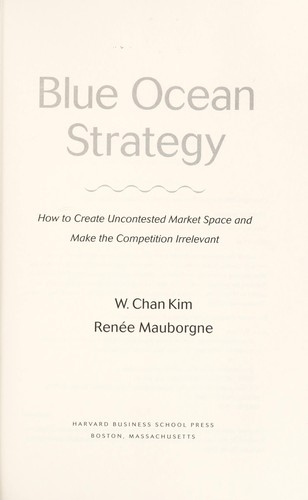
The source: Blue Ocean Strategy
KIM + MAUBORGNE · UNCONTESTED MARKET SPACE
The book that gave strategy a vocabulary for making competition irrelevant instead of winning it: the strategy canvas, the four actions, and the noncustomers most companies never bother to interview. Required reading anytime the honest answer to how do we win is we should not be in this fight at all.
Affiliate links. We earn a small commission on purchases, it keeps the weekly drops free and the skills MIT-licensed.
◆ Get The Skill
Want the Blue-Ocean Audit done for you?
The Blue Ocean Strategy skill draws your strategy canvas against the field, then forces the ERRC grid, eliminate, reduce, raise, create, then scans the three tiers of noncustomers for the demand your research has never been designed to find. It returns the one factor most worth creating and the one most worth cutting. Free. MIT licensed.
Position (the strategy canvas, the value curve versus the field), Research (the three tiers of noncustomers, the boundary-crossing scan), Diagnose (the ERRC grid, the strategic sequence check).
Pairs with
Ries + Trout (owning a word in an existing category versus making a new one); Sharp (penetrating an existing market versus refusing it); JTBD (the unmet job, found inside the market or outside it); Sutherland (reframing value at the message level versus the industry level); Godin (the remarkable outcome the four actions are built to engineer).
Output shape
When the skill leans on Blue Ocean Strategy, it should draw the strategy canvas first, then run the four actions as a full ERRC grid, not just raise and create, then check the three tiers of noncustomers, and only then validate the strategic sequence of utility, price, cost, and adoption. Diagnose in that order.
The Silent DiagnosticIs this move trying to win a fight already defined by competitors, or is it trying to make that fight irrelevant, and if the strategy canvas looks just like everyone else's, why are we calling it a strategy?