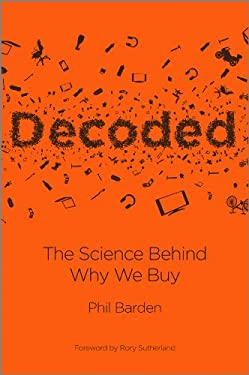
Every purchase is a net-value calculation the buyer never sees: reward on one side, cost on the other. Barden shows you the equation and where to push.
From:Decoded: The Science Behind Why We BuyAuthor:Phil BardenDate:Jan 4, 2027Pages:~272 pages
Two bottles of water, side by side on the same shelf. Same size, same clear liquid, same basic job: quench thirst. One costs four times what the other costs. The pricier bottle outsells it anyway, week after week, store after store.
The buyer standing at that shelf is not a fool, and she is not being tricked in any crude sense either. Her brain is doing something quick and quiet: adding up everything the bottle signals (the label, the shape, the story it tells about who drinks it, the context of the store it sits in) and subtracting what it costs to get it. Phil Barden's whole case in Decoded is that this addition and subtraction happens below awareness, every time, for every purchase, and the pricier bottle simply wins the math more often than the cheaper one does.
Barden gives the two halves of that math a name. There is the Autopilot, the fast system that runs the calculation before you know a calculation happened, and there is the Pilot, the slower system that steps in afterward to explain the choice in words that sound reasonable. The Autopilot picks the bottle. The Pilot tells you why you picked it.
Grab something that is not coffee, ideally water, and let us open the hood on the equation running underneath it.
◆ ◆ ◆
◆ Audio Overview
Prefer to listen?
The chapter as a listen: value equals reward minus pain, and the goal maps behind every purchase. Barden, decoded.
Decoded · Audio Overview
0:00/13:20
The Thesis
Buying is a value equation the brain solves below awareness: perceived reward minus perceived cost, computed fast, before the buyer has a story ready for why they chose what they chose. Barden's contribution is making that equation visible, term by term, so a marketer can raise the reward side on purpose and cut the cost side on purpose instead of hoping the shelf, the price, or the headline happens to land right.
Cite this skill for pricing, packaging, and positioning work, and for any why isn't this converting question that is really a question about perceived value.
◆ ◆ ◆
02The Architecture
Ten frameworks. The buying brain's cost-benefit math, made visible.
Framework 01
The Autopilot and the Pilot
What it is
Barden's names for the two systems making the decision. The Autopilot is fast, automatic, and runs constantly without being noticed. It does almost all the actual choosing. The Pilot is slow, deliberate, and mostly shows up afterward to build a reasonable-sounding story for a decision the Autopilot already made.
Marketing use
Design for the Autopilot first: the shelf impression, the first three seconds of the page, the sensory cues on the pack. Then give the Pilot something to work with, a spec sheet, a comparison, a guarantee, so the story it tells matches the choice it is defending.
"Per Barden's Autopilot and Pilot, the fast system does almost all the choosing and the slow system mostly explains it afterward, so design the fast impression first."
Framework 02
Implicit and Explicit Value
What it is
Explicit value is the value a buyer can name if you ask them: the stated benefit, the feature, the claim on the label. Implicit value is the value they cannot name but still weigh: the goal it quietly serves, the identity it signals, the feeling the packaging primes before a single fact is read.
Marketing use
Audit your positioning for both columns. Most marketing only fills in the explicit column and leaves the implicit one to chance. Name the implicit value on purpose, in the color, the shape, the story, and it starts working for you instead of at random.
"Per Barden's implicit and explicit value, buyers weigh a hidden goal value alongside the stated benefit, and most marketing only ever writes to the stated half."
Framework 03
Net Value = Reward minus Cost
What it is
The purchase equation underneath everything else in the book. Perceived reward (functional, emotional, and social) minus perceived cost (money, effort, risk, and the cognitive load of deciding) equals the net value that actually drives the choice. Raise one side or lower the other and the equation moves.
Marketing use
Stop treating price as the only cost and stop treating features as the only reward. List every reward signal and every cost signal your offer currently sends, then find the cheapest lever: usually a cost you can cut is faster to fix than a reward you have to build.
"Per Barden's net-value equation, perceived reward minus perceived cost decides the purchase, and cutting a cost is often the faster lever to pull than adding a reward."
Framework 04
Framing
What it is
The same fact, presented two ways, produces two different perceived values, because the brain does not evaluate a number in isolation, it evaluates it against whatever frame surrounds it. Ninety percent fat free and ten percent fat describe an identical product and land completely differently.
Marketing use
Reframe your strongest true fact before you assume it is not strong enough. A price framed as a daily cost, a benefit framed against a familiar comparison, a risk framed as a guarantee: same truth, different frame, different net value in the buyer's head.
"Per Barden on framing, an identical fact produces a different perceived value depending on the frame around it, so reframe the true fact before you assume it needs to change."
Framework 05
Signals and Codes
What it is
Brands do not just state value, they speak it in codes: sensory codes (color, shape, sound, texture) and symbolic codes (the visual shorthand a category has trained buyers to read at a glance). A red cap and a certain typeface can say premium before anyone reads a word.
Marketing use
Learn the codes your category already trained buyers to read, then decide whether to use them or break them on purpose. Matching the codes buys instant, wordless credibility. Breaking them on purpose can signal a real departure, but only if you know which code you are breaking and why.
"Per Barden's signals and codes, sensory and symbolic shorthand communicates value before a single claim is read, so know the codes your category trained buyers on."
Framework 06
The Levels of Signal
What it is
Barden stacks signal into levels: sensory (what is seen, heard, felt), symbolic (what it means in the culture), functional (what it does), and emotional (how it makes the buyer feel). A purchase decision draws on all four levels at once, usually in that rough order of speed.
Marketing use
Check your packaging, page, or pitch against all four levels, not just the functional one most teams default to. A product can be functionally excellent and still lose the shelf because the sensory level never got designed on purpose.
"Per Barden's levels of signal, sensory, symbolic, functional, and emotional cues all load into the decision at once, and most marketing only designs the functional level."
Framework 07
Priming and Context
What it is
Value gets set before the product is even seen. The store it sits in, the price it sits next to, the words on the page above it, all prime a range of expected value that the actual product then gets judged against. Context is not neutral packaging, it is an input to the calculation.
Marketing use
Control the frame before the frame controls you. What does the buyer see, read, or experience in the sixty seconds before they meet your offer? That sequence is quietly setting the value range your price and your pitch then have to land inside.
"Per Barden on priming, the context surrounding a product sets the expected value range before the product itself is evaluated, so context is an input, not packaging."
Framework 08
Goal Value and Motivational Goals
What it is
Barden ties implicit value to a small set of deep motivational goals: autonomy, security, excitement, and discipline among them. A purchase gets its implicit charge from which of these goals it serves, whether or not the buyer could name the goal if asked.
Marketing use
Name the specific goal your offer actually serves, not the generic one every competitor claims. Security sells differently than excitement, and discipline sells differently than autonomy. Match the goal, and the implicit value column fills itself in.
"Per Barden's goal value, implicit value traces back to a small set of deep motivational goals like autonomy, security, excitement, and discipline, whether the buyer names them or not."
Framework 09
Reducing Cost
What it is
Cost is not only the price tag. Behavioral cost (the number of steps, the friction of the form, the confusion of the choice) and cognitive cost (how hard the buyer has to think to decide) both weigh on the equation as heavily as money does, sometimes more.
Marketing use
Before touching the price, audit the behavioral and cognitive cost of the path to yes. Cut a form field, cut a decision, cut a moment of confusion, and net value rises without discounting a single dollar.
"Per Barden on reducing cost, behavioral and cognitive friction weighs on the purchase equation as heavily as price, and cutting it raises net value without a discount."
Framework 10
Peak Moments and Remembered Value
What it is
The value a buyer assigns after the fact is not an average of the whole experience, it is dominated by the peak moment and the ending. Decoded ties this to the equation directly: what gets remembered is what gets repurchased and recommended, and the memory is not a fair accounting of the full experience.
Marketing use
Design one deliberate peak into the experience, the unboxing, the onboarding win, the moment support actually helps, and protect the ending. A mediocre middle survives if the peak and the close are strong. A strong middle does not survive a bad ending.
"Per Barden's peak-moment principle, remembered value is dominated by the peak and the ending, not an average of the whole experience, so design one deliberate peak and protect the close."
◆ ◆ ◆
03Lexicon
Named terms a marketer should recognize on sight.
Autopilot
The fast, automatic system that does almost all the actual choosing. Design for it first.
Pilot
The slow system that builds the reasonable-sounding story afterward. Feed it a story that matches the choice.
Implicit value
The hidden goal value a buyer weighs but cannot name. Name it on purpose, do not leave it to chance.
Explicit value
The stated benefit a buyer can name if asked. Necessary, but only half the equation.
Net value
Perceived reward minus perceived cost. The equation the purchase actually runs on.
Framing
The surrounding context that changes perceived value of an identical fact. Reframe the true fact before you assume it is weak.
Signal
Any cue, sensory or symbolic, that communicates value before a claim is read. Design the signal, not just the copy.
Code
The category shorthand buyers were trained to read at a glance. Know it before you match it or break it.
Priming
Setting the expected value range before the product is seen. Context is an input, not packaging.
Goal value
The deep motivational goal (autonomy, security, excitement, discipline) a purchase serves. Match the specific goal, not the generic one.
◆ ◆ ◆
04Tactical Recipes
Plays you can run this week.
The Value-Equation Map. List every reward signal and every cost signal your offer currently sends. Reward on one side, cost on the other, in the buyer's own terms. The gap between the two columns is your actual net value, not the one in your deck.
The Reframe Test. Take your strongest true fact and rewrite it in three different frames: a comparison, a daily cost, a before-and-after. Same truth, three net values. Ship the one that lands hardest.
The Signal Audit. Walk your packaging, page, or pitch through all four levels: sensory, symbolic, functional, emotional. Flag any level nobody designed on purpose.
The Cost Cut. Before touching price, find one behavioral or cognitive cost in the path to yes: a form field, a confusing choice, an extra click. Remove it and watch net value rise for free.
The Priming Setup. Map the sixty seconds before a buyer meets your offer: what they read, saw, or experienced right before. Adjust that sequence on purpose instead of leaving the value range to chance.
The Goal Match. Name the one deep motivational goal (autonomy, security, excitement, discipline) your offer actually serves, and rewrite your top claim to speak to that goal directly instead of a generic benefit.
The Shelf Test. Put your product or page next to your two closest competitors and judge only the first three seconds of sensory and symbolic signal. No reading allowed. What does the Autopilot decide before the Pilot gets a vote?
The Peak Design. Identify the one moment in your customer experience that should be the peak, and the one moment that is the ending. Protect both on purpose, because the average of the middle will not save a weak peak or a bad close.
The Implicit-Value Add. Take a piece of copy that only states explicit value (features, specs, the stated benefit) and add one implicit signal: a story, a code, a sensory detail that speaks to the goal underneath.
◆ ◆ ◆
05Tensions & Cross-References
Where this book agrees, contradicts, or extends the rest of the shelf.
Extends
Kahneman (Q3). The Autopilot and the Pilot are Barden's marketing-facing names for System 1 and System 2. Kahneman supplies the science of the two systems, Barden supplies the equation those systems are running at the register.
Extends
Hormozi (Q3). Net value equals reward minus cost is the grand-slam offer written as an equation. Hormozi stacks the reward side and strips the cost side; Barden explains why that stacking actually moves a purchase decision.
Sharpens
Ariely (Q3). Anchoring is one specific way framing sets the context Barden describes: the first number seen becomes part of the priming that decides what the next number feels like. Read Ariely for the anchor, Barden for the fuller equation the anchor feeds into.
Pairs with
Sutherland (Q3). Sutherland's psycho-logic argues perceived value often has nothing to do with the rational case for a thing. Barden gives that intuition a structure: implicit value, signals, and codes are exactly the psycho-logical inputs Sutherland keeps pointing at.
Sets up
Blindsight (Q4). Barden works at the level of the equation and the signal. Blindsight goes a layer deeper into the brain science generating that equation in the first place. Read this week for the model, read Blindsight for the wiring underneath it.
Tension with
neuro-marketing hype. A lot of neuromarketing writing reaches for scanner jargon to sound scientific and stops there. Barden stays useful precisely because he keeps translating the brain science back into a term a marketer can actually change on a Tuesday: a signal, a frame, a cost. The equation is the discipline, not the mysticism.
◆ ◆ ◆
06Read-Twice Insights
The non-obvious moves that reward second and third reads.
The Pilot did not make the choice, it is defending one already made. Ask a buyer why they picked something and you get the Pilot's story, not the Autopilot's actual math. Take the reasons people give for buying with a grain of salt, and go design for the system that actually decided.
Cost is not just the price tag. A confusing form or an extra decision can cost more net value than a real discount would recover. Marketers who only ever discount are pulling the slow lever when a faster one was sitting right there.
The same fact can be sold twice. Reframing a true claim is not spin, it is recognizing that the brain never evaluates a number in isolation. The honest fact does not have to change for its perceived value to change.
Most brands only ever write to the explicit column. The feature, the spec, the stated benefit get all the attention while the implicit goal value, the thing actually tipping the equation, gets left to whatever the packaging happens to say by accident.
A strong middle does not survive a bad ending. Remembered value is not an average, it is dominated by the peak and the close. Teams pour effort into the sustained experience and forget that the last impression is doing outsized work in what gets recommended.
Matching a category code is a shortcut, not a cheat. Buyers were trained by an entire category to read certain colors, shapes, and cues as premium or cheap in an instant. Using that training on purpose is not manipulation, it is speaking a language the buyer already reads fluently.
◆ ◆ ◆
07Citation-Grade Quotes
Pull-able lines for output. Click any quote to copy it formatted for social.
"We do not buy products, we buy the expectation of a reward."
Phil Barden, Decoded
"Value is not a property of the product. It is computed in the brain."
Phil Barden, Decoded
"The Autopilot makes the decision, and the Pilot builds the story that explains it."
Phil Barden, Decoded, paraphrased
"Implicit associations often have more impact on a decision than the explicit facts."
Phil Barden, Decoded, paraphrased
"Framing an identical choice differently changes the decision, even though nothing real has changed."
Phil Barden, Decoded, paraphrased
◆ Apply This Week
One offer. The equation underneath it.
Pull up one offer you are actively selling right now: a product page, a pricing tier, a pitch you give out loud.
Run it through three moves before you touch the price.
Name it: Write down the one implicit goal value (autonomy, security, excitement, discipline, or another) this offer is actually serving, whether or not you have ever said it out loud.
Cut it: Find one behavioral or cognitive cost in the path to yes, a form field, a confusing step, a moment of doubt, and remove it before you consider a discount.
Reframe it: Take your single strongest true fact and rewrite it in a different frame. Same truth, new context, and watch whether the net value in the room changes.
Do all three on the same offer this week. You are not changing what is true. You are changing what the equation adds up to.
That is week nineteen. One equation, run on purpose instead of by accident. See you Monday.
◆ Going Deeper
The source: Decoded
PHIL BARDEN · THE SCIENCE OF WHY WE BUY
Barden spent years running neuromarketing research inside global brands before writing this down. Decoded is the rare book in this shelf that turns brain science into a term sheet: implicit value, net value, framing, signal. Read it once for the frameworks, read it twice for the vocabulary you will keep reaching for.
Affiliate links. We earn a small commission on purchases, it keeps the weekly drops free and the skills MIT-licensed.
◆ Get The Skill
Want the Value-Equation Audit done for you?
The Decoded skill maps the reward side and the cost side of your offer, checks the framing on your strongest claim, and names the implicit goal value your positioning is actually leaning on, whether you put it there on purpose or not. Free. MIT licensed.
Position (naming the implicit goal value behind a positioning statement), Pricing (the net-value equation behind a price, and where the cheaper lever to pull actually is), Diagnose (why a page, a pitch, or a shelf is not converting when the explicit benefit looks fine on paper).
Pairs with
Kahneman (the two systems Barden names Autopilot and Pilot); Hormozi (the offer stack the equation is scoring); Ariely (anchoring as one input into the framing Barden describes); Sutherland (the psycho-logic Barden gives structure to); Blindsight (the brain science underneath the equation).
Output shape
When the skill leans on Decoded, it should map reward signals and cost signals separately, check whether the strongest claim could be reframed before assuming it needs to change, and name the implicit goal value the offer is serving before it recommends new copy. Diagnose the equation before touching the words.
The Silent DiagnosticWhat is the net value this buyer's Autopilot is actually computing right now, reward minus cost, and are we trying to change that number or just giving the Pilot a better story to tell?