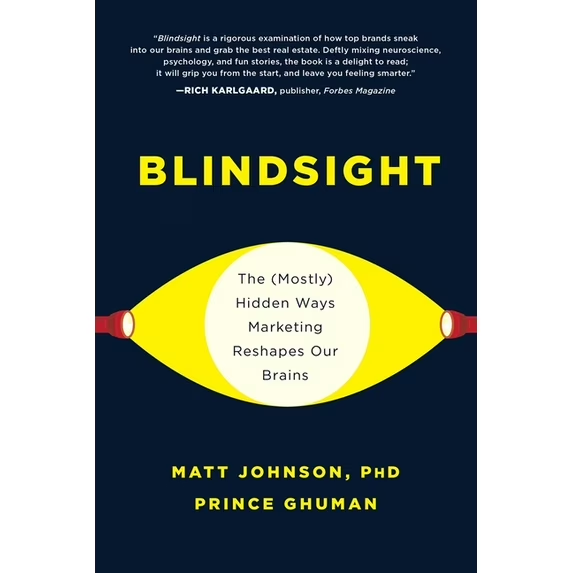
Your Brain Edits Reality, and Marketing Holds the Pen
Perception is not a recording, it is a construction. Neuromarketing without the snake oil: what actually happens in the brain when a brand shows up.
From:Blindsight: How Marketing Reshapes Our BrainsAuthor:Matt Johnson + Prince GhumanDate:Jan 11, 2027Pages:~288 pages
Run a blind taste test between Coke and Pepsi and something strange happens. More people pick Pepsi. It has happened in study after study since the 1970s, sweeter up front, and sweet wins when nobody can see the can. Pepsi built an entire ad campaign on this fact and it was, on the merits, true.
And yet Coke has outsold Pepsi for the better part of a century. Bring the logos back into the room and the whole result flips. Show people the brand before they sip, put them in a scanner while they do it, and the areas of the brain tied to memory and emotion light up brighter for Coke, and people report liking the taste more, the same liquid, a different verdict. Nothing about the syrup changed. What changed was the story the brain was already carrying into the sip.
The tongue did not make that call. The tongue cannot tell you about your grandfather's fridge, or the polar bears, or the red truck at the football game. The brain did, pulling on a lifetime of association the moment the label became visible, and it edited the sensation before the sensation ever reached anything you would call conscious taste.
So no, this is not going to be a chapter about coffee. Grab a cola, a lemonade, whatever is cold and near you, and let us open up the part of marketing that happens below the part you can see.
◆ ◆ ◆
◆ Audio Overview
Prefer to listen?
The chapter as a listen: what the brain does with brands when nobody is watching. Neuromarketing without the snake oil.
Blindsight · Audio Overview
0:00/13:03
The Thesis
Perception is not a recording of the world, it is a construction the brain builds in real time, and marketing's real job is editing that construction through emotion, memory, and attention rather than shouting louder about features. Understand where and how the edit happens and you stop fighting the brain's wiring and start building with it. This is neuromarketing minus the snake oil: no single button, no one brain region that buys, just a handful of honest levers that actually move behavior.
Cite Blindsight for brand, sensory, and packaging decisions, and for any question that starts with why does the better product keep losing to the one with better perception.
◆ ◆ ◆
02The Architecture
Ten frameworks. How the brain builds the brand you think you chose.
Framework 01
Perception Is Constructed
What it is
The brain does not passively record the world, it builds a version of it using expectation, memory, and context, then hands you that build and calls it reality. By the time something reaches awareness it has already been edited. There is no unfiltered signal waiting underneath for a scientist, or a marketer, to find.
Marketing use
Stop treating perception as a fixed thing you are reporting on and start treating it as a thing you are helping construct. The brand, the packaging, the price you show first are not decorations around the product, they are raw material the brain uses to build what the customer will experience as fact.
"Per Johnson and Ghuman's constructed-perception principle, the brain builds experience rather than recording it, so branding is an input to that build, not a coat of paint on top of it."
Framework 02
Neuromarketing Without Snake Oil
What it is
Brain scans cannot read a single buy button and no scanner tells you the exact price to charge. What neuroscience actually offers marketing is a better account of mechanisms already visible in behavior: why emotion outweighs features, why a familiar cue calms a decision, why attention is scarcer than persuasion. Johnson and Ghuman spend real energy debunking the buy-button myth their own field keeps selling.
Marketing use
Use brain science to explain a pattern you already see in the data, not to justify a claim you cannot otherwise defend. If a vendor promises a single neural signal that predicts purchase, that is the tell to ask harder questions, not to buy the report.
"Per Johnson and Ghuman's own caution against the field's overselling, neuromarketing explains mechanisms behind known behavior, it does not locate a single buy button in the brain."
Framework 03
Emotion Tags Memory and Choice
What it is
The brain attaches an affective marker, a rough feeling, to nearly everything it stores, and that marker gets pulled back up faster and more forcefully than any fact sitting next to it. Choices get made on the marker first, the reasoning arrives after, dressed as the cause.
Marketing use
Design for the feeling you want attached before you design for the message you want understood. A checkout flow, an unboxing, a support call all leave an affective tag whether or not you planned one, so plan the tag on purpose.
"Per Johnson and Ghuman on affective tagging, the brain stores a feeling alongside nearly every memory, and that feeling gets retrieved faster than the surrounding facts, which is why the emotional residue of an experience outlasts its details."
Framework 04
Anchoring and Reference Prices
What it is
The brain rarely judges a price on its own, it judges a price against whatever number appeared near it first. A shirt at eighty dollars next to one at two hundred reads as a bargain even if eighty was always going to be the number you charged. The first figure a customer sees quietly becomes the yardstick for every figure after it.
Marketing use
Decide what number you want a customer anchored to before you decide what you are actually charging. A higher-priced option shown first, a was-now price, a per-day breakdown of an annual plan are all ways of choosing the yardstick instead of leaving it to chance.
"Per Johnson and Ghuman on anchoring, the first price a brain encounters becomes the reference point every later price gets measured against, regardless of what that number actually costs to deliver."
Framework 05
Sensory Marketing
What it is
Sound, sight, texture, and smell reach the brain and get folded into perceived quality and even taste before a single fact about the product is processed. The weight of a bottle cap, the crunch turned up in a chip's packaging, the color of a plate under the food all change what people report the product itself is like.
Marketing use
Audit every sensory touchpoint your product has, the sound of the click, the weight in the hand, the color behind the price, because each one is quietly voting on quality before the customer forms an opinion in words. A product's felt quality is being decided by inputs that have nothing to do with its spec sheet.
"Per Johnson and Ghuman on sensory marketing, texture, sound, and color are processed as evidence of quality, so a product's felt value is being shaped by cues that never appear on its spec sheet."
Framework 06
Reconstructive Memory
What it is
Memory is not played back like a recording, it is rebuilt each time it is recalled, and each rebuild is vulnerable to whatever cues are present at the moment of recall. Brands that trade on nostalgia are not retrieving an old memory so much as helping a customer construct a warmer one than the original probably was.
Marketing use
Use nostalgic cues, an old logo, a retro flavor, a jingle from a decade back, deliberately and honestly, because the brain will do the flattering work of warming that memory on its own. Do not manufacture a false history, real cues borrowed from a real past are what the reconstruction needs to work with.
"Per Johnson and Ghuman on reconstructive memory, recall is a rebuild rather than a replay, which is why a well-placed nostalgic cue can make a customer's memory of a brand warmer than the original experience actually was."
Framework 07
Wanting vs Liking
What it is
The brain runs two separate systems for desire, one that generates the pull toward something, dopamine-driven wanting, and a different, calmer system that governs the actual pleasure of having it. Anticipation and consumption are not the same experience wearing two names, and marketing spends most of its time in the wanting system.
Marketing use
Recognize that the excitement before a purchase, a launch countdown, a waitlist, a drop, is manufactured in a different system than the satisfaction after delivery, and that a product can win the wanting and still disappoint on the liking. Protect the second half of that experience as hard as you protect the first.
"Per Johnson and Ghuman on wanting versus liking, the dopamine surge that pulls someone toward a purchase runs on separate circuitry from the pleasure of actually having it, so a great launch and a great product are two different jobs."
Framework 08
Attention and Salience
What it is
Awareness has a spotlight, not a floodlight, and the brain decides what enters that spotlight largely on its own, based on contrast, motion, and relevance to a current goal, well before conscious choice gets a vote. Whatever sits outside the spotlight might as well not exist for that customer in that moment.
Marketing use
Design for salience before you design for message. A product buried in visual sameness on a shelf or a feed loses the argument before anyone reads a word of the copy. Contrast, motion, and personal relevance are what earn the spotlight, and the best headline in the world does nothing outside it.
"Per Johnson and Ghuman on salience, the brain's attentional spotlight is claimed by contrast and relevance before conscious reasoning engages, so a message that never earns the spotlight never gets evaluated at all."
Framework 09
Brand as Association Network
What it is
A brand lives in the brain as a web of linked nodes, a logo tied to a feeling tied to a memory tied to a color, and activating any single node lights up the network around it. This is why a font, a jingle, or a shade of red can carry as much of the brand's meaning as the name itself.
Marketing use
Protect and reuse the specific nodes that already fire your network, the color, the sound, the shape, rather than resetting them with every campaign. Consistency is not a design preference here, it is what keeps the association network intact enough to fire on a single cue.
"Per Johnson and Ghuman's association-network model, a brand exists as a web of linked cues in the brain, and touching any one node, a color, a sound, a shape, activates the feeling attached to the whole network."
Framework 10
The Ethics Line
What it is
Neuroscience narrows the gap between persuasion, which respects a person's ability to say no, and manipulation, which quietly routes around that ability. Johnson and Ghuman argue the tools that reveal how the brain can be nudged are the same tools that reveal when a nudge has crossed into exploiting a vulnerability the customer never consented to.
Marketing use
Ask, of every sensory cue, every default, every scarcity claim, whether a fully informed version of this customer would still say yes. If the answer depends on the customer not noticing what you did, you are on the wrong side of the line, and eventually they will notice anyway.
"Per Johnson and Ghuman's ethics line, the same neuroscience that explains how a nudge works also marks the point where a nudge stops respecting a customer's ability to say no."
◆ ◆ ◆
03Lexicon
Named terms a marketer should recognize on sight.
Blindsight
Acting on visual information the conscious mind never registers. The title's metaphor for marketing that works below awareness.
Constructed perception
Reality as something the brain builds, not something it records. Design the inputs to the build, not just the pitch.
Affective tag
The feeling attached to a memory or a choice. Plan the tag on purpose, it outlasts the facts.
Anchoring
Judging a number by whatever number appeared near it first. Choose the yardstick before you set the price.
Sensory marketing
Sound, sight, and touch feeding perceived quality. Audit the feel, not just the spec sheet.
Reconstructive memory
Recall as a rebuild, not a replay. Nostalgia works because the brain flatters the past.
Wanting vs liking
Two separate systems for desire and pleasure. A great launch is not the same job as a great product.
Salience
What claims the brain's attentional spotlight. Earn the spotlight before you write the headline.
Association network
A brand as linked nodes in the brain. One node, touched, lights up the whole web.
Neuro-ethics
The line between a nudge and an exploit. Would a fully informed customer still say yes?
◆ ◆ ◆
04Tactical Recipes
Plays you can run this week.
The Sensory Audit. List every sensory touchpoint your product has, sound, weight, texture, color, smell, and rate each one for the quality signal it is quietly sending. Fix the weakest link before you touch the copy.
The Anchor Set. Before pricing anything, decide what number you want shown first, a higher tier, a was-price, a per-day breakdown, and place it so it becomes the yardstick your real price gets measured against.
The Nostalgia Pull. Pick one honest cue from your brand's real past, an old logo mark, a retro flavor, an original jingle, and reintroduce it deliberately. Let the customer's brain do the warming.
The Salience Test. Put your ad, package, or headline next to five competitors the way a customer would actually see them. If it does not claim the spotlight in two seconds, fix contrast and motion before you fix the words.
The Association Map. Draw your brand's network: the color, the sound, the shape, the feeling each is tied to. Find the node doing the most work and protect it across every campaign instead of resetting it.
The Wanting Trigger. Add one clean anticipation mechanic, a countdown, a waitlist, a reveal, to your next launch, but only if the product on the other side of it can deliver a liking experience that matches the wanting you built.
The Emotion Tag. Walk your onboarding or unboxing sequence and name the feeling it is leaving at each step. Redesign the step that is leaving no feeling or the wrong one.
The Blind-Test Check. Strip your brand from your product and test it blind against a competitor. If you lose blind and win branded, you know exactly how much of your edge lives in perception versus performance, and that number tells you where to invest.
The Ethics Line. For every nudge in your funnel, a default, a scarcity claim, a sensory cue, ask whether a fully informed customer would still say yes. Cut or disclose the ones that only work because they were not noticed.
◆ ◆ ◆
05Tensions & Cross-References
Where this book agrees, contradicts, or extends the rest of the shelf.
Extends
Kahneman (Q3). Johnson and Ghuman put a brain-imaging floor under System 1: the fast, automatic judgments Kahneman described in behavior are, in Blindsight, watchable as activity in memory and emotion regions before conscious evaluation ever starts.
Pairs with
Barden (Q4). Decision science maps the biases that shape a choice, Blindsight explains some of the neural machinery running underneath those same biases. Read Barden for the pattern, this week for a piece of the mechanism.
Extends
Ariely (Q3). Ariely's anchoring experiments show the behavioral effect from the outside, the number people wrote down after seeing an arbitrary reference point. Johnson and Ghuman push the same anchoring effect down to how the brain forms a reference point at all.
Extends
Sutherland (Q3). Sutherland argues perception beats the physical product for what people actually experience. Blindsight is the neuroscience underneath that claim, the literal brain regions that light up differently when perception, not the product, is what changed.
Extends
Berger (Q3). Berger explains why ideas spread between people. Blindsight explains part of why an idea sticks inside one person's head long enough to be worth spreading in the first place, through the affective tag and the association network.
Tension with
neuro-hype itself. The book spends real pages pushing back on its own industry's overclaiming, the buy-button myth, the single-region promises, the pseudo-scientific vendor decks. Cite Blindsight for the mechanisms it defends, and use its own skepticism against anyone selling you a single neural silver bullet.
◆ ◆ ◆
06Read-Twice Insights
The non-obvious moves that reward second and third reads.
The Pepsi paradox is the whole book in one experiment. Better on the tongue and worse at the register, because the tongue was never actually running the decision alone. The brand had already cast a vote before the sip landed.
Neuromarketing's biggest contribution might be a list of things it cannot do. Johnson and Ghuman spend real space debunking the buy-button myth their own field is famous for selling. The honest use of the science is narrower and more useful than the pitch decks suggest.
The feeling outlives the facts almost every time. People forget the details of an experience far faster than they forget how it made them feel, which means the affective tag, not the feature list, is the part of the memory doing the marketing later.
A great launch and a great product are graded by two different brain systems. Wanting and liking do not have to agree, and a lot of hype-driven launches quietly bank on customers never noticing the gap between the two.
Consistency is not a style guide, it is network maintenance. Every time a brand resets its color, sound, or shape for the sake of a fresh look, it is disconnecting a node from an association network that took years to wire together.
The ethics test is simpler than it sounds. Would this still work if the customer understood exactly what you were doing. If the tactic depends on them not noticing, the neuroscience that built it can also be used to explain, later, exactly why they feel used.
◆ ◆ ◆
07Citation-Grade Quotes
Pull-able lines for output. Click any quote to copy it formatted for social.
"We do not experience the world directly. We experience a version of it that our brain has constructed."
Johnson & Ghuman, Blindsight
"Branding does not live on the product. It lives in the mind of the person experiencing it."
Johnson & Ghuman, Blindsight
"There is no buy button in the brain, no matter how many conference slides say otherwise."
Johnson & Ghuman, Blindsight
"Wanting and liking are run by different systems, which is why the anticipation of a purchase can outshine the purchase itself."
Johnson & Ghuman, Blindsight
"The same science that explains how a nudge works also tells you exactly where it turns into manipulation."
Johnson & Ghuman, Blindsight
◆ Apply This Week
One product. Three edits.
Pick one product or offer you sell right now and walk it through the brain's construction process instead of your usual pitch review.
Make three specific edits before you touch a single word of copy.
The sensory cue: Find the one sound, texture, weight, or color touchpoint sending the weakest quality signal, and fix that cue directly.
The memory hook: Add one honest nostalgic or emotionally tagged cue, tied to something real in the product's or the brand's actual past, not a manufactured one.
The anchor: Decide what number or comparison you want shown first, before your real price or offer appears, so the brain has the yardstick you chose instead of the one it finds on its own.
Ship the edit that touches the most customers first, watch the number, then come back for the other two.
That is week twenty. One product. Three edits. The brain was always going to build a version of your brand, you might as well hold the pen. See you Monday.
◆ Going Deeper
The source: Blindsight
JOHNSON + GHUMAN · NEUROMARKETING WITHOUT THE SNAKE OIL
Matt Johnson and Prince Ghuman spent years inside the neuromarketing industry before writing the book that calls out its own overclaiming. What is left after the hype is stripped away is a genuinely useful map of perception, memory, and emotion, and exactly where the science stops and the pitch deck begins.
Affiliate links. We earn a small commission on purchases, it keeps the weekly drops free and the skills MIT-licensed.
◆ Get The Skill
Want the Perception Audit done for you?
The Blindsight skill checks the sensory cues first (what quality signal is the product quietly sending), then the memory hooks (is there an honest emotional or nostalgic tag in place), then the anchor (what number is the brain measuring the price against), and returns the single edit worth making first. Free. MIT licensed.
Position (perception versus performance, what the brain is actually comparing), Hook (salience and the affective tag in an opening line), Diagnose (why a better product keeps losing to a better-perceived one).
Pairs with
Kahneman (System 1 with a brain-imaging floor under it); Barden (decision science patterns paired with neural mechanism); Ariely (anchoring from the outside and from underneath); Sutherland (perception beats product, and the neuroscience of why); Berger (why an idea spreads once it has stuck).
Output shape
When the skill leans on Blindsight, it should check the sensory cues first (what quality signal is being sent before any words are read), then the memory or emotional hook (is there an honest tag in place), then the anchor (what reference point the brain is using), and only then the surface message. Diagnose in that order and flag any tactic that only works if the customer does not notice it.
The Silent DiagnosticWhat is this customer's brain actually comparing our price, our quality, and our claim against, and would they still say yes if they could see the comparison we chose for them?