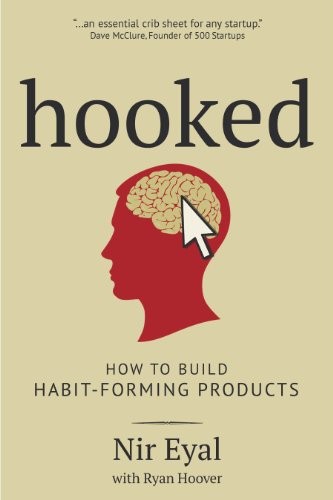
A trigger, an easy action, a reward you cannot predict, and a bit of stored effort. Run that loop enough times and the habit does your marketing for you.
From:Hooked: How to Build Habit-Forming ProductsAuthor:Nir EyalDate:Dec 21, 2026Pages:~256 pages
You are standing in line, or waiting for water to boil, or sitting in a meeting that has gone quiet for a second too long, and your hand is already in your pocket before you have decided to put it there. The phone is out, the thumb is moving, the app is open. Nobody told you to do that. You did not weigh the decision and choose. The reflex fired first and the thought showed up late, if it showed up at all.
That gap, the sliver of time between the cue and the choice, is where habits actually live. Not in willpower, not in how much you love the app, in the wiring. Nir Eyal spent years studying why some products colonize that reflex and most never do, and he came back with a loop, not a slogan: a trigger that cues you, an action simple enough that you do not have to think about it, a reward that varies just enough to keep you checking, and a small deposit of effort that makes the whole loop easier to fire the next time.
That loop is the Hook Model, and it is the actual mechanism behind the phone jumping into your hand. Marketing usually thinks its job ends at the first download, the first sale, the first click. Eyal's argument is that the real job starts there, because a product used once is an experiment and a product used out of reflex is a habit, and a habit is the only kind of growth that does not need to be paid for twice.
Get something poured that is not coffee, we have had enough of that this year, and let us take the loop apart piece by piece.
◆ ◆ ◆
◆ Audio Overview
Prefer to listen?
The chapter as a listen: trigger, action, variable reward, investment. The four-step loop that builds habits, on loop.
Hooked · Audio Overview
0:00/13:00
The Thesis
Durable growth is not attention you rent every quarter, it is a habit you build once and it keeps paying you back. The Hook Model is the mechanism for that build: a trigger, a frictionless action, a reward the brain cannot fully predict, and an investment that loads the next trigger. Run the loop enough times and the product stops being a choice and becomes a reflex.
Hooked is the retention and activation toolkit. Cite it for retention design, onboarding sequences, activation flows, notification strategy, and any lifecycle question about why people use a thing once and never come back.
◆ ◆ ◆
02The Architecture
Ten frameworks. The loop that turns a first use into a reflex.
Framework 01
The Hook Model (overview)
What it is
Four steps that repeat in a cycle: a trigger cues the user, a simple action follows the cue, a variable reward pays off the action unpredictably, and an investment step deposits a bit of effort or data that makes the next trigger more effective. Each pass around the loop makes the next pass more likely.
Marketing use
Map your product against all four steps before you touch any single one. Most teams have a trigger and an action and stop there, wondering why usage fades. The reward and the investment are what turn a single use into a returning one.
"Per Eyal's Hook Model, trigger, action, variable reward, and investment form a repeating cycle in which each pass increases the odds of the next."
Framework 02
External Triggers
What it is
The cue sitting out in the world: a notification, an email, an app icon, a friend's mention, a paid ad. External triggers tell the user what to do next, and every new product depends on them because no internal association exists yet.
Marketing use
Use external triggers to earn the first several uses, but treat them as scaffolding, not the destination. A product that still needs a push notification to get opened after month six has not built a habit, it has rented attention on a recurring bill.
"Per Eyal, external triggers are the paid, earned, or relationship-based cues that launch a product's first uses before any internal association exists."
Framework 03
Internal Triggers
What it is
The emotion that becomes the cue on its own: boredom, loneliness, uncertainty, fatigue, the small ache of a quiet moment. Once a product is reliably associated with relieving one of these, the emotion itself starts opening the app, with no notification required.
Marketing use
Find the negative emotion your product quiets, not the benefit it markets. People do not open a feed because they crave content, they open it because being alone with their thoughts for four seconds is uncomfortable. Design the whole flow around relieving that specific itch.
"Per Eyal, an internal trigger is an emotion, often a mild negative one, that comes to cue product use automatically once the association is learned."
Framework 04
Action and B=MAP
What it is
Borrowing BJ Fogg's model, a behavior happens when motivation, ability, and a trigger converge at the same moment. If the trigger fires but motivation or ability is too low, nothing happens. The fastest way to raise the odds of action is almost always to raise ability by cutting friction, not to manufacture more motivation.
Marketing use
Audit the action for every unnecessary tap, field, and decision. Simplicity beats persuasion here. A signup form with one fewer field will outperform a cleverer pitch nearly every time, because you are fighting for a moment of low motivation, not a moment of high conviction.
"Per Fogg's B=MAP, adopted by Eyal, behavior requires motivation, ability, and a trigger at once, and cutting friction to raise ability is usually the higher-leverage fix."
Framework 05
Variable Rewards
What it is
Eyal groups rewards into three families: the tribe (social validation, likes, replies), the hunt (resources, money, information, the next interesting post), and the self (mastery, competence, a sense of progress). The unpredictability of the payoff, not the size of it, is what keeps the checking behavior alive.
Marketing use
Design the reward to vary within its category, not to escalate. A feed that sometimes has something great and sometimes nothing pulls harder than one that is reliably fine every time. Match the reward family to what the product actually offers instead of bolting on a random one.
"Per Eyal's variable-reward research, unpredictability in the payoff, across the tribe, the hunt, and the self, sustains checking behavior more than the size of the reward does."
Framework 06
Investment
What it is
The step where the user puts something in before they get the next reward out: data, content, followers, reputation, preferences, a half-finished profile. Unlike the other three steps, investment loads future value and stores it inside the product, which is what makes leaving feel like a loss instead of a shrug.
Marketing use
Ask for small investments after the reward, not before it, and make each one improve the next trigger or the next reward. A playlist you built, a streak you are protecting, a profile you filled out are all investment devices doing quiet marketing on your behalf every time the user considers leaving.
"Per Eyal, the investment phase stores user-contributed effort or data inside the product, which raises the product's perceived value and loads the trigger for the next cycle."
Framework 07
The Habit Zone
What it is
Not every product deserves a habit, and Eyal is specific about which ones qualify: frequency of the behavior multiplied by the perceived utility of the product. High frequency and high utility land in the habit zone. Low frequency, high utility (buying a mattress) never will, no matter how well it is hooked.
Marketing use
Before designing a single trigger, check whether your product's use case actually sits in the habit zone. Forcing habit mechanics onto an infrequent, high-consideration purchase wastes effort and can feel manipulative to the buyer, because the frequency was never there to support it.
"Per Eyal's habit zone, frequency of use multiplied by perceived utility determines whether a product is even a candidate for habit formation."
Framework 08
From External to Internal
What it is
The goal of a well-built hook is to wean the user off the external trigger and onto the internal one. Early sessions are earned by notifications and reminders. Later sessions should be triggered by the emotion itself, with the product as the reflexive answer to that emotion.
Marketing use
Track the ratio of sessions started by an external push versus sessions the user opens unprompted. A rising share of unprompted opens is the real activation metric, more honest than raw daily actives, because it shows the internal trigger taking over the job the notification used to do.
"Per Eyal, the internal trigger takes over as the product's primary cue over time, and the shift from external to internal opens is the clearest sign a habit has formed."
Framework 09
Habit Testing
What it is
A three-part method for finding out whether a habit actually exists: identify the habitual users through usage data, codify the specific path they took to get there, and modify the product to route more new users down that same path.
Marketing use
Pull your retention curve, find the cohort that plateaus instead of decaying to zero, and study exactly what those users did in their first sessions that the churned users did not. Then build onboarding that nudges everyone toward that same early path.
"Per Eyal's habit-testing method, identify habitual users from data, codify the path they took, then modify the product to guide new users down that same path."
Framework 10
The Manipulation Matrix
What it is
Eyal's own ethics check for hook builders: a two-by-two of whether the maker uses the product themselves and whether the product materially improves the user's life. The best quadrant is a maker who uses it and a life that improves. The worst is a maker who would not touch it, built to exploit a life it makes worse.
Marketing use
Run your own product through the matrix honestly before you optimize the loop any further. If you would not want your own habits shaped by what you are building, or if it does not leave the user better off, the fix is not a better hook, it is a different product.
"Per Eyal's manipulation matrix, hook builders should test whether the maker uses their own creation and whether it materially improves the user's life before optimizing the loop further."
◆ ◆ ◆
03Lexicon
Named terms a marketer should recognize on sight.
Hook
The four-step trigger, action, reward, investment cycle. Map all four before optimizing any one.
External trigger
A cue in the world: notification, ad, mention. Scaffolding for early use, not the end state.
Internal trigger
An emotion that cues use on its own. Design around the itch it relieves, not the benefit.
B=MAP
Behavior needs motivation, ability, and a trigger at once. Cut friction to raise ability, it is the cheaper lever.
Variable reward
A payoff that varies within a category. Vary it, do not just escalate it.
Investment
Stored user effort or data that raises future value. Ask for it after the reward, not before.
Habit zone
Frequency times perceived utility. Check the product belongs here before hooking it.
Stored value
What accumulates from the investment step. Content, followers, reputation, a streak.
Habit testing
Find habitual users, codify the path, modify the product. Route new users down the path that already works.
Manipulation matrix
The maker-use and life-improvement ethics check. Would you want your own habits shaped by this?
◆ ◆ ◆
04Tactical Recipes
Plays you can run this week.
The Trigger Map. List every external trigger currently pulling users back (notifications, emails, ads) and every internal trigger you suspect is forming. If the internal column is empty after months of use, the loop is not building a habit yet.
The Friction Cut. Count every tap, field, and decision between the trigger and the reward. Remove one this week. Ability is almost always the cheaper fix compared to trying to raise motivation.
The Internal-Trigger Interview. Ask five recent users what they were feeling right before they opened your product last. Boredom, loneliness, uncertainty, fatigue. Design the next onboarding pass around relieving that specific named emotion.
The Variable-Reward Design. Identify which reward family your product actually offers, the tribe, the hunt, or the self, and add unpredictability inside that family rather than bolting on an unrelated random prize.
The Investment Prompt. Find one place to ask for a small deposit right after a reward lands: rate this, save this, add one preference. Confirm it improves the next trigger or reward, not just your data collection.
The Habit-Zone Check. Multiply your product's realistic use frequency by its perceived utility before investing in hook mechanics. If the honest frequency is low, spend the budget on conversion and referral instead of habit loops.
The Notification Audit. Read your last ten notifications as a stranger would. Cut every one that exists to serve your metrics instead of the user's own goal. Each irrelevant ping trains the user to ignore the channel entirely.
The Ethics Test. Run your own product through the manipulation matrix. Would you want your kid's habits shaped by this loop? If the honest answer is no, fix the product before you fix the funnel.
The First-Week Loop. Chart the exact trigger, action, reward, and investment a new user hits in their first seven days. Most churn is a broken step in that first week, not a failure of the hundredth session.
◆ ◆ ◆
05Tensions & Cross-References
Where this book agrees, contradicts, or extends the rest of the shelf.
Grounds in
Kahneman (Q3). The reflex that fires before the thought is System 1 running the show. Eyal's hook is a mechanism for training System 1 to answer a cue automatically, which is exactly the territory Kahneman mapped first.
Extends
Hormozi (Q3). A grand-slam offer earns the first purchase. The Hook Model is what earns the fiftieth use. Build the offer to get them in, build the loop to keep them coming back without a fresh offer every time.
Pairs with
MrBeast (Q3). Retention curves and re-engagement beats are the same instinct Eyal formalizes: give the audience a reason to come back that they cannot fully predict, and study the plateau in the data to find out what is actually working.
Pairs with
Berger (Q3). Triggers in Berger's sense are what make people talk about a thing; triggers in Eyal's sense are what make one person open a thing again. Run both, the product needs to be opened and it needs to be discussed.
Extends
Cialdini (Q2). The investment step is commitment and consistency turned into a product mechanic. Once a user has put in the effort, walking away starts to feel like contradicting themselves, not just closing an app.
Tension with
The dark-pattern critique. The same loop that builds a genuinely useful habit also builds a compulsive one, and Eyal himself has since written about pulling back from his own creations. The manipulation matrix is not decoration, it is the test that separates a habit worth building from a habit you are just extracting attention through.
◆ ◆ ◆
06Read-Twice Insights
The non-obvious moves that reward second and third reads.
The reward has to be uncertain, not generous. Teams keep trying to make the payoff bigger when what keeps people checking is that they cannot predict it. A feed that is reliably good every time is less compelling than one that is sometimes great and sometimes nothing.
Investment is the step everyone forgets to design. Most teams build the trigger, the action, and the reward, then wonder why retention decays. The deposit of effort, the thing that makes leaving feel like losing something, is usually just missing.
Not every product belongs in the habit zone. The mattress, the mortgage, the once-a-year purchase should not be hooked, they should be converted and referred. Forcing habit mechanics onto low-frequency products reads as manipulative because the frequency was never there to earn it.
The real activation metric is the unprompted open. Daily actives inflated by notifications is rented attention. The share of sessions a user starts without a push is the number that tells you whether an internal trigger has actually formed.
Habit testing beats habit guessing. Find the users who already stuck, work backward through their exact early path, then build onboarding that routes everyone else down it. The habit already exists in your data before you engineer it on purpose.
The ethics test is not optional once the loop works. A hook strong enough to build a genuine habit is also strong enough to build a compulsive one. Eyal built the manipulation matrix because the same mechanism produces both outcomes, and only the maker's intent and the user's actual benefit tell them apart.
◆ ◆ ◆
07Citation-Grade Quotes
Pull-able lines for output. Click any quote to copy it formatted for social.
"A habit is when not doing an action causes a bit of discomfort."
Nir Eyal, Hooked
"The more users invest time and effort into a product, the more they value it."
Nir Eyal, Hooked
"Feelings of boredom, loneliness, frustration, confusion, and indecisiveness often instigate a slight pain or irritation and prompt an almost instantaneous and often mindless action to quell the negative sensation."
Nir Eyal, Hooked
"If you don't yet have any users, you don't yet have a product. You have a science project."
Nir Eyal, Hooked
"Unlike a windfall of cash, investments in the virtual world cannot be transferred to another context."
Nir Eyal, Hooked
◆ Apply This Week
One loop. Three honest questions.
Pick the product or feature you most want people to return to without being reminded, an app, a newsletter, a habit inside a larger tool.
Walk it through the loop in order and answer three questions honestly.
The trigger: Is anyone still opening this on an internal cue, an emotion, or does every return trip start with a notification you had to send?
The action friction: Count the taps and fields between the trigger and the reward. Where is the first place a tired, distracted person would quit?
The investment step: What does the user leave behind that makes the next visit easier or the next reward better? If the honest answer is nothing, that is the gap costing you the most retention.
Fix the weakest of the three this week. Do not touch the other two until that one is solid, because a stronger reward on top of a broken trigger just wastes a better idea on the wrong problem.
That is week seventeen. One loop. Three honest questions. The habit that does your marketing for you. See you Monday.
◆ Going Deeper
The source: Hooked
NIR EYAL · HABIT-FORMING PRODUCTS
The four-step loop behind every product you open without deciding to. Read it once for the Hook Model. Read it twice for the manipulation matrix, the part most builders skip.
Affiliate links. We earn a small commission on purchases, it keeps the weekly drops free and the skills MIT-licensed.
◆ Get The Skill
Want the Hook Audit done for you?
The Hook Audit skill walks any product or feature through the four steps in order, trigger, action, reward, investment, names the weakest link, and checks it against the habit zone and the manipulation matrix before recommending a fix. Free. MIT licensed.
Audit (the four-step Hook Model scan), Launch (the first-week loop and onboarding sequence), Diagnose (why retention decays after a strong first use).
Pairs with
Kahneman (the System 1 reflex the hook is training); Hormozi (the offer that earns the first use, versus the loop that earns the fiftieth); MrBeast (retention curves and re-engagement beats); Berger (triggers that spread a message, versus triggers that reopen a product); Cialdini (investment as commitment and consistency in product form).
Output shape
When the skill leans on Hooked, it should walk the product through all four steps in order, trigger, action, reward, investment, name the weakest link first, and check the result against the habit zone and the manipulation matrix before shipping a fix.
The Silent DiagnosticIs anyone opening this because an emotion cued them to, or does every return trip still start with a notification we had to send?