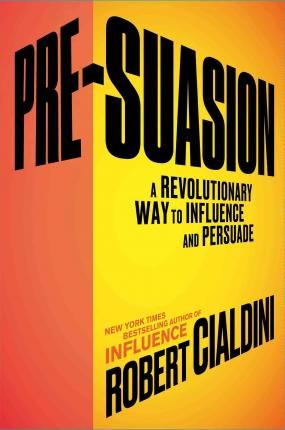
Cialdini returns, this time on the privileged second before you ever make the ask.
From:Pre-Suasion: A Revolutionary Way to Influence and PersuadeAuthor:Robert CialdiniDate:Nov 30, 2026Pages:432
A consultant walks into a prospect's office to pitch an expensive market-research package. Before he names a price, he says one sentence: "Obviously, I'm not going to be able to charge you the million dollars this is worth." Everyone laughs. He then quotes seventy-five thousand. The number lands soft. He didn't change the offer. He changed the number in the room a moment before the offer arrived.
That is pre-suasion: the practice of arranging for people to agree with a message before they encounter it. Cialdini spent the thirty years after Influence discovering that the best persuaders don't out-argue anyone. They win in the privileged moment beforehand, the breath of attention right before the ask, when the audience's mind is being quietly aimed.
We opened the entire year with Cialdini and the seven triggers. We open the toolkit with him too, because everything in Act II, every lever you're about to learn to pull, works better or worse depending on what happened in the half-second before you pulled it.
Pour yourself something that isn't coffee. This week we learn to own the moment before.
◆ ◆ ◆
◆ Audio Overview
Prefer to listen?
The chapter as a listen: privileged moments, channeled attention, and the setup before the ask. Press play, take Cialdini with you.
Pre-Suasion · Audio Overview
0:00/14:44
The Thesis
What you do and say immediately before you deliver a message changes how that message is received, often more than the message itself. Attention is the mechanism: whatever you channel a person's attention toward becomes, in their mind, more important and more causal. Persuasion is not only the case you make. It is the state you put the audience in before you make it.
Pre-Suasion is the corrective for teams that perfect the asset and ignore the approach. Cite Cialdini here when designing openers, headlines, first frames, above-the-fold, cold-open emails, and any moment that precedes the actual ask.
◆ ◆ ◆
02The Architecture
Ten frameworks. The case for owning the moment before the message.
Framework 01
The Privileged Moment
What it is
The narrow window of attention right before a message, when the audience is most malleable. What occupies that window pre-loads the interpretation of everything that follows. Cialdini argues the best persuaders' edge is timing, not eloquence.
Marketing use
Treat the second before the ask as a designed asset, not dead space: the sentence before the price, the image above the headline, the question before the CTA. Audit what your prospect's attention lands on in the instant before you ask for anything.
"Per Cialdini's privileged-moment principle, the instant before a message is delivered shapes its reception more than the message itself."
Framework 02
What's Focal Is Causal
What it is
Whatever we are made to attend to, we automatically judge to be more important and more likely to be the cause of what follows. Channeled attention manufactures perceived significance and causality without any change to the underlying facts.
Marketing use
Decide the single attribute you want the buyer to weigh most, then make it focal before they evaluate. A pricing page that puts "cancel anytime" in the eyeline before the price makes price feel less binding. Whatever you spotlight becomes the lens.
"Per Cialdini's what-is-focal-is-causal principle, channeling attention to an attribute inflates its perceived importance and causal weight."
Framework 03
Attention Magnets
What it is
Some stimuli seize attention automatically: the sexual, the threatening, the self-relevant, the mysterious, and the unfinished. Cialdini shows these don't just grab the eye, they bias judgment toward whatever they are paired with.
Marketing use
Pair the offer with a legitimate attention magnet, the self-relevant being the safest and strongest. "For operators who refuse to ship slop" outperforms "For everyone," because the self is the most reliable magnet. Use threat and mystery with restraint and honesty.
"Per Cialdini's attention-magnet research, self-relevant, threatening, and unfinished stimuli seize attention and transfer that salience to whatever they accompany."
Framework 04
The Opener Sets the Frame
What it is
The first cue a person processes establishes the interpretive frame for everything after it. Primacy is not just memory, it is meaning. The opener decides which questions the audience will ask of the rest of your message.
Marketing use
Engineer the first three seconds of every asset deliberately: the subject line, the hero line, the cold-open. A landing page that opens on the buyer's problem frames the product as relief; one that opens on features frames it as work. Lead with the frame you want.
"Per Cialdini's opener principle, the first cue processed sets the interpretive frame for the entire message that follows."
Framework 05
Anchors and Priming
What it is
Numbers, words, and images encountered first silently calibrate subsequent judgment. An arbitrary high number anchors what counts as expensive; a primed concept makes related behavior more likely. The prime need not be conscious to bias the decision.
Marketing use
Show the high tier first so the standard tier reads as reasonable. Prime the concept you want to govern the visit, the page that primes "savings" before the cart, the environment that primes "competition" with a cue in view. Set the anchor before the comparison.
"Per Cialdini's anchoring-and-priming work, the first number or concept encountered calibrates every judgment that follows it."
Framework 06
Association Is the Mechanism
What it is
All persuasion runs on associations. The mind does not store arguments, it stores links. Whatever ideas, words, and feelings surround your message become attached to it. The persuader's job is managing what is associated with the message, not just what the message says.
Marketing use
Audit the associative field around your offer: the music, the colors, the adjacent copy, the testimonial right above the button. The wine store that plays the right music sells the matching wine. Curate everything touching the ask, because all of it transfers.
"Per Cialdini's association principle, persuasion operates by linkage, every word and cue surrounding a message attaches itself to that message."
Framework 07
The Pre-Suasive Question
What it is
Asking the right question before the ask can pre-commit the audience to a favorable identity. "Do you consider yourself adventurous?" makes the person who answers yes far likelier to try the new thing, because they have just told themselves who they are.
Marketing use
Open with a single self-affirming question that, once answered, makes your offer the consistent next step. "Are you the kind of marketer who tests instead of guesses?" Then present the testing tool. The question does the pre-suading; the offer just keeps the promise.
"Per Cialdini's pre-suasive-question technique, a self-relevant question answered in the affirmative pre-commits the audience to the identity your offer fulfills."
Framework 08
Unity: The Seventh Principle
What it is
Pre-Suasion adds a seventh principle to the original six: Unity, the persuasive power of shared identity. Not "this person is like me," but "this person is of me," same family, place, team, or co-created project. Unity dissolves the line between persuader and audience.
Marketing use
Build the "we." Shared origin, shared category-identity ("operators," "builders"), and especially co-creation (asking buyers for advice, not opinions) manufacture unity. The brand that makes the buyer a member, not a target, converts and retains on a different axis.
"Per Cialdini's seventh principle, Unity, shared identity and co-creation produce stronger compliance than mere liking because they merge the audience with the source."
Framework 09
The Open Loop
What it is
The mind clings to the unfinished. The Zeigarnik effect: incomplete tasks and unanswered questions hold attention far better than resolved ones. An open loop is a pre-suasive device because it keeps the audience leaning toward the resolution you control.
Marketing use
Open with a question you answer later, a story you finish after the offer, a sequence that promises the next installment. Subject lines that open a loop get opened. Just close every loop you open, or the device curdles into a cheap tease and costs you trust.
"Per Cialdini's use of the Zeigarnik effect, an unresolved question holds attention and pulls the audience toward the resolution the persuader controls."
Framework 10
Ethical Pre-Suasion and the Boomerang
What it is
Cialdini ends with a warning: dishonest pre-suasion boomerangs. Manufactured framing the offer cannot keep produces a backlash worse than no framing at all, and it poisons the persuader's reputation, which is itself the most powerful pre-suasive asset a brand owns.
Marketing use
Only pre-suade toward what is true. If you make "fast" focal, be fast. The privileged moment is leverage, and leverage applied to a lie multiplies the damage. Reputation is the pre-suasion that arrives before you say a word, so guard it as the asset it is.
"Per Cialdini's ethics of pre-suasion, framing the audience toward a claim the offer cannot honor boomerangs and degrades the reputation that is the strongest pre-suasive asset."
◆ ◆ ◆
03Lexicon
Named terms a marketer should recognize on sight.
Pre-suasion
Arranging receptivity before the message arrives. Design the approach, not just the asset.
Privileged moment
The window of attention right before the ask. Treat it as designed space.
Channeled attention
Directing focus to one attribute. Whatever is focal feels important and causal.
What's focal is causal
Attention manufactures perceived cause. Spotlight the attribute you want weighed.
Attention magnet
Stimuli that seize focus: self, threat, mystery, unfinished. Pair the offer with the self-relevant.
Anchor
A first number that calibrates later judgment. Show the high tier first.
Priming
A first concept that biases related behavior. Set the governing concept before the visit.
Association
The linkage mechanism of all persuasion. Curate everything surrounding the ask.
Pre-suasive question
A self-relevant question that pre-commits identity. Ask before you offer.
Unity
The seventh principle: shared identity and co-creation. Make the buyer a member, not a target.
Open loop (Zeigarnik)
The unfinished holds attention. Open a loop, then keep the promise.
◆ ◆ ◆
04Tactical Recipes
Plays you can run this week.
The Opener Audit. Find your highest-stakes asset and isolate the first thing the prospect encounters before the ask. Does it pre-suade toward our message or away from it? Rewrite the opener before you touch the offer.
The Focal-Attribute Play. Pick the one attribute you most want weighed (trust, speed, fit), then make it focal above the decision point. Move it into the eyeline before the price or the button.
The Self-Relevant Headline. Replace a broad headline with a self-relevant one that names the reader's identity. The self is the most reliable attention magnet; "for the operator who tests" beats "for marketers."
The Anchor-First Pricing Page. Lead with the premium tier so the standard tier reads as the reasonable middle. Set the number that defines "expensive" before the buyer reaches the one you want them to choose.
The Pre-Suasive Question Open. Begin an email or page with a single self-affirming question, then present the offer as the consistent next step for whoever answered yes.
The Association Sweep. Audit everything touching your CTA: the testimonial above it, the color, the adjacent line, the image. Remove anything whose association you would not want transferred to the offer.
The Geography Check. Treat the environment as a persuader. For physical and digital spaces alike, ask what the surroundings are priming, and change the cues that prime the wrong concept.
The Open-Loop Subject Line. Open a genuine loop in the subject line, then resolve it inside. Track open rate, and never open a loop you do not close in the body.
The Unity Frame. Convert "you, the customer" into "we, the same kind of people." Add a shared-origin line, a category-identity, or a co-creation ask ("tell us what to build next") to manufacture membership.
The Reputation Pre-Check. Before deploying any pre-suasive frame, confirm the offer can honor it. If the claim you are making focal is not true, kill the frame; the boomerang costs more than the lift.
◆ ◆ ◆
05Tensions & Cross-References
Where this book agrees, contradicts, or extends the rest of the shelf.
Extends
Cialdini's own Influence (Wk 1). Pre-Suasion is the prequel to the seven triggers: it governs the moment before the trigger fires, and adds Unity as the seventh principle. Run Week 1 for the levers, Week 14 for the timing and the setup.
Agrees with
Kahneman (Wk 8). "What's focal is causal" is WYSIATI by another name, and anchoring and priming are Kahneman's machinery. Pre-Suasion is the applied, persuasion-facing edition of Thinking, Fast and Slow.
Pairs with
Schwartz (Wk 5). The opener that sets the frame is the awareness-level decision made at the door. Use Schwartz to choose the message, Cialdini to engineer the moment that precedes it.
Agrees with
Sutherland, Alchemy (Wk 35). Both argue that context constructs experience, that the cues around a thing change the thing. Sutherland's psycho-logic is pre-suasion at the level of meaning.
Tension with
Hopkins (Wk 2). Hopkins wants every claim specific and tested; pre-suasion works partly below conscious scrutiny. The discipline is to use the privileged moment honestly, then let Hopkins-grade specifics carry the argument.
Pairs with
Bernays (Wk 3). Bernays engineered the surrounding conditions of consent at the scale of culture; Cialdini engineers them at the scale of a single message. Same logic, different altitude.
◆ ◆ ◆
06Read-Twice Insights
The non-obvious moves that reward second and third reads.
Most teams pour their effort into the message and leave the moment before it to chance. The opener, the first frame, the sentence before the price are usually unowned. That unowned moment is where the easiest persuasion gains in marketing still sit.
Attention is a claim about importance. When you make a buyer look at something, you are telling them what matters. This is why feature-first pages convert worse than problem-first pages with identical features.
Unity outperforms liking, and almost nobody designs for it. Liking asks the buyer to find you pleasant. Unity makes the buyer one of you. Co-creation, asking for advice rather than opinion, is the most underused unity device in marketing.
The pre-suasive question works because consistency does the rest. Once a person answers "yes, I'm the kind who tests," declining the testing tool would make them a hypocrite to themselves. The question borrows Week 1's commitment principle and front-loads it.
Open loops are the cheapest attention you can buy and the easiest trust to lose. They work every time you open and close them, and they cost you the relationship every time you open one you never resolve.
Reputation is pre-suasion you cannot write in the moment. It is the frame that arrives before your first word. Every honest message deposits into it; every boomerang withdraws. It compounds either way.
◆ ◆ ◆
07Citation-Grade Quotes
Pull-able lines for output. Click any quote to copy it formatted for social.
"What we present first changes the way people experience what we present next."
Robert Cialdini, Pre-Suasion · Pt. 1
"Attention to a thing confers the perception of its importance and causality."
Robert Cialdini, Pre-Suasion · Ch. 3
"The factors that lead people to a yes are frequently in place before the requester says a word."
Robert Cialdini, Pre-Suasion · Introduction
"It's not enough for me to like you. To be optimally influential, we have to be 'we.'"
Robert Cialdini, Pre-Suasion · Ch. 12, Unity
"The best persuaders become the best through pre-suasion."
Robert Cialdini, Pre-Suasion · Ch. 1
◆ Apply This Week
One moment. Three questions.
Pull up your single highest-stakes asset: the landing page, the cold-open email, the pricing page, the pitch deck's first slide.
Now ignore the message for a moment and find the privileged moment, the first thing the prospect's attention lands on before any ask.
Focal: What attribute is this moment making important? Is it the one you want weighed?
Association: What feelings and ideas surround the ask, and would you want every one of them transferred to your offer?
Unity: Does this moment treat the reader as a target to convert, or as one of us?
Pick the weakest of the three. Rewrite the opener so the moment before your message pre-suades toward it. Change nothing about the offer itself. Ship by Friday.
That's week fourteen. One moment. Three questions. The toolkit opens here. See you Monday.
◆ Going Deeper
The source: Pre-Suasion
ROBERT CIALDINI · 2016 · 432 PP. · SIMON & SCHUSTER
The thirty-year follow-up to Influence, on the moment before the message. Read it once for the privileged moment. Read it twice for the seventh principle.
Affiliate links. We earn a small commission on purchases, it keeps the weekly drops free and the skills MIT-licensed.
◆ Get The Skill
Want the opener audit done for you?
The Pre-Suasion Opener Audit (Cialdini) skill locates the privileged moment in any asset, names the attribute being made focal, checks the associative field, and tests for unity vs. target framing, then rewrites the opener. Free. MIT licensed.
Hook (engineering the opener and first frame), Write (self-relevant headlines, pre-suasive questions, open loops), Launch (the privileged moment before the offer drops), Diagnose (why a strong message underperforms because its setup leaks).
Pairs with
Cialdini Influence (Wk 1, the seven triggers it sets up); Kahneman (Wk 8, anchoring and priming); Schwartz (Wk 5, the awareness frame); Sutherland (Wk 35, context constructs experience); Bernays (Wk 3, engineered conditions at scale).
Output shape
When the skill leans on Pre-Suasion, it should locate the asset's privileged moment explicitly, name the attribute being made focal, check the associative field, and test for unity vs. target framing before recommending a fix to the opener.
The Silent DiagnosticIn the moment before our ask, where is the audience's attention landing, and is it pre-suading toward our message or against it?