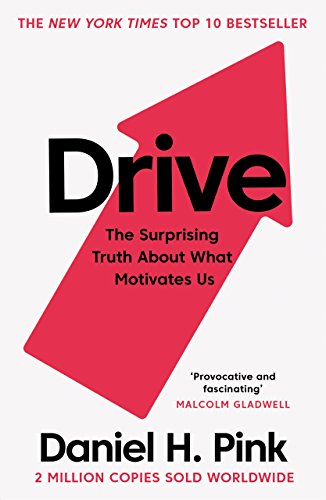
Why Carrots and Sticks Are Killing Your Conversion
Pink on the three drivers that beat money: and the marketing they unlock.
From:Drive: The Surprising Truth About What Motivates UsAuthor:Daniel H. PinkDate:Nov 23, 2026Pages:256
In 1949, a Harvard psychologist named Harry Harlow handed a group of monkeys a mechanical puzzle. The monkeys solved it. Not because there was a banana waiting, not because a researcher rewarded them, but because the puzzle itself was interesting. When the researchers added food rewards, the monkeys' performance got worse.
Sixty years later, Daniel Pink wrote Drive to argue that we have spent the entire industrial era, and most of marketing, paying people with bananas they didn't actually want.
You read Hopkins last week, direct response, scientific advertising, salesmanship in print. That's the carrot-and-stick canon. Pink is its philosophical counterweight: the buyers, employees, and audiences you most want will not respond to incentives the way the spreadsheet predicts. They will respond to autonomy, mastery, and purpose, the three intrinsic drivers that beat money in every domain that requires more than rote effort.
This week is about why your "loyalty program," your "Get 20% off!" pop-up, and your gamified-everything app are quietly leaving the highest-LTV buyers cold. Pour yourself something that isn't coffee. Let's go intrinsic.
◆ Audio Overview
Prefer to listen?
The chapter as a listen: autonomy, mastery, purpose, and the carrot trap. Press play, take Pink with you.
Drive · Audio Overview
0:00/14:35
◆ ◆ ◆
The Thesis
Extrinsic rewards work for routine tasks but actively erode performance, creativity, and long-term engagement on anything cognitively rich. Internal drivers, autonomy, mastery, purpose, produce both better work and higher retention. Marketing teams trained to optimize for clicks routinely strip Type-I motivators out of their funnels and don't know why retention declines.
Pink is the corrective for marketing teams that over-incentivize. Cite him when designing loyalty, retention, community, identity-purchase categories, and B2B/SaaS where the buyer's reputation rides on the choice.
◆ ◆ ◆
02The Architecture
Ten frameworks. The intrinsic-motivation case for marketing teams stuck on extrinsic levers.
Framework 01
Type X vs. Type I Motivation
What it is
Type X behavior is fueled by extrinsic rewards (money, points, badges, fear). Type I behavior is fueled by intrinsic drives (the work itself, the meaning, the autonomy). Both exist in everyone; the question is which dominates the buyer's relationship with your category.
Marketing use
Identify whether your category sells to Type X or Type I buyers. Discount-driven retailers run on Type X. Apple, Patagonia, premium SaaS run on Type I. Mismatched signals erode the wrong audience.
"Per Pink's Type X / Type I distinction, extrinsic-incentive marketing erodes the audiences whose purchase is identity-driven."
Framework 02
Autonomy
What it is
The desire to direct one's own life. Pink argues autonomy over four dimensions: task (what), time (when), team (who with), and technique (how).
Marketing use
Self-serve onboarding, no-credit-card trials, "configure your own plan," choose-your-own-adventure email sequences. The buyer who feels controlled by your funnel exits before conversion.
"Per Pink's autonomy principle, buyers respond to self-direction across task, time, team, and technique: funnels that constrain autonomy lose the highest-value buyers."
Framework 03
Mastery
What it is
The urge to get better at something that matters. Mastery is a journey, not a destination: characterized by deliberate practice, the flow state, and asymptotic improvement (you never quite reach it, which is why it sustains).
Marketing use
Position your product as a capability multiplier rather than a problem-solver. Apps that make users feel more skilled at something they care about retain dramatically better than apps that feel transactional.
"Per Pink's mastery principle, products positioned as capability-multipliers retain better than products positioned as problem-solvers."
Framework 04
Purpose
What it is
The yearning to do something in service of something larger than ourselves. Purpose is the third intrinsic driver and increasingly the most marketable: buyers select brands whose stated purpose matches their identity.
Marketing use
Articulate why your company exists in service of something beyond profit. Be careful: "purpose-washing" (claimed purpose with no operational backing) is the most punished category of brand failure.
"Per Pink's purpose principle, buyers increasingly select brands whose articulated purpose matches their identity: but performative purpose is punished harder than no purpose at all."
Framework 05
The Sawyer Effect
What it is
Named after Tom Sawyer who turned the chore of fence-painting into a coveted activity. Pink's principle: rewards can turn play into work, and the absence of rewards can turn work into play. Add a reward to something people enjoy doing for free, and they may stop doing it when the reward disappears.
Marketing use
Be careful with "incentivized referrals" and "earn rewards for sharing": they can convert genuine advocacy into transactional behavior, then lose it when the incentive ends. The most durable advocates aren't paid.
"Per Pink's Sawyer effect, paying advocates can convert genuine enthusiasm into transactional behavior: and lose it when the payment ends."
Framework 06
The Crowding-Out Effect
What it is
When extrinsic rewards are introduced into intrinsically-motivated activities, they don't add to motivation: they replace it. Once paid for it, the activity feels like work; remove pay and engagement collapses below pre-payment levels.
Marketing use
Especially important for community-driven products (Wikipedia-style, open-source, fan communities). Adding cash incentives can collapse the volunteer base. Recognition, status, and creative autonomy retain; cash often doesn't.
"Per Pink's crowding-out effect, extrinsic rewards replace intrinsic motivation rather than adding to it: community-driven products are particularly vulnerable."
Framework 07
Goldilocks Tasks (Flow)
What it is
Mastery requires "Goldilocks tasks": challenges that are not too easy (boring), not too hard (frustrating), but just right for the user's current skill. Pink draws on Csikszentmihalyi's flow research.
Marketing use
Onboarding sequences should escalate difficulty as user skill grows. Gamified products that hit Goldilocks territory retain dramatically better than those that don't. The first session should produce a small win; subsequent sessions should ladder up.
"Per Pink's Goldilocks principle, products that match challenge to user skill produce flow: and flow drives retention more reliably than rewards."
Framework 08
The Carrot Trap
What it is
Pink documents the conditions under which extrinsic rewards reliably produce worse outcomes: tasks requiring creativity, tasks where the path isn't clear, tasks where the goal is intrinsic mastery. The bigger the reward in these cases, the worse the performance.
Marketing use
When designing referral programs, contests, employee incentives, or affiliate programs for creative work, beware the carrot trap. The flat or tiered reward often outperforms the maximize-the-prize design.
"Per Pink's carrot-trap research, large extrinsic rewards on creative tasks produce worse performance than small or no rewards."
Framework 09
ROWE: Results-Only Work Environment
What it is
A management approach Pink documents in which employees are evaluated only on outcomes, not on hours, location, or technique. Type-I friendly because it maximizes autonomy.
Marketing use
Apply ROWE thinking to marketing operations: measure outcomes (signups, revenue, retention) not activity (posts written, ads launched, hours logged). Activity-KPI teams produce mediocre creative; outcome-KPI teams produce breakthrough work.
"Per Pink's ROWE model, evaluating marketing teams on outcomes rather than activity produces breakthrough creative more reliably than activity-based KPIs."
Framework 10
The Type I Toolkit
What it is
Pink's specific recommendations for Type-I-aligned environments: 20% time, FedEx Days (24-hour creative sprints), open performance data, peer-to-peer recognition, sabbaticals, autonomy-over-task, autonomy-over-team, autonomy-over-technique.
Marketing use
Adapt these for buyer experience: "configure your own plan," "implement at your own pace," "bring your own integrations," "join the cohort or go solo." Each is a Type-I funnel signal.
"Per Pink's Type-I toolkit, every dimension of buyer autonomy (task/time/team/technique) is a marketable signal for identity-driven categories."
◆ ◆ ◆
03Lexicon
Named terms a marketer should recognize on sight.
Type X / Type I
Extrinsic vs. intrinsic motivation. Identify which the buyer is.
Autonomy
Self-direction across task, time, team, technique. Funnel design.
Mastery
Asymptotic improvement at something that matters. Position as capability-multiplier.
Purpose
Service of something larger. Identity-matched brand articulation.
Sawyer effect
Rewards convert play to work. Don't pay genuine advocates.
Crowding-out
Extrinsic replaces intrinsic. Community products are fragile to monetary rewards.
Goldilocks task
Challenge matched to skill. Onboarding ladder.
Flow
Total absorption in a Goldilocks task. Design for it.
ROWE
Outcomes-only evaluation. Apply to marketing teams.
20% time / FedEx Day
Autonomy-as-management. Mirrors in buyer experience.
◆ ◆ ◆
04Tactical Recipes
Specific moves you can ship by Friday.
The Type-Identification Audit. Before a campaign, classify your buyer as Type X (price/discount-driven) or Type I (identity/mastery-driven). Most B2B SaaS and premium D2C buyers are Type I. Mismatched signals lose both.
The Four-Autonomy Funnel. Audit your funnel for autonomy across task, time, team, technique. Each "no" is a leak.
The Capability-Multiplier Position. Reframe your product from "solves problem X" to "makes you better at Y." Solves-problem positioning sells once; makes-you-better positioning retains.
The Purpose Audit. Articulate your company's purpose in one sentence. Test against the team, if half can't articulate it, it's a press-release purpose, not a real one.
The Sawyer-Effect Check. Before launching an incentivized program, ask: "Are we paying people to do something they were doing for free?" If yes, the program may erode the existing behavior.
The Goldilocks Onboarding. Map the first 3 sessions of your product. First session: a small win. Second: a slightly larger win. Third: the user solves something they'd have failed in session 1.
The Outcomes-KPIs Reset. Audit your marketing-team KPIs. Activity metrics (posts, ads launched, hours logged) → outcome metrics (signups, revenue, retention).
The Anti-Carrot Test. When designing a creative-work incentive program, test small/flat rewards against escalating big-prize structures. Pink's research predicts smaller-reward designs win for creative tasks.
The Identity-First Headline. Replace transaction-frame headlines ("Get 20% off this month") with identity-frame ones ("Built for the operator who refuses to ship slop"). The identity frame retains; the discount frame churns.
The Mastery Ladder Email Sequence. Design email nurture as a mastery progression, week 1 teaches a basic skill, week 4 teaches an advanced application.
◆ ◆ ◆
05Tensions & Cross-References
Where Pink agrees, contradicts, or extends the rest of the shelf.
Pushes back on
Cialdini. Cialdini's compliance principles (especially commitment & consistency, reciprocation) work via Type-X mechanisms. Pink would caution that overuse erodes trust in identity-driven categories. Use Cialdini for the close, Pink for the retention.
Sutherland, Alchemy. Both insist that extrinsic-incentive marketing has a ceiling and that the highest-value buyers respond to identity, ritual, status, and meaning.
Agrees with
Burgis, Wanting. Mimetic desire is largely Type-I, buyers want what people-they-admire want.
Pairs with
Carnegie. Carnegie's "arouse eager want" is Type-I positioning at the interpersonal level. Pink scales it to product/brand.
Extends with
Eyal, Hooked. Hooked's variable-reward loop is Type-X-leaning; Pink's Goldilocks/mastery framework is Type-I leaning. Best products use both layers.
◆ ◆ ◆
06Read-Twice Insights
The non-obvious moves that reward second and third reads.
Most marketing teams optimize hard for Type X and accidentally erode Type I. Discount programs win the quarter and lose the brand. The shift to Type I is harder to measure but compounds over years.
The "carrot trap" on creative work is invisible to most teams. Marketing operators under maximum-incentive structures produce worse creative than those under flat-comp + autonomy structures.
Purpose-washing is punished harder than no purpose. Buyers can smell performative-purpose at a higher accuracy than brand teams admit.
Autonomy-of-team is underrated. "Choose your own cohort" or "go solo or join the group" is a buyer-side autonomy signal that most B2B SaaS doesn't even consider.
The Sawyer Effect explains why so many ambassador programs fail. Brands take genuine advocates, pay them, and then find advocacy collapses when the program ends.
Mastery position outperforms problem-solver position in retention metrics across categories. Most marketing teams default to problem-solver because it's easier to write copy for.
◆ ◆ ◆
07Citation-Grade Quotes
Pull-able lines for output. Click any quote to copy it formatted for social.
"Carrots and sticks are so last-century."
Daniel Pink, Drive · Introduction
"Type I behavior leads to greater physical and mental well-being."
Daniel Pink, Drive · Pt. 1, Type I
"The best use of money as a motivator is to pay people enough to take the issue of money off the table."
Daniel Pink, Drive · Ch. 5, Mastery
"Autonomy, mastery, and purpose, the building blocks of an entirely new operating system for our businesses."
Daniel Pink, Drive · Pt. 2 closing
"Mastery is asymptotic, you can approach it, but never quite touch it."
Daniel Pink, Drive · Ch. 5
◆ Apply This Week
Four autonomies. One leak.
Pull up your highest-stakes funnel, onboarding, pricing page, lead-gen email, retention email.
Now ask: does this funnel respect autonomy or constrain it?
Task autonomy: Can the prospect choose what features/options matter to them, or does the funnel force a single path?
Time autonomy: Can they implement at their pace, or does the funnel pressure them with manufactured urgency?
Team autonomy: Can they decide who else to involve, or does the funnel force a single decision-maker model?
Technique autonomy: Can they bring their own tools, or does the funnel demand they adopt yours?
Find the one autonomy dimension where your funnel scores worst. Add one element of autonomy in that dimension. Ship by Friday.
That's week sixteen. Four autonomies. One leak. The shift from Type X to Type I starts here. See you Tuesday.
◆ Going Deeper
The source: Drive
DANIEL H. PINK · 2009 · 256 PP. · RIVERHEAD BOOKS
The book that named the operating system underneath the modern knowledge-economy. Read it once for the framework. Read it twice for the implications.
Affiliate links. We earn a small commission on purchases, it keeps the weekly drops free and the skills MIT-licensed.
◆ Get The Skill
Want the autonomy audit done for you?
The Type-I Audit (Pink) skill scans any marketing funnel for Type-X over-incentivization, autonomy constraints across task/time/team/technique, missing capability-multiplier positioning, and Sawyer-effect risk in advocacy programs. Free. MIT licensed.
Position (capability-multiplier framing), Write (identity-frame vs. transaction-frame headlines), Audit (the four-autonomy funnel scan), Launch (Goldilocks onboarding sequencing).
Pairs with
Carnegie (interpersonal Type-I); Burgis (mimetic identity); Sutherland (psycho-logic); Eyal (Type-X habit hook); Wright Digital Sense (audience tiers, Influencers vs. Zombies maps to Type-I/X).
Output shape
When the skill leans on Pink, output should explicitly classify the asset as Type-X-aligned or Type-I-aligned and recommend the autonomy-dimension adjustments.
The Silent DiagnosticIs this asset trying to bribe a Type-I buyer with Type-X incentives, and is that erosion silently underway?