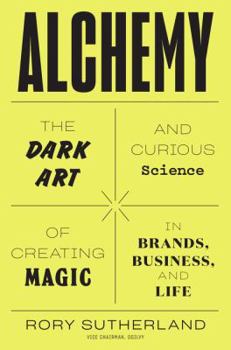
When the Opposite of a Good Idea Is Also a Good Idea
Why your "rational" brief is leaving alpha on the table.
From:Alchemy: The Surprising Power of Ideas That Don't Make SenseAuthor:Rory SutherlandDate:Nov 16, 2026Pages:278
Rory Sutherland has spent forty years near the very top of one of the world's biggest advertising agencies. He's also the person most likely to walk into your strategy meeting and tell you that your meticulously-rational brief is the exact reason your campaign won't work.
His thesis: most things that move human behavior aren't logical, they're psycho-logical. The two diverge constantly. A logically optimal solution that contradicts psycho-logic loses in market. A psycho-logically resonant solution that's logically suboptimal wins. The data spreadsheet says one thing; the buyer's brain laughs and does the opposite.
You read Cialdini at Week 1 and Kahneman at Week 2. Those books explained how the buyer makes decisions. Sutherland is the book that says: and now, having understood that, here's how to weaponize it on the brief. This is the contrarian creative bible. The one that gives you permission to test the irrational thing, because most of the time, your competitors won't.
Pour yourself something that isn't coffee. We're going sideways.
◆ Audio Overview
Prefer to listen?
The chapter as a listen: psycho-logic, costly signals, and why the opposite of a good idea works. Press play, take Sutherland with you.
Alchemy · Audio Overview
0:00/13:30
◆ ◆ ◆
The Thesis
Most things that work in human behavior aren't logical, they're psycho-logical. Marketing teams that brief only for logic leave a fortune in unmineable creative territory to anyone willing to be irrational on purpose.
Sutherland is the creative-leverage capstone of the cognitive arc. Where Kahneman and Cialdini explain the irrational machinery, Sutherland teaches you to weaponize it on the brief.
◆ ◆ ◆
02The Architecture
Ten frameworks. Sutherland's heuristics for finding the counterintuitive move that pays.
Framework 01
Psycho-Logic vs. Logic
What it is
Logic is what successful engineers and mathematicians use; psycho-logic is what works on humans. The two are non-identical and frequently divergent. A logically correct solution that contradicts psycho-logic will fail in market. A psycho-logically resonant solution that's logically suboptimal will succeed.
Marketing use
Briefs written in pure logic (lowest price, fastest speed, most features) underperform briefs that incorporate psycho-logic (signal, ritual, fairness, narrative, status, surprise). Read every brief and ask: where is the psycho-logic in this document?
"Per Sutherland's psycho-logic principle, market-winning solutions are not logically optimal, they are psycho-logically resonant."
Framework 02
Costly Signaling Theory
What it is
A signal is credible in proportion to how costly it would be to fake. Peacock tails, expensive engagement rings, hand-built craftsmanship, slow shipping, ugly websites, foreign provenance, all communicate something the cheap competitor cannot. Apparent waste is informational content. The signal is the cost.
Marketing use
Don't optimize away every cost. Some costs are signal. Hand-finishing, limited production runs, slow service that conveys craft, premium packaging that costs disproportionate to the product, each communicates trust at a level no claim can match. Ruthless efficiency erodes signaling.
"Per Sutherland & costly-signaling theory, apparent waste is informational content, the cost itself communicates commitment."
Framework 03
The Placebo Principle
What it is
Subjective experience is constructed, not received. Wine tastes better with a higher price tag; pills work better with a brand name; pain is reduced by ritual. The "placebo effect" is not a bug to be controlled away, it is the dominant mechanism in many product experiences. Engineering the placebo is engineering the product.
Marketing use
Packaging, ritual, expectation-setting, pricing, and presentation are not separate from the product, they are the experience. The "real" coffee, watch, headphones, software is whatever the user experiences, and the experience is built from cues and context.
"Per Sutherland's placebo principle, perceived experience is constructed from cues, packaging, ritual, and price are not separate from the product but constitute it."
Framework 04
The Four Conditions for Alchemy
What it is
Sutherland's heuristic for spotting alchemical opportunities, counterintuitive solutions that work because they violate logic. (1) The opposite of a good idea is also a good idea. (2) You must test counterintuitive things because no one else will. (3) The solution must be defensible only after the fact. (4) The upside must be asymmetric (large gain × small cost).
Marketing use
Run "what if we did the opposite" sessions on briefs. Test counterintuitive moves at small budget, they're cheap to validate and the conventional team won't try them. Most of the breakthrough creative in the canon was indefensible until it worked.
"Sutherland's alchemical heuristic: when the opposite of the brief might also be true, the upside is asymmetric, and no competitor will try it, that's where the alpha lives."
Framework 05
Reframing: The Cheapest Innovation
What it is
A reframe changes nothing about the product but changes everything about how it's perceived. Calling the same drink "premium" doubles willingness-to-pay; calling the same delay "estimated arrival in 17 minutes" feels shorter than "average wait 12-22 minutes." Frames are leverage; product changes are work.
Marketing use
Before changing the product, exhaust reframes. The same offer described as "saving 40%" vs. "earning back 40%" vs. "the only one without [pain]" produces different conversion. Reframing should be a discipline before product or pricing changes.
"Per Sutherland's reframing principle, perceived value is shifted by frame more cheaply than by product, exhaust reframes before product changes."
Framework 06
Asymmetric Solutions & The Butterfly Effect
What it is
Many of the largest behavior shifts come from disproportionate small interventions in obscure variables. Adding "please" to a checkout button. Showing a calendar on the booking page. Naming a fee something less negative. Changing the default option. The intervention is trivial; the effect is large because it hits a high-leverage pivot in the psycho-logic.
Marketing use
Marginal copy and UX experiments are the highest-ROI work in most marketing programs. The breakthrough rarely comes from the big rebrand; it comes from the seven-word change that nobody would have predicted.
"Per Sutherland, behavior change comes from disproportionate small interventions in psycho-logical pivot points, not from big rebrands."
Framework 07
The Eyebrow Test
What it is
If your campaign idea doesn't make at least one person in the room raise an eyebrow, it's probably too safe to break through. Pattern-conforming creative is invisible because it pattern-conforms. Pattern-breaking creative is risky, and gets remembered because it doesn't conform.
Marketing use
Evaluate creative by asking: "Does this pass the eyebrow test?" If everyone nods comfortably, the idea is invisible. If at least one stakeholder is uncomfortable, the asymmetric upside is worth small-scale testing.
"Per Sutherland's eyebrow test, creative that doesn't make at least one stakeholder uncomfortable is too pattern-conforming to break through."
Framework 08
Status, Signaling, and the Real Buyer Motive
What it is
Most consumer purchases serve status and signaling functions that the buyer would never admit on a survey. The car, the watch, the bag, the laptop, the SaaS subscription often serve identity-confirmation more than functional utility. Brands that recognize this design for the implicit status function alongside the explicit utility.
Marketing use
Identify the status / signaling function your product serves and design implicit cues that amplify it (logos, vocabulary, ritual, scarcity, in-group markers). Pretending utility is the only buyer motive cedes the signaling layer to less inhibited competitors.
"Per Sutherland, most purchases serve a status or signaling function the buyer can't acknowledge, design for the implicit motive alongside the explicit utility."
Framework 09
Rory's Rules of Alchemy
What it is
Sutherland's working heuristics. Selected: The opposite of a good idea is also a good idea. Don't design for the average, design for the variance. The nature of our attention affects the nature of our experience. Solving the wrong problem precisely is worse than solving the right problem approximately. Test counterintuitive things, because no one else will.
Marketing use
Read these rules quarterly. They're correctives against the institutional pull toward logical optimization, average-targeting, and conformity to the brief.
"Per Rory's Rules: 'Test counterintuitive things only because no one else will', institutional pull is toward conformity; alpha lives in the unconformed."
Framework 10
The Anti-Rationality Imperative
What it is
Sutherland's most provocative claim: in many domains, deliberately suboptimal solutions outperform optimal ones because they signal commitment, build narrative, create ritual, or confer status. Hyper-rational organizations strip these out and underperform irrational competitors who keep them. The "inefficient" feature might be the load-bearing feature.
Marketing use
Audit the cuts. What "inefficiencies" was the optimization team about to remove? Some of them are signal, ritual, or narrative. Removing them is removing the product. Strategic suboptimality is sometimes the highest-ROI design choice available.
"Per Sutherland's anti-rationality imperative, hyper-optimization erodes signal, ritual, and narrative, the apparent inefficiencies are sometimes the load-bearing features."
◆ ◆ ◆
03Lexicon
Named terms a marketer should recognize on sight.
Psycho-logic
The logic of human cognition, distinct from logic. Brief for both.
Costly signal
Informational because expensive to fake. Don't optimize away the signal.
Placebo principle
Experience is constructed from cues. The packaging is the product.
Reframe
Same product, different perceptual lens. Cheaper than reformulation.
Eyebrow test
Does this make anyone uncomfortable? Discomfort is a leading indicator of breakthrough.
Asymmetric upside
Small cost, large potential gain. The test budget for counterintuitive ideas is much lower than people think.
Status function
Implicit signaling motive in a purchase. Design for it; don't deny it.
The opposite of a good idea is also a good idea
Rory's Rule. Always brief both directions.
Strategic suboptimality
Deliberate inefficiency that serves signal/ritual/narrative. Don't remove the load-bearing inefficiency.
Solving the wrong problem precisely
The optimization trap. Re-question the problem before refining the answer.
◆ ◆ ◆
04Tactical Recipes
Specific moves you can ship by Friday.
The "What If We Did the Opposite" Brief. For every brief, generate the inverse strategy. Cheaper → more expensive. More features → fewer. Faster → slower-but-higher-craft. Most won't ship; one might be alchemy.
The Costly-Signal Audit. List every "inefficiency" in the customer experience (slow, hand-built, limited, foreign, ritual-heavy). Score each on signal value vs. operational cost. The optimization team wants to remove them, some shouldn't go.
The Reframe Pass. Before product changes, generate 5 reframes of the existing offer. Different headlines, different category framing, different unit ("$1/day" vs. "$365/year" vs. "less than your daily coffee"). Test reframes before reformulating.
The Eyebrow Test on Creative. When stakeholders all comfortable-nod at the creative, the creative is too safe. Push for a version that makes one stakeholder visibly uncomfortable.
The Status-Function Identifier. For your product, write down the implicit status function it serves. Then design implicit cues that confirm and amplify the function.
The Asymmetric Test Allocation. Carve 5-10% of the marketing test budget for counterintuitive moves no one else will run. Expected value is positive; institutional pressure pushes against running them.
The Strategic Suboptimality Hunt. When the operations team proposes removing a "low-value" customer-facing element, audit whether it's signal/ritual/narrative-bearing. Some efficiencies are losses.
The "Solving the Wrong Problem" Reframe. When stuck on optimization, re-question the problem. Half the time the problem definition is broken.
The Variance Brief. Don't design for the average customer. Design for the customer at the long tail of love (your evangelist), the average will follow.
The Counterintuitive A/B Test. When designing A/B tests, always include one variant that contradicts conventional wisdom. Cheap, high optionality.
◆ ◆ ◆
05Tensions & Cross-References
Where Sutherland agrees, contradicts, or extends the rest of the shelf.
Builds on
Kahneman. "Kahneman with a marketing brief." Where TFS describes irrationality as cognitive science, Alchemy weaponizes it as creative leverage.
Builds on
Barden, Decoded. Both insist the autopilot/implicit layer dominates. Sutherland is more provocative; Barden is more operational.
Pushes back on
Hopkins / E. Schwartz / classical direct-response. The systematic-rational play is now Stage-4 commodity territory; the alchemy lies in counterintuitive moves the awareness ladder wouldn't surface.
Pushes back on
Data-driven marketing dogma. A/B testing optimizes within the existing solution space and never surfaces ideas outside it. Pure optimization converges on local maxima.
Agrees with
Burgis, Wanting. Both insist human motivation is heavily mimetic, status-driven, and irrational at the level the buyer can articulate.
Agrees with
Berger, Invisible Influence. Social influence is largely unconscious; rational accounts of decision-making are post-hoc.
Pairs with
Cialdini, Pre-Suasion. Both treat context, framing, and adjacent cues as the primary persuasion levers.
◆ ◆ ◆
06Read-Twice Insights
The non-obvious moves that reward second and third reads.
The "opposite is also a good idea" rule is the most actionable creative heuristic on the shelf. Use it weekly. For every brief, write down the inverse. Most won't ship. The one that does is often the breakthrough.
Costly signaling explains why ruthlessly optimized brands lose to apparently inefficient ones. Hand-built, slow, limited, foreign, ritual-heavy, these communicate commitment that the optimized competitor cannot. Don't optimize away the signal.
The placebo principle reframes "marketing" as product-construction. The packaging is the experience. The price is the experience. The ritual is the experience. There is no "real product" separate from the cues that frame it.
Status and signaling explain more buying behavior than admitted on surveys. Treat survey-stated motives as polite fictions; reverse-engineer the implicit status function from the buying behavior.
A/B testing has a ceiling. It optimizes within the current solution space. Step-changes require irrational exploration outside that space, usually counterintuitive moves no one runs because no one would defend them in the brief. Carve a budget for these.
Solving the wrong problem precisely is the most common high-IQ failure mode. When the optimization is failing, re-question the problem. Half the time the problem definition is broken; refining the answer is wasted work.
◆ ◆ ◆
07Citation-Grade Quotes
Pull-able lines for output. Click any quote to copy it formatted for social.
"Most things aren't logical, they are psycho-logical."
Rory Sutherland, Alchemy · Pt. 1, Introducing Psycho-Logic
"The opposite of a good idea is also a good idea."
Rory Sutherland, Alchemy · Rory's Rules
"Test counterintuitive things only because no one else will."
Rory Sutherland, Alchemy · Rule 8
"Apparent waste is informational content."
Rory Sutherland, Alchemy · Pt. 3, Signalling
"Don't design for the average, design for the variance."
Rory Sutherland, Alchemy · Rory's Rules
"Solving the wrong problem precisely is worse than solving the right problem approximately."
Rory Sutherland, Alchemy · Rory's Rules
◆ Apply This Week
One brief. The opposite. The eyebrow test.
Pull out your latest brief, or the strategic deck that's about to ship. Read it once.
Now answer this: what's the opposite of what this brief recommends?
Cheaper → more expensive. More features → fewer. Faster → slower-but-higher-craft. Generic → niche. Modern → retro. Loud → quiet. The opposite isn't always right, but Sutherland's rule says it might be. And you'll never know unless you test it.
Pick the most asymmetric inverse-bet (cheap to test, large upside if it works), and run it as a 5-10% experiment alongside the conventional approach.
The eyebrow test: if at least one stakeholder in the room raises an eyebrow when they read the inverse-bet idea, you're in alchemy territory.
Ship the test by Friday. Watch what happens.
That's week thirty-five. One brief. The opposite. The eyebrow test. See you Tuesday.
◆ Going Deeper
The source: Alchemy
RORY SUTHERLAND · 2019 · 278 PP. · WILLIAM MORROW
Forty years of advertising-agency wisdom distilled into one disciplined argument for the irrational. Read it twice. Once for the case. Once for permission.
Affiliate links. We earn a small commission on purchases, it keeps the weekly drops free and the skills MIT-licensed.
◆ Get The Skill
Want the opposite-brief generated for you?
The Anti-Brief Generator (Sutherland) skill takes any marketing brief or strategic deck you paste in and returns the conventional response, the inverse-bet candidate, the eyebrow-test scoring, and the asymmetric-upside ranking. Free. MIT licensed.
Especially Naming (anti-pattern names that break category convention), Position (the reframe; the status function), Diagnose (when conventional optimization is stuck, run the opposite-brief), Write (the eyebrow-test filter on copy).
When the skill leans on Sutherland, output should always include (a) the conventional brief response and (b) at least one counterintuitive alternative ("the opposite-of-the-brief" candidate) for asymmetric-upside testing.
The Silent Diagnostic
What's the conventional answer to this brief, and what's the opposite of the conventional answer? Which has more asymmetric upside if it works?