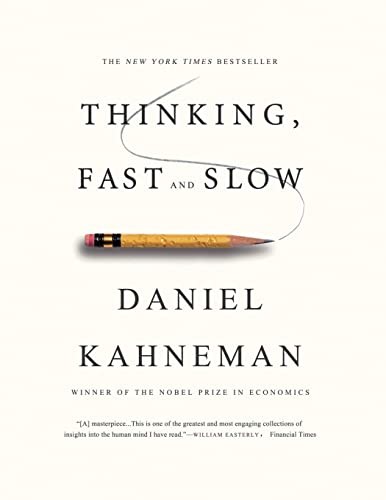
From:Thinking, Fast and SlowAuthor:Daniel KahnemanDate:Sep 14, 2026Pages:533
Here's a bet: if I could get you to read one marketing book in your life, I'd skip the marketing books entirely and hand you a 533-page doorstop written by an Israeli psychologist who never wrote a line of copy.
Daniel Kahneman won a Nobel Prize for proving, with a fifty-year experimental record, that the buyer you're writing copy for isn't the rational evaluator your CMO thinks they are. They're a fast, lazy, story-loving brain that decided about you 1.5 seconds ago and is currently manufacturing reasons to feel okay about it.
You read Cialdini last week. We're going under Cialdini now. Every persuasion principle in that catalog, reciprocity, authority, scarcity, the rest, fires automatically because of what's documented in this 533-page brick. Cialdini named the levers. Kahneman explains why they fire without the buyer noticing. You can argue with the application. You cannot argue with the substrate.
Pour yourself something that isn't coffee. Let's go.
◆ ◆ ◆
◆ Audio Overview
Prefer to listen?
The chapter as a listen: two systems, anchors, losses, and the ease that sells. Press play, take Kahneman with you.
Thinking, Fast and Slow · Audio Overview
0:00/13:35
The Thesis
Most decisions are made by an automatic, error-prone, story-loving brain (System 1) that the slower, lazier System 2 routinely rubber-stamps. Marketing that ignores this loses to marketing that engineers it.
Kahneman is the bedrock, every other behavioral book on this shelf assumes you've metabolized this one. Cite him most heavily when diagnosing why a campaign isn't working and when engineering price/loss frames.
◆ ◆ ◆
02The Architecture
Thirteen frameworks that show up everywhere else on the shelf, and most marketing campaigns currently ignore.
Framework 01
Two Systems: System 1 / System 2
What it is
System 1 is fast, automatic, intuitive, emotional, associative. System 2 is slow, effortful, deliberate, lazy. System 2 mostly endorses what System 1 produces; it intervenes only when something feels wrong, novel, or numerically forced.
Marketing use
All marketing first lives or dies in System 1. If your message requires System 2 to do work before it generates a feeling, it loses. Engineer the System 1 reaction first, then let System 2 rationalize the buy.
"Per Kahneman's two-system model, this asks System 2 to work where it should be hitting System 1."
Framework 02
WYSIATI: What You See Is All There Is
What it is
System 1 builds the most coherent story it can from whatever's in front of it, and treats that story as complete. It does not search for missing information.
Marketing use
Whatever you put in the ad is the customer's full picture of the product. Anything left out doesn't haunt them, it doesn't exist. Control the frame absolutely; absent benefits get no credit.
"Kahneman's WYSIATI principle, what you see is all there is, means the customer judges this only on what's on the page."
Framework 03
Cognitive Ease & Fluency
What it is
Easy-to-process inputs feel truer, friendlier, more familiar, more likable. Fluent stimuli get unearned credibility. Disfluent stimuli (hard fonts, foreign names, complex syntax) trigger System 2 vigilance and skepticism.
Marketing use
Make claims rhyme (rhyme-as-reason effect). Use simple, recognizable names. High-contrast type. Familiar imagery. Repetition itself increases truthiness, the mere-exposure effect.
"Kahneman's cognitive ease research shows fluent stimuli are perceived as more truthful and likable."
Framework 04
The Associative Machine & Priming
What it is
System 1 is a network of associations; activating one node activates connected nodes. Words, images, and even physical postures prime downstream judgment and behavior.
Marketing use
Every adjacent cue, site colors, font weight, the order images appear, the ad before yours, primes how the buyer reads your offer. Audit: what's primed in the 5 seconds before they see your CTA?
"Kahneman's associative-priming work shows the cue immediately preceding your offer shapes how it's read."
Framework 05
Anchoring
What it is
Any number people are exposed to before making a numeric judgment biases that judgment toward the anchor, even when the anchor is obviously random.
Marketing use
Show the high-tier price first. The "compare at" striked-out price. The "starts at $499" qualifier. The donation slider preset to a high default. Anchors set the conversation.
"Kahneman & Tversky's anchoring research finds even arbitrary numbers shift downstream willingness-to-pay."
Framework 06
Availability Heuristic
What it is
Frequency and probability are estimated by how easily examples come to mind, not by base rates. Vivid, recent, emotionally charged examples dominate.
Marketing use
Make your category-defining example the mental example. Repetition and vividness beat literal data. Testimonials with sensory detail outperform statistical claims because they're more retrievable.
When asked a hard question, System 1 silently swaps it for an easier one and answers that, without telling you.
Marketing use
"Is this product worth $400?" gets substituted with "How do I feel about this brand?" Decide which easier question they substitute, then engineer the feeling that answers it.
"Per Kahneman's substitution heuristic, buyers don't answer 'is this worth it', they answer the easier feel-question their System 1 swapped in."
Framework 08
Prospect Theory & Loss Aversion
What it is
Losses hurt about 2× more than equivalent gains feel good (loss-aversion ratio ≈ 1.5-2.5). Value is judged from a reference point, not in absolute terms.
Marketing use
Frame as loss-avoidance, not gain-acquisition, when stakes are personal. "Stop losing customers" beats "Get more customers." Risk-free trials, money-back guarantees, "don't miss out." Default opt-ins use loss aversion against switching.
"Kahneman & Tversky's prospect theory predicts losses loom roughly twice as large as equivalent gains."
Framework 09
The Endowment Effect
What it is
People demand more to give up something they own than they'd pay to acquire it in the first place. Ownership inflates value.
Marketing use
Free trials. "Take it home." "Try it for 30 days." Custom configuration before purchase. Every minute of perceived ownership tilts the payoff math toward keeping it.
"Per the endowment effect, mere possession (or simulated possession) inflates the felt cost of giving the product back."
Framework 10
The Fourfold Pattern
What it is
Risk-averse for high-probability gains and low-probability losses; risk-seeking for low-probability gains and high-probability losses. Lotteries and insurance both prosper because of this asymmetry.
Marketing use
Sweepstakes and "1 in 1,000 winners" exploit risk-seeking on low-prob gains. Insurance and warranties exploit risk-aversion on low-prob losses. Match offer structure to which corner of the matrix you're playing.
"Kahneman's fourfold pattern explains why both lottery tickets and insurance sell to the same person, different cells of the same matrix."
Framework 11
Framing
What it is
Logically equivalent options are evaluated differently depending on how they're described. "90% lean" beats "10% fat." "Survival rate of 90%" beats "mortality rate of 10%."
Marketing use
Every benefit has at least four frames (gain/loss × short-term/long-term). Test all four. The math is the same; the conversion isn't.
"Kahneman's framing research demonstrates that mathematically identical options produce different choices when worded as gains vs. losses."
Framework 12
Peak-End Rule & Duration Neglect
What it is
People remember experiences not by their average pleasure or pain but by the peak intensity and the ending. Length of the experience barely registers.
Marketing use
Engineer a peak (a delight moment, a wow) and engineer the ending (the unboxing, the post-purchase email, the "thanks for being a customer" surprise). Cheap; high leverage on memory and reorders.
"Per Kahneman's peak-end rule, customers don't remember average experience, they remember the peak and the ending."
Framework 13
Halo Effect
What it is
A favorable impression in one dimension bleeds across all dimensions. Attractive people are judged smarter; companies with good products are assumed to have good ethics.
Marketing use
Win one dimension hard (design, packaging, founder story) and the rest gets graded on a curve. Conversely, one ugly UI element can drag perceived quality of the whole product.
"Kahneman's halo effect, a strong impression on one attribute spills over to assessment of all the others."
◆ ◆ ◆
03Lexicon
Named terms a marketer should recognize on sight, definition plus marketing payoff.
System 1 / System 2
Fast/automatic vs. slow/effortful thought. Every output is a System 1 product first.
WYSIATI
What you see is all there is. Control the frame absolutely.
Anchor
Number that biases subsequent numeric judgment. Lead with high price tier or "compare at."
Availability
Easier-to-recall = more probable-feeling. Vividness over statistics.
Substitution
Answering an easier question than the one asked. Engineer the easy-question feeling.
Reference Point
Baseline gains/losses are measured against. Set the reference where your product looks like a gain.
Loss Aversion
Losses ~2× more painful than equivalent gains. Loss-frame for high-stakes decisions.
Endowment Effect
Ownership inflates value. Free trial / take it home / configure-before-buy.
Framing
Equivalent options described differently produce different choices. Test gain vs. loss frames.
Peak-End Rule
Memory weighted to peak + ending. Engineer both.
Halo Effect
One favorable dimension bleeds into all. Win design or founder story; the rest gets graded easy.
Hindsight Bias
Past events feel inevitable in retrospect. "I knew it all along" testimonials feel more credible than they should.
Planning Fallacy
Projects take longer & cost more than predicted. Under-promise on speed; over-deliver creates surprise.
Optimism Bias
Most people think they're above average. "For people who want more" beats "for people who are struggling."
Narrative Fallacy
Coherent stories overweight a few causes. One tight story beats five stats.
Focusing Illusion
"Nothing in life is as important as you think it is, while you're thinking about it." Attention IS persuasion. Hold attention on the right attribute.
Mere Exposure
Repetition breeds liking. Frequency caps too low leave fluency on the table.
Conjunction Fallacy
The Linda problem; specific feels more probable than general. Specific use cases convert better than generic "for everyone."
Regression to Mean
Extreme observations drift toward average on retest. Be wary of "this campaign 10×'d, do more of it", some of that was luck.
◆ ◆ ◆
04Tactical Recipes
Specific moves you can ship by Friday, labeled plays.
The High-Anchor Open. Lead the price page with the premium tier. Make standard look like the deal. (Anchoring + WYSIATI.)
The Loss-Frame Headline Swap. Take any gain-framed headline ("Get 30% more leads") and write the loss-framed twin ("Stop losing 30% of your leads to broken follow-up"). A/B both. Loss usually wins for established categories.
The Default Trap. Make the higher-LTV plan the default selection on the order form. Switching costs psychological energy people don't spend.
The Peak Engineering. In any user journey, identify one moment where you can spike delight cheaply (a handwritten note, an unexpected upgrade, a personalized message). That moment colors the whole memory of the experience.
The Ending Engineering. The last touchpoint matters more than the middle. Re-engineer the order confirmation, the install completion screen, the unboxing.
The Vivid Beats Statistical. Replace "92% satisfaction" with one customer's specific 90-second story. The story is more available; the story wins.
The Substitution Diagnosis. When a campaign isn't converting, ask: "What easier question is the buyer's System 1 actually answering?" Then engineer that feeling, not the rational pitch.
The Rhyme-As-Reason Tagline. Tagline candidates that rhyme are perceived as truer. Test rhymed against unrhymed. Brain doesn't fact-check fluent.
The Pre-Mortem (Klein/Kahneman). Before launch, imagine the campaign tanked. Have the team write what killed it. Surfaces blindspots planning fallacy hides.
The Fluency Audit. Read every headline aloud. If it stumbles, rewrite. If a name is hard to pronounce, change it. Disfluent equals distrusted.
◆ ◆ ◆
05Tensions & Cross-References
Where Kahneman agrees, contradicts, or extends the rest of the shelf.
Agrees with
Cialdini, Influence & Pre-Suasion. System 1 is the engine that makes Cialdini's principles reliable; automaticity is what powers "click-whirr" responses to authority, scarcity, and social proof.
Agrees with
Barden, Decoded. Barden's autopilot/pilot maps almost 1:1 onto System 1/System 2; Barden adds the value/cost commercial layer.
Agrees with
Shotton, bias trilogy. Shotton is essentially a tactical bias-marketing playbook on top of Kahneman's cognitive psychology.
Pushes back on
Hopkins / E. Schwartz "rationality." Hopkins assumed buyers reasoned and counted features. Kahneman shows they don't, they feel and confabulate. The classic ad lineage is right about what to say but Kahneman explains why it works.
Extends with
Sutherland, Alchemy. Sutherland weaponizes Kahneman's irrationality as creative leverage. If buyers don't reason, "logical" briefs leave alpha on the table. Anti-rational creative is rational marketing.
Tension with
Pink, Drive. Loss-aversion / extrinsic-incentive framing can collide with Pink's intrinsic-motivation thesis. Use loss frames for transactional decisions; use intrinsic frames for identity/lifestyle products.
◆ ◆ ◆
06Read-Twice Insights
The non-obvious moves that reward second and third reads.
WYSIATI is the most underrated marketing insight in the book. The whole concept of "messaging" is downstream of WYSIATI, your message is their reality. Most brands act as if customers do research; they don't. They take the headline at face value and move on.
Substitution is operational gold. Every conversion problem can be re-asked as: "What easier question are they actually answering, and does my page answer it?" Often the gap is enormous.
The fourfold pattern explains why two of the largest consumer industries, gambling and insurance, both prosper among the same population. They're hitting different cells of one matrix.
Peak-end rule is unfair leverage. Engineering a peak and an ending costs nearly nothing; the LTV impact is disproportionate because the customer's memory of the experience determines reorder/refer/review behavior, and memory is dictated by peak and end.
Optimism bias plus planning fallacy explains why most marketing teams over-forecast and under-deliver. Build pre-mortems into every launch.
◆ ◆ ◆
07Citation-Grade Quotes
Pull-able lines for output. Click any quote to copy it for social.
"The most important question is how System 1 shapes everything that follows."
Daniel Kahneman, Thinking Fast and Slow · Pt. I, Two Systems
"WYSIATI, what you see is all there is."
Daniel Kahneman, Thinking Fast and Slow · Ch. 7
"Losses loom larger than gains."
Daniel Kahneman, Thinking Fast and Slow · Ch. 26
"The remembering self is a tyrant."
Daniel Kahneman, Thinking Fast and Slow · Pt. V
"Nothing in life is as important as you think it is, while you are thinking about it."
Daniel Kahneman, Thinking Fast and Slow · Focusing Illusion
"Anchoring effects threaten our autonomy as never before."
Daniel Kahneman, Thinking Fast and Slow · Ch. 11
◆ Apply This Week
One asset. Two seconds.
Open the page that's underperforming, the pricing page, the landing page, the sales email, whichever one isn't pulling its weight. Read it aloud once.
Now time the cognitive reaction. How many seconds until a feeling forms? Not a thought. A feeling. If it takes more than two seconds, the asset is asking System 2 to work, System 2 is the laziest cognitive system in the buyer's head, the one that's already decided this isn't worth the effort.
Rewrite the first two seconds. Hero image, headline, the eight words above the fold. Everything after that is downstream of those two.
Ship the rewrite by Friday. Watch what happens to the conversion curve. Loss-frame the rewrite if you want a bonus dose of Kahneman.
That's week eight. One asset. Two seconds. See you Tuesday.
◆ Going Deeper
The source: Thinking, Fast and Slow
DANIEL KAHNEMAN · 2011 · 533 PP. · FARRAR, STRAUS AND GIROUX
If this chapter set the table, Kahneman's book is the meal. Half a century of experiments. The substrate every other behavioral-marketing book on the shelf is built on.
Affiliate links. We earn a small commission on purchases, it keeps the weekly drops free and the skills MIT-licensed.
◆ Get The Skill
Want the audit done for you?
The Cognitive Audit (Kahneman) skill runs this exact analysis on any asset you paste in, landing page, email, headline, ad, pricing page. Returns System 1 reactions, biases at play, missing levers, and rewrite recommendations with citation-grade phrasing.
Free. MIT licensed. 30 seconds to install in Cowork or Claude Code.
Every mode (Kahneman is the substrate). Heaviest in Diagnose (which bias is breaking the funnel?), Pricing (anchoring, prospect theory, framing), and Write (loss frames, fluency, vivid > statistical).
When the skill cites Kahneman, output frequently includes (a) which System the move targets, (b) the bias being engineered, (c) a citation string. Outputs that lean on Kahneman read MBA-credible because his vocabulary is academically respected.
The Silent Diagnostic
What System 1 reaction does this asset produce in the first 2 seconds, and is it the reaction we want?