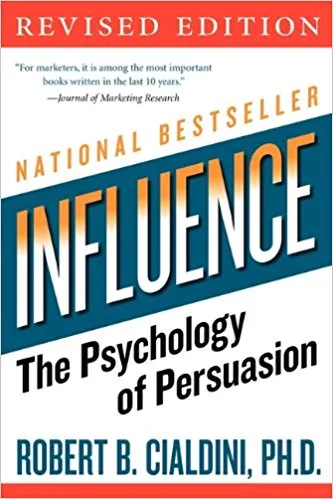
The 7 Universal Triggers Every Marketer Should Know
Cialdini spent three years undercover at car dealerships. He came back with seven principles.
From:Influence: The Psychology of PersuasionAuthor:Robert CialdiniYear:1984 · rev. 2021Pages:592
Robert Cialdini spent three years undercover at car dealerships, used-car lots, fundraising operations, and door-to-door sales offices. Not as a researcher with a clipboard. As a trainee. He wanted to know what actually worked when the customer was wavering and the meter was running.
He came back with seven principles. They're not theories. They're the moves people who have to close make every day, distilled to their molecular weight. If you've read any marketing book published since 1984, you've read a watered-down version of Cialdini.
Week one of fifty-two starts here because before Kahneman's substrate, before Sutherland's contrarian creative, before Hormozi's offer stacks, every persuader for the last forty years has known: there are seven levers, they fire reliably, and most marketers leave four of them on the table.
Pour yourself something that isn't coffee. Let's start the year strong.
◆ Audio Overview
Prefer to listen?
The chapter as a listen: the seven levers, click-whirr compliance, and the ethics line. Press play, take Cialdini with you.
Influence · Audio Overview
0:00/12:07
◆ ◆ ◆
The Thesis
Humans run on cognitive shortcuts ("click-whirr" automatic behavior). Seven universal principles trigger compliance reliably enough that ethical operators should engineer them and self-respecting buyers should learn to detect them.
Cialdini is the persuasion principle catalogue, the seven moves you check every campaign against before shipping. The 7-principle audit is the skill's go-to deliverable.
◆ ◆ ◆
02The Architecture
Ten frameworks. The seven principles plus the click-whirr meta-model, the contrast principle, and the compliance techniques that operationalize them.
Framework 01
Click-Whirr: Fixed-Action Patterns
What it is
Humans run pre-programmed response sequences when a single trigger feature appears. The trigger fires the whole behavior, even when the trigger is fake. Compliance professionals exploit triggers; targets feel they decided freely.
Marketing use
Every Cialdini principle is a click-whirr trigger. The principle = the whole behavior; the cue = the trigger feature you place in the asset. You don't argue someone into compliance. You trip the right trigger and the behavior fires.
"Per Cialdini's click-whirr model, the principle fires automatically once the trigger feature is present. Argument is downstream."
Framework 02
Reciprocation
What it is
Humans are obligated to repay what they received (gifts, favors, concessions). The obligation is unequal in size, asymmetric in value, and survives even unwanted gifts. Engine of free samples, "we're including this at no cost," and the rejection-then-retreat technique.
Marketing use
Lead with genuine value before the ask. Free chapters, audits, calculators, samples. The size of the gift doesn't have to match the size of the ask. Only the order matters. Reciprocation is also why "free + shipping" outperforms "$5" by a wider margin than the math alone explains.
"Per Cialdini's reciprocation principle, the felt obligation to repay an unsolicited gift is asymmetric. Small gift, large return."
Framework 03
Liking
What it is
We comply with people we like. Liking is amplified by physical attractiveness, similarity (background, dress, opinions, names), compliments, contact and cooperation, and conditioning/association.
Marketing use
Make the messenger resemble the audience. Founders look like the target customer. Testimonial-givers share names/professions/locations with the reader. The Tupperware party works because someone you like is asking. Not because the bowl is good.
"Cialdini's liking principle predicts compliance scales with similarity to the messenger. Match the founder/spokesperson to the reader."
Framework 04
Social Proof
What it is
When uncertain, people look at what others (especially similar others) are doing and copy. Most powerful under uncertainty and when the others are perceived as similar to the self. Can produce pluralistic ignorance ("everyone seems unconcerned, so I shouldn't be") and the bystander effect.
Marketing use
Counts beat adjectives ("47,892 active users" beats "thousands of happy users"). Customer logos work when prospects identify with the customers. "Most popular" badges. Live activity widgets. Beware: showing how many people don't do the desired behavior backfires.
"Cialdini's social proof principle predicts uncertainty-driven imitation, and the strength scales with perceived similarity to the proof source."
Framework 05
Authority
What it is
Symbols of authority (titles, uniforms, credentials, trappings) trigger compliance independent of actual expertise. Even fake authority (actor in a doctor's coat) produces large compliance shifts. Connoted authority: "doctors recommend," "engineered by," "as featured in."
Marketing use
Credentials in proximity to the offer. Earned-media logos ("As seen in Forbes"). Expert spokespeople. Formal language register. Awards icons. The symbol is the trigger; the actual credential matters less than the visibility of the credential.
"Cialdini's authority principle: symbols of expertise trigger deference reliably enough that the symbol itself moves behavior."
Framework 06
Scarcity
What it is
Things become more attractive as they become less available. Loss-framed scarcity (you'll lose access) is more powerful than gain-framed (you can still have it). Newly-scarce > always-scarce. Scarcity caused by competition > scarcity from physical limit. Censored information becomes more persuasive.
Marketing use
Real deadlines (countdown timers tied to actual cutoff). Limited supply with the reason visible ("only 200 produced because we hand-build them"). "Only 3 left at this price." Waitlists. Cohort caps. The scarcity must be credible. Phony scarcity erodes trust faster than no scarcity.
"Cialdini's scarcity principle predicts that loss-framed limitation increases desirability and conversion, but only when the limit is credible."
Framework 07
Commitment & Consistency
What it is
Once we make a commitment (especially active, public, voluntary, written), we feel pressure to behave consistently with it. Small initial commitments lead to larger ones (foot-in-the-door). Self-image follows behavior more than behavior follows self-image.
Marketing use
Get the small yes first. Quiz funnels that ask the prospect to identify their own situation create a commitment that the offer then matches. Public commitments (sharing the trial, posting the goal). Identity questions ("are you the kind of person who…?"). The "yes ladder" before the close.
"Per Cialdini's commitment & consistency principle, behavior aligns with prior public commitments. Get the small yes before the big one."
Framework 08
Unity (added 2021)
What it is
The deepest trigger. Not just liking or similarity, but a sense of shared identity, "we-ness." Family, kin, tribe, nation, fandom, alma mater. Unity-based persuasion isn't "I will reciprocate because you helped me". It's "we are the same."
Marketing use
Tribal language. Insider vocabulary. Shared origin stories. Cause alignment. The brand-as-tribe move. Categories with strong unity activation: motorcycles (Harley), CrossFit, religious communities, sports fandoms, alma maters. The new gold standard above mere community.
"Cialdini's unity principle moves above liking to shared identity. We rather than I and you."
Framework 09
Contrast Principle
What it is
Sequential perception is relative. The second item is judged relative to the first, not absolutely. Heavy package after light package feels heavier than its actual weight. Expensive item shown first makes the second feel cheap.
Marketing use
Show the premium tier first. Show the worst-case scenario before the offer. Sales floor sequencing (suit first, then accessories).
"Cialdini's contrast principle: sequential judgment is relative. Show the high-anchor first to make the offer feel light."
Framework 10
The Compliance Techniques
What it is
Door-in-the-face: big ask refused, smaller ask accepted (reciprocation of concession + contrast). Foot-in-the-door: small yes, then larger yes (commitment & consistency). Low-ball: secure commitment, then reveal full cost. That's not all: offer the deal, then add a sweetener before they can refuse.
Marketing use
Pricing pages with a premium tier you don't expect to sell ("decoy"). Free trials that secure the commitment before the upsell. Pricing reveals after the prospect has already self-identified as a buyer. Surprise bonuses dropped after the prospect leans in.
"Cialdini's rejection-then-retreat technique uses concession reciprocity to make the smaller ask feel like a deal."
◆ ◆ ◆
03Lexicon
Named terms a marketer should recognize on sight.
Click-whirr
Automatic compliance trigger response. Design for the trigger, not the argument.
Compliance professional
Someone who trades in influence. Assume your buyer is being trained against your moves.
Trigger feature
The cue that fires the whole behavior. The cue itself does the work.
Concession
A step back from a larger ask. Reciprocates obligation in your direction.
Pluralistic ignorance
Everyone privately uncertain, publicly conforming. Show the active minority, not widespread inaction.
Descriptive vs. injunctive norm
What people do vs. what they should do. Never accidentally show how many people don't do the desired behavior.
Foot-in-the-door
Small yes precedes large yes. Engineer micro-commitments early in the funnel.
Door-in-the-face
Large no precedes acceptable yes. Lead with the premium / decoy.
Low-ball
Secure commitment, reveal full cost. Ethical version: free trial → paid plan reveal after value experienced.
Authority symbol
Visual proxy for expertise. The symbol moves behavior; the credential is secondary.
Newly-scarce
Recently became limited. "Going off the menu next month" outperforms "rare item."
Unity activation
Sense of shared identity firing. Tribal language + shared origin > generic community.
◆ ◆ ◆
04Tactical Recipes
Specific moves you can ship by Friday.
The 7-Principle Audit. Before shipping any campaign, score it 1-10 on each principle. Anything below 5 is a missed lever. Anything at 0 is malpractice on a marketing-funded asset.
The Reciprocation Lead. Open every funnel with a real gift before the first ask. The gift should feel personal (free audit > free PDF) and arrive before the prospect has to commit.
The Mirrored Founder. Make the founder photo and bio resemble the customer in age, dress, geography, language register. Liking via similarity is the single most undervalued conversion lever.
The Specific Number. Replace "thousands" with the actual count. "47,892" beats "thousands" because precision implies real measurement (and triggers authority via specificity + social proof via volume).
The Credible Scarcity. Always pair the limit with the reason for the limit. "Only 200 because we hand-finish each one" is credible. "Only 3 left!" with no reason is suspicious. Trust > urgency.
The Yes Ladder. Quiz funnel that asks 4-7 micro-yes questions before showing the offer. Each yes is a small commitment. Conversion lifts are routinely 30%+ over a non-quiz path.
The Identity Frame. Phrase the call-to-action as identity ("Become a [tribe name]") not transaction ("Buy now"). Unity > scarcity for high-LTV products.
The Authority Stack. Pair every claim with at least one authority symbol: testimonial from a credentialed source, "as seen in" logo strip, expert quote. Don't just claim, certify.
The Live Social Proof. Real-time activity widgets ("Sarah from Topeka just signed up") work because they convert anonymous social proof into specific, similar-other social proof. Effective for low-trust categories.
The Door-in-the-Face Pricing Page. Lead with a premium tier the prospect probably won't buy. The "main" tier reads as moderate, not high. The "starter" reads as a deal.
◆ ◆ ◆
05Tensions & Cross-References
Where Cialdini agrees, contradicts, or extends the rest of the shelf.
Agrees with
Kahneman. Click-whirr is System 1 in compliance dress. The 7 principles all bypass System 2 deliberation.
Agrees with
Hopkins / Whitman / Cashvertising. The classic ad lineage learned the same lessons from copy testing decades earlier. Cialdini gave them the psychology.
Agrees with
Pre-Suasion (same author). Influence is the menu of principles; Pre-Suasion is the timing of when you deploy them.
Extends with
Berger, Contagious. STEPPS is partly Cialdini-applied. Social currency is reciprocation/unity of perceived status.
Pushes back on
Pink, Drive. Compliance levers are largely extrinsic. Intrinsic-motivation work suggests overuse of compliance triggers can erode trust over time. Use Cialdini for the close, Pink for retention.
Pushes back on
Sutherland, Alchemy. Sutherland argues compliance fails when the audience smells the trigger. Cialdini agrees, but Sutherland pushes us further toward unexpected, anti-formula moves that don't pattern-match to "another marketing trick."
Extends with
Schwartz, Breakthrough Advertising. Schwartz tells you what to say at each awareness level. Cialdini tells you which compliance principles to layer in. Combined they're devastating.
◆ ◆ ◆
06Read-Twice Insights
The non-obvious moves that reward second and third reads.
The rejection-then-retreat sequence is the most underused pricing structure in B2B SaaS. Lead with the enterprise tier, retreat to "team," and "team" feels reasonable. Most pricing pages lead with the cheapest tier and pay for it in conversion.
Unity is the new gold standard. Liking and similarity were the old top-of-stack; Unity (tribal identity) is meaningfully more durable. Categories with weak unity activation (utilities, B2B tooling) are leaving compounding LTV on the table.
Authority symbols pay even in skeptical audiences. The "this is just marketing theater" objection underestimates how much of the response is below the level of conscious detection. The skeptic's System 2 dismisses the badge while their System 1 already updated.
Scarcity + reason > scarcity alone. "Limited" is meaningless without "limited because." The reason fortifies belief; without it, scarcity reads as manipulation and erodes the other principles in the same asset.
The principles compound. A single asset using one principle hard outperforms an asset using one weakly. An asset stacking three principles outperforms either. The diminishing return is real but not steep.
Descriptive norms can backfire. Telling visitors how many people haven't signed up makes signup feel less normal. Always frame social proof around the desired behavior, never around its absence.
◆ ◆ ◆
07Citation-Grade Quotes
Pull-able lines for output. Click any quote to copy it formatted for social.
"The principles: reciprocation, liking, social proof, authority, scarcity, commitment and consistency, and unity."
Robert Cialdini, Influence · Introduction
"Click-whirr. And the appropriate tape is activated."
Robert Cialdini, Influence · Ch. 1
"A small first commitment can be used to manipulate a person into compliance with larger requests."
Robert Cialdini, Influence · Ch. 7, Commitment & Consistency
"The unity principle: the 'we' is the shared me."
Robert Cialdini, Influence · Ch. 8, Unity
"People most often agree to a request from someone they know and like."
Robert Cialdini, Influence · Ch. 5, Liking
◆ Apply This Week
One asset. Seven principles. One missing lever.
Pull up your highest-stakes marketing asset, the homepage, the pricing page, the lead-gen email, the sales deck. Score it 1-10 on each of the seven principles:
Reciprocation
Liking
Social Proof
Authority
Scarcity
Commitment & Consistency
Unity
You'll see it immediately. Most assets fire one or two principles hard and ignore four or five entirely. The gaps aren't oversights. They're leaks.
Pick the lowest-scoring principle that's actually relevant to your offer. Add one deployment of it: a real testimonial logo strip (Authority), a credible scarcity reason (Scarcity), a small reciprocation lead-magnet (Reciprocation), a tribal-language CTA (Unity). One move. One asset.
Ship the change by Friday. Watch what happens to your conversion curve.
That's week one. Seven principles. One missing lever activated. See you Tuesday.
◆ Going Deeper
The source: Influence
ROBERT CIALDINI · 1984 (REV. 2021) · 592 PP. · HARPERBUSINESS
Forty years on, still the most-quoted persuasion book ever published. The 2021 edition added the seventh principle (Unity) and modernized every example. If our chapter is the audit, the book is the field manual.
Affiliate links. We earn a small commission on purchases. It keeps the weekly drops free and the skills MIT-licensed.
◆ Get The Skill
Want the audit done for you?
The 7-Principle Audit (Cialdini) skill scores any marketing asset on the seven principles, identifies which are firing, which are missing, and recommends the highest-leverage deployment to add. Free. MIT licensed.
Every mode, especially Write (every CTA & headline gets a principle audit), Audit (the 7-principle scorecard), Launch (sequencing principles across the launch arc), Pricing (door-in-face, contrast, decoy).
When the skill leans on Cialdini, output explicitly calls which principle(s) the move triggers. The 7-principle audit is the skill's go-to AUDIT-mode primary deliverable.
The Silent Diagnostic
Of the 7 principles, which two is this asset firing? Which two could be added without crowding?