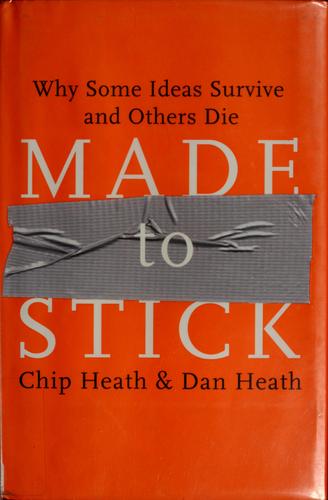
Six Traits Separate Ideas That Stick From Ideas That Vanish
Why does a made-up kidney-heist legend outlive your last mission statement? The Heath brothers found the pattern: simple, unexpected, concrete, credible, emotional, story. The year ends on the exam.
From:Made to StickAuthor:Chip Heath + Dan HeathDate:Aug 23, 2027Pages:~336 pages
There is an urban legend that has been circling dinner tables and college dorms for decades. A traveler meets someone at a bar, has one drink too many, and wakes up hours later in a hotel bathtub full of ice. Taped to the wall is a note. Call 911 or you will die. Do not move. When the traveler checks, there is a fresh surgical wound in the small of the back. A kidney, gone, harvested by an organ-theft ring while the drink did its work.
It never happened. Not once, not to anyone, anywhere, as far as any journalist or folklorist has ever been able to trace. And yet you just read that paragraph and you will remember it next month. Meanwhile the mission statement your team spent a Thursday afternoon workshopping last quarter, the one about synergy and customer-centric excellence, is already gone. You could not recite it if a kidney depended on it.
Chip Heath and Dan Heath spent an entire book chasing that gap. Why do some ideas, some of them flatly untrue, lodge themselves in memory for life, while other ideas, some of them true and important and expensive to produce, evaporate by Friday. They found six traits that sticky ideas share, and one enemy that works against every single one of them, a condition they call the curse of knowledge, which is what happens when you know a thing so well you forget what it was like not to know it.
This is the fifty-second week of this canon, the last one, and it is fitting that it lands here. Everything you have read all year, every trigger, every bias, every offer and story and pricing model, only matters if it survives being repeated by someone other than you. So pour whatever you actually drink on a Monday morning, one more time, and let us finish on the trait that makes all the others worth having: stickiness itself.
◆ ◆ ◆
◆ Audio Overview
Prefer to listen?
The chapter as a listen: simple, unexpected, concrete, credible, emotional, stories. The final week, and the ideas that last.
Made to Stick · Audio Overview
0:00/13:37
The Thesis
Ideas stick when they are simple, unexpected, concrete, credible, emotional, and wrapped in a story, and the single force working against every one of those traits is the curse of knowledge, the near-universal habit of forgetting what it is like not to already know the thing you are trying to explain. Fight the curse and the six traits become learnable, not accidental.
Cite Made to Stick for messaging, headlines, pitches, positioning statements, and any idea that has to survive being repeated by someone who was not in the room when you wrote it.
◆ ◆ ◆
02The Architecture
Ten frameworks. The six traits of a sticky idea, plus the curse that kills them.
Framework 01
Simple
What it is
A sticky idea finds its core and says it in one sentence. Simple does not mean short or dumbed down, it means stripped to the single most important thing, the way a proverb carries a worldview in ten words. Most communication fails not because it says too little but because it tries to say everything at once.
Marketing use
Before you write the deck, the ad, or the pitch, force yourself to name the one idea underneath it. If you cannot cut a sentence, you have not found the core yet, you have found a list.
Per the Heaths' simplicity principle, an idea sticks in proportion to how ruthlessly it has been stripped to its single most important element, not to how much of the truth it manages to include.
Framework 02
Unexpected
What it is
Attention goes where patterns break. A sticky idea violates an expectation, opens a gap between what people assumed and what is actually true, and that gap itself becomes the reason to keep listening. Predictable messaging is invisible messaging, no matter how accurate it is.
Marketing use
Find the counterintuitive fact inside your offer, the thing that surprises even people who work in your category, and lead with that instead of the safe summary. Southwest did not say we are a low-fare airline, they said we compete with cars, not other airlines.
Per the Heaths' unexpectedness principle, the most basic way to earn attention is to break a pattern, and the gap that breaking creates is what pulls people forward to close it.
Framework 03
Concrete
What it is
Abstract language is efficient for experts and useless for everyone else. Concrete language, sensory and specific, gives every listener the same picture regardless of their background knowledge. A proverb like a bird in the hand is worth two in the bush works because you can see it, not because it is logically airtight.
Marketing use
Replace every abstraction in your copy, our platform drives efficiency, with something you could photograph. Show the hand, show the bird, show the bush. If a stranger cannot picture your claim, they cannot remember it.
Per the Heaths' concreteness principle, an idea is memorable in proportion to how vividly it can be pictured, not how precisely it can be defined.
Framework 04
Credible
What it is
People do not believe claims because an authority made them, they believe claims they can test themselves, or that come from a source close enough to home to feel real. The Heaths point to the Sinatra test, if an example is impressive enough on its own terms, it makes the whole claim credible without needing outside statistics.
Marketing use
Give one vivid, checkable example instead of ten reassuring adjectives. If it can make it there, it will make it anywhere, one story about surviving the hardest case does more than a slide of aggregate percentages.
Per the Heaths' Sinatra test, a single example so extreme it could stand for the whole category does more persuasive work than any number of averaged statistics.
Framework 05
Emotional
What it is
People do not act on statistics, they act on feeling. A sticky idea makes someone feel something, care about an individual rather than weigh a population, and that feeling is what converts belief into behavior. Analysis paralysis is often just an absence of anything to feel.
Marketing use
Trade the aggregate for the individual. Not thousands of families lack access, but the specific family, the specific kid, the specific Tuesday night. Self-interest and identity are the two levers the Heaths keep returning to, so ask what this means for them, specifically, not for the market.
Per the Heaths' emotional principle, people are moved to act by feeling something about one person, not by understanding a statistic about many.
Framework 06
Stories
What it is
A story is a mental flight simulator, it lets the listener rehearse the response before the real moment arrives. The Heaths identify three shapes that recur across sticky stories, the challenge plot, the connection plot, and the creativity plot, each one training a different kind of behavior in advance.
Marketing use
Do not summarize the lesson, tell the story that contains it and let the listener extract the lesson themselves, because a rehearsed response sticks harder than an instructed one. A case study is a flight simulator for your next customer's decision.
Per the Heaths' story principle, a well-told story functions as a mental flight simulator, letting listeners rehearse a response mentally so they are more prepared to act when the real situation arrives.
Framework 07
The Curse of Knowledge
What it is
Once you know something, it becomes almost impossible to imagine not knowing it. Experts tap out a tune in their head and cannot understand why the listener does not hear it, because the expert's brain is filling in a melody the listener never received. This single failure explains most bad marketing, most confusing pitches, most jargon-choked slides.
Marketing use
Assume your reader has none of your context. Cut the acronyms, cut the internal shorthand, cut the sentence that only makes sense to someone who sat in the strategy meeting. If a smart outsider would ask what does that mean, you are still cursed.
Per the Heaths' curse of knowledge, once an idea is familiar to you it becomes nearly impossible to imagine the mind of someone hearing it for the first time, which is why experts routinely write copy that only other experts can follow.
Framework 08
The Velcro Theory of Memory
What it is
Memory works like Velcro, not glue. An idea sticks when it has many hooks catching many hooks, sensory detail, emotion, story structure, surprise, all reinforcing the same core at once. One clever line rarely survives alone, but a message built with several sticky traits working together becomes very hard to shake loose.
Marketing use
Do not settle for one trait. Layer a concrete detail onto an emotional beat, wrap both in a short story, and open with something unexpected. Each additional hook is another loop of Velcro holding the same idea in place.
Per the Heaths' velcro theory of memory, an idea sticks not through one perfect hook but through many small hooks, sensory, emotional, structural, all catching hold of the same core simultaneously.
Framework 09
Finding the Core
What it is
Before an idea can be simple, it has to be found, and finding it means cutting everything that is merely true in favor of the one thing that is essential. The Heaths compare it to a newspaper lede, burying it under ten qualifications kills the story before a reader gets to the point.
Marketing use
Ask what is the one sentence a reader must walk away with if they forget everything else. Write that sentence first, and only then decide what earns the right to sit beside it.
Per the Heaths' core-finding discipline, the real work of communication happens before the writing starts, in the ruthless decision about which single idea earns the front of the sentence.
Framework 10
The SUCCESs Checklist
What it is
The six traits are not a menu, they are a system, and the Heaths bundle them into one checklist, simple, unexpected, concrete, credible, emotional, story, so a communicator can run any message against all six before it ships. An idea that passes all six is not lucky, it was built.
Marketing use
Before you publish anything that has to survive being repeated, run it against all six letters in order and note which ones are missing. The gap tells you exactly what to add, not just that something feels flat.
Per the Heaths' SUCCESs checklist, a message built to satisfy all six traits at once, simple, unexpected, concrete, credible, emotional, story, is engineered to stick rather than left to chance.
◆ ◆ ◆
03Lexicon
Named terms a marketer should recognize on sight.
Simple
The one core idea, stripped of everything else. Find the sentence, then earn the rest.
Unexpected
A broken pattern that opens a gap the mind wants closed. Lead with the surprise, not the summary.
Concrete
Sensory, specific, picturable, not abstract. If they cannot picture it, they will not keep it.
Credible
Proof a listener can test or picture, not a claim they must trust. One vivid example beats ten reassuring adjectives.
Emotional
Feeling for one person, not weighing a population. Trade the aggregate for the individual.
Story
A mental flight simulator for future behavior. Tell it, do not summarize it.
Curse of knowledge
Forgetting what it is like not to already know. Assume zero context, cut the shorthand.
The core
The single sentence that must survive if nothing else does. Write it first, then decide what else earns a seat.
Sinatra test
One example so strong it proves the whole claim. Find the case that could stand for the category.
Velcro memory
Many small hooks holding one idea, not one big hook. Stack traits, do not rely on a single clever line.
◆ ◆ ◆
04Tactical Recipes
Plays you can run this week.
The Core Strip. Take your longest pitch and cut it until only one sentence survives. That sentence is the core. Everything else in the pitch now has to justify its place next to it.
The Curiosity Gap. Find the counterintuitive fact inside your offer, the thing that surprises people in your own category, and open with that instead of the safe summary.
The Concrete Swap. Circle every abstraction in your copy, efficiency, excellence, innovation, and replace each one with something you could photograph or act out.
The Sinatra Proof. Replace your statistics slide with one specific, checkable, slightly extreme example that could stand for the whole claim on its own.
The Emotion Lift. Find the sentence in your copy that talks about a market or a population, and rewrite it about one specific, named person instead.
The Story Wrap. Take your best case study and stop summarizing the lesson at the end. Tell the story straight through and let the reader supply the lesson themselves.
The Curse-of-Knowledge Check. Hand your draft to someone outside your team and ask them to explain it back. Every place they hesitate is a place the curse got you.
The One-Sentence Core. Before drafting anything long, write the single sentence a reader must remember if they forget everything else. Draft only after that sentence is locked.
The SUCCESs Pass. Score your finished message against all six letters, simple, unexpected, concrete, credible, emotional, story. Fix the lowest-scoring letter first, not the one that is easiest to fix.
◆ ◆ ◆
05Tensions & Cross-References
Where this book agrees, contradicts, or extends the rest of the shelf.
Extends
Story Craft (Q2). Story Craft built the shapes a story can take, Made to Stick explains why story is one of six traits an idea needs to survive at all. The story is necessary, but it is not sufficient alone.
Extends
Berger (Q3). Berger mapped what makes people share; the Heaths map what makes the shared idea survive being retold a second and third time. Shareability gets the idea out the door, stickiness keeps it alive after that.
Extends
Caples and Whitman (Q4). Concrete, specific copy was their whole discipline; the Heaths supply the psychological reason it works, specificity is picturable and picturable is memorable.
Pairs with
Sutherland (Q3). Sutherland's love of the counterintuitive and the Heaths' unexpectedness trait are the same insight from two different rooms, attention follows the broken pattern, not the confirmed one.
Grounds in
Ogilvy (Foundations). Ogilvy's plain, concrete, no-jargon copy was practicing simplicity and concreteness decades before the Heaths gave the traits names and a research base.
Tension with
jargon-heavy expert communication. Internal decks, technical pitches, and category-insider language optimize for precision among people who already know the material, exactly the audience least at risk from the curse of knowledge, and most at risk of boring or losing everyone else.
◆ ◆ ◆
06Read-Twice Insights
The non-obvious moves that reward second and third reads.
The curse of knowledge is not a character flaw, it is a tax on expertise. The better you get at your work, the harder it becomes to remember not knowing it. Fighting the curse is not a one-time fix, it is a habit you have to keep practicing as you get smarter.
Simple is not the same as short. A ten-word proverb can carry a lifetime of wisdom. Simple means finding the core, then compressing everything else around it, not deleting words until the page looks tidy.
An urban legend is a masterclass, not an accident. The kidney-heist story hits all six traits without anyone designing it on purpose. That is the uncomfortable proof that stickiness is a mechanism, not a talent some people are born with.
Statistics rarely move anyone by themselves. A number needs a face before it becomes a decision. The Heaths keep returning to the single named example because the brain acts on people, not on populations.
Unexpected only works once the gap gets closed. A surprise that never resolves just feels like a trick. The pattern break earns attention, but the payoff is what earns trust, so do not open a gap you have no intention of closing.
Velcro beats glue because it is redundant on purpose. One brilliant line is fragile. A message with several traits reinforcing the same core survives forgetting, distraction, and a bad retelling by someone who only half remembers it.
◆ ◆ ◆
07Citation-Grade Quotes
Pull-able lines for output. Click any quote to copy it formatted for social.
"The most basic way to get someone's attention is to break a pattern."
Chip & Dan Heath, Made to Stick
"The Curse of Knowledge: once we know something, we find it hard to imagine not knowing it."
Chip & Dan Heath, Made to Stick
"If you say three things, you say nothing."
Chip & Dan Heath, Made to Stick
"Stories act as a kind of mental flight simulator, preparing us to respond more quickly and effectively."
Chip & Dan Heath, Made to Stick
"Simplicity isn't about dumbing down, it's about prioritizing."
Chip & Dan Heath, Made to Stick
◆ Apply This Week
One idea. Six traits, one pass.
Pull up the message you most need someone else to repeat correctly, without you in the room: your positioning line, your best pitch, the thing new hires are supposed to understand about why the company exists.
Run it through three quick fixes before you run the full SUCCESs pass.
Strip it: Cut the message down to one sentence, the core. Everything else has to earn a place beside it.
Make it concrete: Find the biggest abstraction in the message and replace it with something a stranger could picture.
Break one expectation: Find the safest, most predictable line in the message and swap it for the counterintuitive fact underneath it.
Say the new version out loud to someone who was not there when you wrote it. If they can repeat it back an hour later, you built something with hooks. If they cannot, you know exactly which trait to add next.
That is week fifty two. The whole canon, in your hands. Fifty two Mondays, fifty two books, one long argument that behavior beats belief and that the right idea, built well, outlasts the meeting where you first said it. Thank you for showing up every week. Now go make something stick.
◆ Going Deeper
The source: Made to Stick
CHIP + DAN HEATH · WHY IDEAS SURVIVE
The book that explains why a kidney-theft urban legend outlives a mission statement. Six traits, one curse, and a lifetime of case studies proving that stickiness is a discipline you can learn, not a gift some communicators are just born with.
Affiliate links. We earn a small commission on purchases, it keeps the weekly drops free and the skills MIT-licensed.
◆ Get The Skill
Want the Stickiness Audit done for you?
The Made to Stick skill runs any headline, pitch, or positioning line against the six traits in order, simple, unexpected, concrete, credible, emotional, story, then flags where the curse of knowledge is hiding. It returns the missing trait and the specific rewrite. Free. MIT licensed.
Write (stripping copy to the core, swapping abstractions for concrete detail), Hook (the unexpected fact that opens the curiosity gap), Audit (the full SUCCESs pass on a finished message).
Pairs with
Story Craft (the story trait, one of six); Berger (what earns the share versus what survives the retelling); Caples and Whitman (concrete, specific copy); Sutherland (the unexpected as attention); Ogilvy (simple, jargon-free, concrete copy as the foundation).
Output shape
When the skill leans on Made to Stick, it should score the message against all six SUCCESs traits in order, name the weakest one first, and give the specific rewrite, then flag any place the curse of knowledge is likely hiding jargon or unearned assumptions.
The Silent DiagnosticIf a stranger who was not in the room heard this once, could they repeat it back correctly an hour later, or does it only make sense to the people who already understand it?