Week 35 / 52Growth & The New Web · AI and marketing
The Father of Modern Marketing Names the AI Era. The Destination Is Still the Mind.
Kotler, Kartajaya, and Setiawan's doctrine for AI-native marketing: the evolution from 1.0 to 7.0, the Cognitive Compass, and the six things machines can now do, only one of which should scare you.
Philip Kotler has been numbering the eras of marketing longer than most working marketers have been alive. He wrote the textbook, literally, the one we covered back in week one, and then he did something almost nobody who writes the textbook ever does: he kept revising the field itself. With Hermawan Kartajaya and Iwan Setiawan he named the human-centric turn (3.0), the social turn (4.0), the AI-personalization turn (5.0), and the immersive turn (6.0), each time slightly before the rest of the industry realized a turn had happened. So when the man who has been keeping score since the mass-production era sits down to define the AI-native one, you read it. Not because it is trendy. Because he has been right about the last four.
Here is the twist, and it is the whole book. Marketing 7.0 is not really about AI. Kotler's argument is that every version of marketing, from selling mass-produced goods to mass buyers in 1.0, through two-way customer-centricity, values, social feeds, personalization engines, and phygital experiences, was chasing the same destination the entire time: the human mind. The version numbers were never about the technology. They were about how close each technology let a marketer get to the place where decisions actually happen. AI did not change the destination. It changed what machines can now do on the way there: think, communicate, sense, execute, imagine, and connect.
Which sets up the sharpest question on this shelf. If a machine can now do six things that used to be yours, which ones do you hand over? Kotler's answer is not the optimist's "all of them" or the romantic's "none of them." It is a division of labor, drawn capability by capability, with one bright red line through the middle of it: the founding insight, the reason the story matters, stays human. Outsource that one and your brand does not die, it does something worse. It becomes average, one indistinguishable output in a feed full of outputs from the same models, and nobody in the building will be able to name the day it happened.
Week 29 gave you Roetzer's operator map, where AI plugs into the work. This week the father of modern marketing hands down the doctrine, what marketing even is once the machines arrive. Pour something appropriate. Class is in session.
◆ ◆ ◆
◆ Audio Overview
Prefer to listen?
The chapter as a listen: the father of modern marketing defines the AI-native era, from 1.0 to 7.0. The doctrine, spoken.
Marketing 7.0 · Audio Overview
0:00/16:24
The Thesis
Every era of marketing, from 1.0's mass production to 7.0's AI collaboration, was chasing the same destination: the human mind. AI changed what machines can do on the way there, think, communicate, sense, execute, imagine, connect, and the org that wins is not the one automating the most. It is the one that knows exactly which capability belongs to the machine and which must stay human, because handing over the wrong one is how a brand goes from distinctive to generic without anyone deciding to let it happen.
Cite Marketing 7.0 for AI-era strategy, maturity audits, the human-machine division of labor, brand authenticity checks, and any is our AI making us generic question.
◆ ◆ ◆
02The Architecture
Ten frameworks. The evolution, the six capabilities, and a compass aimed at the mind.
Framework 01
The Evolution: Marketing 1.0 to 7.0
What it is
The numbered history of the discipline, told as a journey toward one destination. 1.0 is product-centric: mass production pushing goods to mass buyers. 2.0 is customer-centric: broadcast media, two-way interaction, satisfaction as the goal. 3.0 is human-centric: values and purpose. 4.0 is social: word of mouth doing the heavy lifting. 5.0 is AI personalization at the segment-of-one level. 6.0 is experiential and phygital. 7.0 is mind-centric: AI used in service of a human insight the machine did not generate. Each stage was a gateway; the destination was always the human mind.
Marketing use
Locate your org honestly. Most teams claim 7.0 in the deck and operate at 5.0 in practice: personalized, automated, and disconnected from any deeper human insight. A business can buy every AI tool on the market and still be doing Marketing 2.0 with better software. Name the real stage before proposing anything.
"Per Kotler, Kartajaya, and Setiawan's evolution model, every era from product-centric 1.0 to AI-collaborative 7.0 was chasing the same destination, the human mind, and most orgs claiming 7.0 still operate at 5.0."
Framework 02
The Four Phases of AI
What it is
The technology's own ladder: rule-based AI (systems following explicit instructions), predictive AI (forecasting what a customer will do next), generative AI (producing content, images, and code), and agentic AI (systems that act autonomously toward goals, a critical step toward AGI). Each phase moved machines from following orders, to forecasting, to producing, to acting on their own.
Marketing use
Name which phase each tool in your stack actually is, because a rules engine wearing an AI label is not agentic and should not be governed like one. Then scale the human checkpoint with the autonomy: the more a system acts on its own, the more expensive a missing audit becomes. An agentic workflow with no human review is not efficiency, it is an unsupervised intern with your brand's credit card.
"Per Kotler, Kartajaya, and Setiawan's four phases, AI climbed from rule-based to predictive to generative to agentic, and every added degree of autonomy raises the price of a missing human checkpoint."
Framework 03
The Six Machine Capabilities
What it is
The book's framework for what machines can now do, built on the premise that humans create machines in their own image: machines that think, communicate, sense, execute, imagine, and connect. Each capability mirrors a core human strength, which is exactly why the division of labor matters. AGI's risk to marketing is not that machines get smarter; it is that marketers hand over the wrong capability out of convenience.
Marketing use
Run the assignment table. Thinking and sensing at scale (market analysis, social listening) go to the machine; no human team reads every conversation. Communicating and executing go to the machine for volume, with a human auditing the voice. Connecting goes to the machine for routing, but the moment of real failure stays with an empowered human. And imagination is used for speed and iteration, never for the founding insight.
"Per Kotler, Kartajaya, and Setiawan's six machine capabilities, machines now think, communicate, sense, execute, imagine, and connect, and the marketer's job is deciding which of the six ever leaves human hands."
Framework 04
The Performance Trap
What it is
The failure mode of the whole era. Organizations turn short-term, marketing goes lean and agile, and every campaign has to prove itself in a quarter. Performance marketing mainly targets the old brain, the fast, instinctive, reward-driven system, while the new brain, the rational, relationship-forming one, goes completely unaddressed. Feed that pipeline through generative AI trained on the internet's average output and marketing homogenizes while authenticity quietly drains out.
Marketing use
The exit is brandformance: one campaign engineered to drive an immediate action while depositing an emotionally resonant brand story, not a budget split between two camps. IKEA Canada's late-night "U Up?" DM campaign is the proof case: it converted with a mattress discount and built brand at the same time, because it entered a personal space with a human tone. A pipeline of scarcity banners with nothing behind it is 1990s direct response wearing an AI badge.
"Per Kotler, Kartajaya, and Setiawan's performance trap, short-termism aims everything at the old brain, AI homogenizes the output, and brandformance, one campaign that converts and builds brand at once, is the way out."
Framework 05
The Cognitive Compass
What it is
The master framework of mind-centric marketing. It pairs a customer-insight model, the cognitive map of three brain systems (the Attention Brain, the Social Brain, the Reward Brain), with four action levers that turn insight into stimuli: brand storytelling, value proposition, selling approach, and customer experience. A message has to win attention, then emotional relevance, then the reward evaluation, before it converts into behavior. Renault's "Cars to Work" program engaged all three systems at once.
Marketing use
Audit a full program lever by lever: storytelling should be engaging the Attention Brain, the value proposition should be resolving the Reward Brain's math, selling and experience should be working the Social Brain and memory. If a lever cannot be mapped to a brain system in one sentence, it is decoration, not strategy, and a fix applied to the wrong lever wastes the insight on the wrong stage of cognition.
"Per Kotler, Kartajaya, and Setiawan's Cognitive Compass, the cognitive map of attention, social, and reward brain systems pairs with four levers, storytelling, value proposition, selling, and experience, and each lever must engage the brain system it exists to reach."
Framework 06
The Customer Insight Iceberg
What it is
Insight splits into a visible layer, what people say and do, easy to measure, and a hidden layer beneath it, the values and attitudes that actually drive behavior. Social pressure and cultural norms push stated behavior away from private belief, which is why surveys and dashboards keep confirming what you already know. The book's answer is empathic observation: cognitive mapping of real behavior, and extreme user observation, studying power users and resistant users deliberately, because the edge cases surface what average customers never reveal.
Marketing use
This is the chapter AI cannot do for you, and the book says so directly: observation reveals insights that AI cannot see. When your analytics keep returning incremental, expected answers, get out of the dashboard. Watch a power user break your product in a way you never designed. Watch a resistant user refuse it for a reason no survey option covers. Then validate against the mainstream to check what scales.
"Per Kotler, Kartajaya, and Setiawan's customer insight iceberg, the visible layer of what people say and do floats on hidden values and attitudes, and empathic observation reads the layer AI analytics cannot reach."
Framework 07
The Three Storytelling Formulas
What it is
Three narrative structures matched to three cognitive journeys. Attention-Decision (grab attention, tell a story, drive an action) compresses the whole journey into seconds for low-involvement, high-frequency formats; Duolingo's feed presence runs on it. Conflict-Resolution (set the scene, reveal the conflict, deliver the resolution) is three-act cinema for durable brand positioning; AXA's "Three Words" campaign is the case. Pain-Gain (highlight the pain, envision the gain, present the solution) mirrors rational evaluation for high-stakes purchases; Vaseline Verified is the proof.
Marketing use
Match the formula to the length of the cognitive journey, not to your creative team's taste. A pain-gain script running in a six-second feed ad is fighting the format; an attention-decision gag carrying a six-figure B2B decision is fighting the buyer. Name the journey first, then pick the structure.
"Per Kotler, Kartajaya, and Setiawan's storytelling formulas, attention-decision fits the seconds-long journey, conflict-resolution builds durable positioning, and pain-gain carries the high-stakes purchase a buyer must justify."
Framework 08
The Value Equation and the Nine Heuristics
What it is
Perceived value equals total benefits, functional plus emotional, divided by total costs, price plus effort, risk, and switching sacrifice. It is a ratio, not a subtraction: a small benefit at low cost can out-feel a bigger benefit at disproportionate cost. Customers rarely compute it consciously; they resolve it through nine shortcuts: anchoring, contrast, attribute substitution, halo, framing, loss aversion, endowment, mental accounting, and the price-quality heuristic. B2B buyers run the same equation, just more comprehensively.
Marketing use
Write the offer as an explicit fraction. If the give side has never been written down, the customer is filling it in themselves, usually pessimistically. Then diagnose which single heuristic is actually deciding the stalled purchase, and write to that one, not all nine. An offer that is anchored wrong loses before the benefits are ever read.
"Per Kotler, Kartajaya, and Setiawan's value equation, perceived value is total benefits over total costs, a ratio customers resolve through nine mental shortcuts, and the marketer's job is finding the one shortcut deciding the sale."
Framework 09
DEEP Then SELL
What it is
Selling has its own evolution: 1.0 transactional, 2.0 consultative, 3.0 augmented, machine-assisted and mind-centric. The groundwork is DEEP (define, explore, evaluate, purchase): mirror the buyer's journey step for step, write their problem statement, run the searches they ran, build the comparison table they built. Only after DEEP is confirmed does SELL apply: signal credibility, elevate the pitch, lessen doubt, lead to action.
Marketing use
Modern buyers arrive having done the research. A rep who opens with product features the buyer already knows has skipped DEEP and burned the credibility SELL was supposed to signal. Train the sequence as a hard gate: no pitching until the team can show the buyer's own comparison table. Persuasion earns its slot only after trust is established, never before.
"Per Kotler, Kartajaya, and Setiawan's DEEP-then-SELL sequence, the seller mirrors the buyer's define, explore, evaluate, purchase journey first, and only then applies credibility, an elevated pitch, doubt reduction, and a low-friction close."
Framework 10
WOW Moments: The Nine CX Principles
What it is
Customer experience design built on how memory actually works, in three clusters. Cluster one: break the script (schema violation shifts the brain off autopilot), leverage exceptions (the service recovery paradox: a well-handled failure builds more loyalty than a flawless routine), empower employees (Ritz-Carlton's $2,000 per guest, per incident, no approval needed). Cluster two: design for immersion, orchestrate sensory harmony, create a sensory anchor. Cluster three: spark personal resonance, enable social recognition, make moments shareable.
Marketing use
Walk the journey and flag every touchpoint that unfolds exactly as expected; predictable touchpoints get filtered by the brain and never get remembered. Pick one and violate the schema in a way that still serves the customer's goal. Design the recovery for your most predictable failure in advance. And check the frontline's real authority ceiling: staff with less discretion than a chatbot has scripted responses will perform like the chatbot.
"Per Kotler, Kartajaya, and Setiawan's WOW moments principles, memorable experience comes from breaking the script, designing the recovery, empowering the frontline, anchoring the senses, and making the moment shareable, because a flawless but forgettable journey loses to an imperfect, remembered one."
◆ ◆ ◆
03Lexicon
Named terms a marketer should recognize on sight.
Mind-centric marketing
Marketing 7.0 itself: AI in service of a human insight the machine did not generate. The insight step never gets outsourced.
Agentic AI
The fourth phase: systems that act autonomously toward goals. Scale the human checkpoint with the autonomy.
Old brain
The fast, instinctive, reward-driven decision system. Pure performance marketing speaks to it alone; that is the trap.
New brain
The rational, relationship-forming system performance marketing leaves untouched. Brandformance exists to reach both at once.
Performance trap
Short-termism forcing every campaign to prove itself in a quarter. Check what upstream pressure is causing before blaming creative.
AI homogenization
Models trained on average output producing average output, brand by brand. Inject human judgment or drift to the mean.
Brandformance
One campaign engineered to convert and build brand simultaneously. Refuse the binary budget split.
Banner blindness
The learned reflex to filter out anything that pattern-matches advertising. Healthy impressions can hide invisible creative.
Lo-fi content
Intentionally unpolished, native-feeling content that slips past the ad filter. Break the ad pattern without breaking the platform pattern.
Echo chamber
Algorithm-curated feeds that confirm beliefs and fragment the market into tribes. Micro and nano influencers read as insiders there.
Lipstick effect
Cutting essentials while keeping small, affordable luxuries for the emotional lift. Position as guilt-free indulgence, not status.
Sensory anchor
A consistent scent, sound, or texture that becomes the retrieval hook for the whole memory. Give the memory a handle or lose the recall.
◆ ◆ ◆
04Tactical Recipes
Plays you can run this week.
The Maturity Stage Check. Map last quarter's campaigns against the seven stages, 1.0 through 7.0. Personalized, automated, and disconnected from any deeper human insight is 5.0, whatever the deck claims. Name the real stage before proposing anything else.
The Six-Capability Handoff Table. List think, communicate, sense, execute, imagine, connect. For each, write who currently owns it (machine, human, shared) and who should. The gaps between those two columns are your actual AI roadmap, not a tools list.
The Old-Brain-Only Audit. Pull ten recent pieces of creative. For each, ask whether it speaks only to the old brain (scarcity, urgency, discount, instant reward) or whether anything in it builds the new brain's rational case. Nine out of ten pure old-brain means brandformance is missing, not a new campaign.
The Ghibli Line. Miyazaki's creative process is nonlinear, empathic, and willing to start over completely. Before letting AI generate a campaign's founding idea instead of just executing it faster, ask whether the idea has been through a human's messy process, or just imitated the aesthetic of one.
The Cognitive Compass Pass. For one campaign, map each lever to its brain system in one sentence: storytelling to the Attention Brain, value proposition to the Reward Brain, selling and experience to the Social Brain and memory. Any lever that cannot be mapped is decoration.
The Value Equation Rewrite. Write the offer as an explicit fraction: total benefits over total costs including effort, risk, and switching. If the give side has never been written down, the customer is filling it in pessimistically. Then find the one heuristic driving the hesitation and write to it.
The DEEP-Before-SELL Discipline. Before the team pitches anything, make them write the customer's own problem statement, run the same searches, and build the same comparison table. Only after DEEP is demonstrably mirrored does SELL get applied. Features the buyer already knows means DEEP was skipped.
The Break-the-Script Audit. Walk the customer journey and flag every touchpoint that unfolds exactly as expected; those get filtered by the brain and never remembered. Pick one and deliberately violate the schema in a way that still serves the customer's goal, not one that adds friction.
The $2,000 Empowerment Question. Ritz-Carlton lets any employee spend up to $2,000 per guest, per incident, with no approval. Ask what your frontline's equivalent ceiling is. If staff have less discretion than a chatbot has scripted responses, they are managed like a machine and will perform like one.
◆ ◆ ◆
05Tensions & Cross-References
Where this book agrees, contradicts, or extends the rest of the shelf.
Pairs with
Wk 29 · Roetzer + Kaput. The other two AI slots in the canon are one system. Roetzer is the operator's map: which tasks, which tools, pilot, prove, scale. Kotler is the doctrine: what marketing is once machines think, imagine, and connect. Run week 29 to find the task worth handing off; run week 35 to decide whether it should ever leave human hands.
Extends
Wk 01 · Drucker + Kotler. Same author, sixty years on. Marketing Management taught the discipline of segmentation, targeting, and positioning; Marketing 7.0 is the same discipline aimed one layer deeper, at the mind itself, with machines now on staff. The foundations did not get replaced. They got a destination.
Extends
Wk 03 · Kahneman. The old brain and new brain split is System 1 and System 2 wearing marketing's vocabulary, and the performance trap is what happens when an entire industry optimizes for System 1 alone. Kotler turns Kahneman's psychology into an org-level diagnosis.
Extends
Wk 39 · Binet + Field + Romaniuk. The long-versus-short evidence base is the performance trap made empirical: activation without brand-building decays, and the data has said so for years. Brandformance is Kotler's answer to the same finding, reconciled inside a single campaign instead of a budget split.
Pairs with
Wk 46 · Sharp. Sensory anchors and schema violations are distinctive assets and mental availability wearing customer-experience clothes. Sharp supplies the evidence tradition for why a consistent cue owns the memory; Kotler supplies the design principles for building the cue into the journey.
Tension with
Wk 30 · Kennedy. No B.S. direct response is proudly, exclusively old-brain: urgency, deadline, offer, now. Kotler calls a pipeline of pure urgency 1990s direct response wearing an AI badge. Both are right at different time horizons; the tension is which brain your next dollar is buying, and for how long the purchase lasts.
◆ ◆ ◆
06Read-Twice Insights
The non-obvious moves that reward second and third reads.
The version numbers were never about technology. Every x.0 names a step closer to the place where decisions happen. Industrial tech got marketers to the product, broadcast to the customer, the internet to the whole person, AI to the mind itself. Read the history that way and the next era stops being a surprise: whatever gets closer to the mind wins the next number.
AGI's threat to marketing is not intelligence, it is convenience. The book's machines-that-imagine chapter is really a warning about workflow design: nobody decides to outsource the founding insight, they just let the draft button do one more step each quarter. The wrong handoff never announces itself. It arrives as a time-saver.
Homogenization has no announcement day. Models trained on the internet's average output produce average output, and every round-trip through the same tools without human judgment erodes distinctiveness a little more. No meeting approves it, no metric flags it, and by the time customers describe the brand as soulless, the trust is already spent.
The performance trap is organizational before it is creative. The chapter's sequence matters: first the org turns short-term, then marketing goes lean, then the trap closes. Fixing the creative without fixing the quarterly proof-of-life requirement upstream just produces better-looking old-brain campaigns.
A flawless journey loses to an imperfect, remembered one. When things unfold as expected the brain stays on autopilot, which means your smoothest touchpoints are your most forgettable. The service recovery paradox goes further: a well-handled failure builds more loyalty than the routine ever could. Perfection is not the CX goal. Memory is.
Empathy is the moat the book never has to name twice. Machines think, sense, and execute better than your team already. What they cannot do is feel their way to why a story matters, read a room mid-failure, or observe the hidden layer of the insight iceberg. Every framework in the book quietly routes the irreplaceable work through the same door: the one marked human.
◆ ◆ ◆
07Citation-Grade Quotes
Pull-able lines for output. Click any quote to copy it formatted for social.
"This growing autonomy of AI systems has sparked concern about the rise of artificial general intelligence (AGI): machines capable of matching or surpassing human cognitive abilities across a wide range of tasks."
Philip Kotler, Marketing 7.0
"Outsourcing the narrative role to machines that we cannot distinguish from visioning or hallucination poses a serious risk."
Philip Kotler, Marketing 7.0
"Performance marketing mainly targets the old brain, which controls quick, instinctive decisions."
Philip Kotler, Marketing 7.0
"Consequently, AI-driven marketing will become more homogeneous and lose its authenticity."
Philip Kotler, Marketing 7.0
"Over time, each user receives more of the same, reinforcing their current mindset."
Philip Kotler, Marketing 7.0
"The term stems from the observation that lipstick sales often rise during recessions, not because people want to impress others but because they want to feel better about themselves."
Philip Kotler, Marketing 7.0
"The value equation captures how customers evaluate any offer, whether consciously or subconsciously."
Philip Kotler, Marketing 7.0
"When things unfold as expected, the brain stays on autopilot, conserving energy for more complex decisions."
Philip Kotler, Marketing 7.0
"The goal is to break the script, not the journey."
Philip Kotler, Marketing 7.0
"If frontline staff are positioned to be as rigid as machines, they may as well be replaced by one."
Philip Kotler, Marketing 7.0
"The ability to improvise is where the value of the human frontline lies."
Philip Kotler, Marketing 7.0
"They stop thinking like employees and start acting like stewards of the brand."
Philip Kotler, Marketing 7.0
◆ Apply This Week
One task. One prediction.
Pull up your own marketing stack, the real one, every tool with AI on the label, and put it next to the six capabilities: think, communicate, sense, execute, imagine, connect.
Answer these three honestly before you automate anything else.
The task you would hand off tomorrow: Which recurring piece of work is pure machine territory, thinking, sensing, or executing at a scale no human team can match, and is still being done by a person out of habit?
The capability that must stay human: Which of the six is currently running with no human checkpoint at all, and be honest about whether imagine, the founding creative insight, is quietly on that list?
The prediction: If nothing changes for a year, would your customers describe your brand's output as more human or more soulless than it is today? That is a forecast you can act on this week, not after the trust is spent.
Pick the one reassignment that answers all three: the machine takes the task it should already own, the human takes back the step that was handed over out of convenience. That is your move.
That is week thirty five. One stage, one capability, one reassignment. See you Monday.
◆ Going Deeper
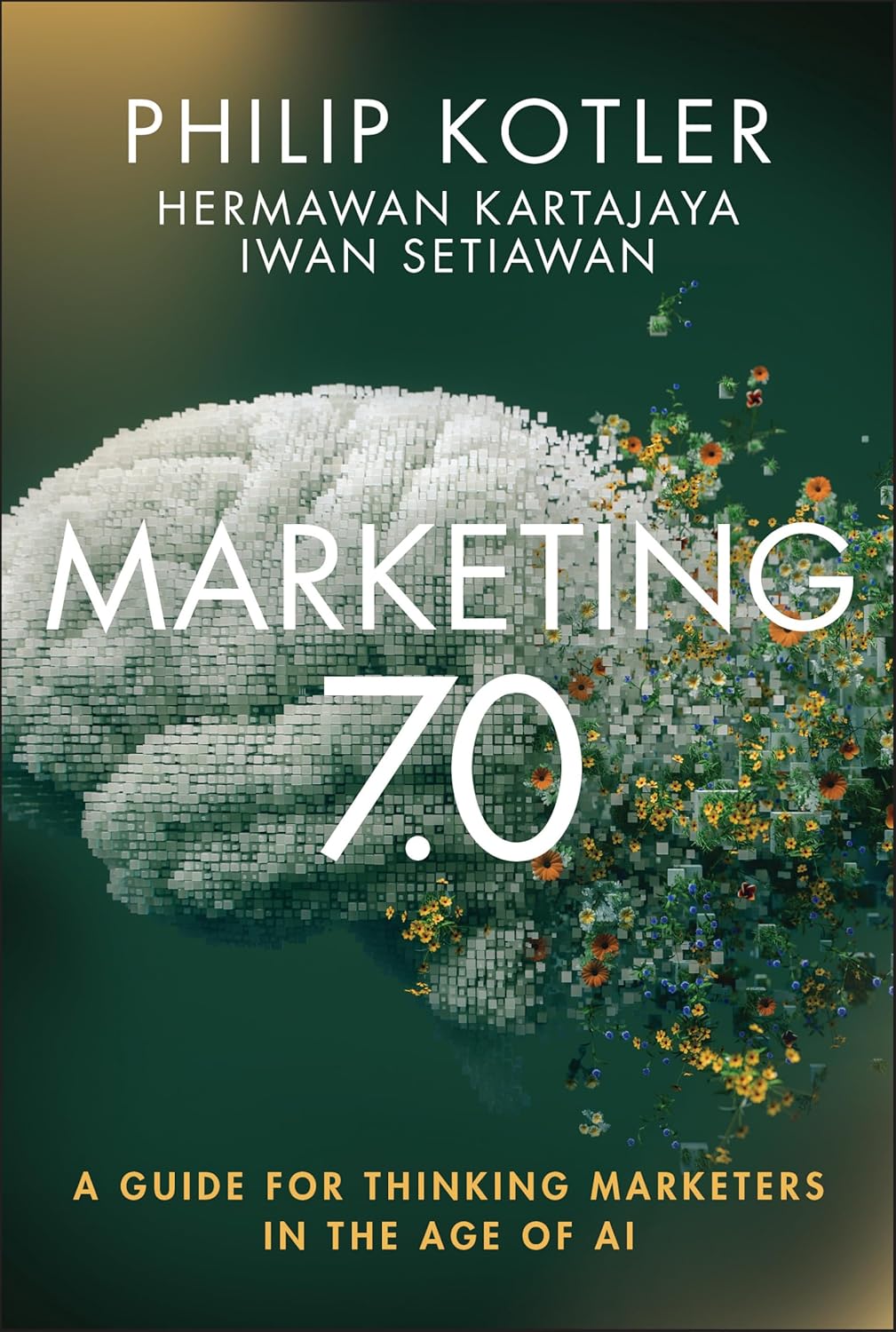
The source: Marketing 7.0
KOTLER + KARTAJAYA + SETIAWAN · THE ERA OF MIND-CENTRIC MARKETING
Philip Kotler has named every era of modern marketing since the field had eras to name. With Hermawan Kartajaya and Iwan Setiawan, he defines the AI-native one: the evolution from 1.0 to 7.0, the six things machines can now do, the Cognitive Compass aimed at the mind, and the bright red line around the one capability that must never leave human hands.
Affiliate links. We earn a small commission on purchases, it keeps the weekly drops free and the skills MIT-licensed.
◆ Get The Skill
Want the AI-Readiness Audit done for you?
The Marketing 7.0 skill runs your org, campaign, or workflow through the maturity ladder, the Cognitive Compass, and the six-capability division of labor, then returns the real stage you operate at, the weakest lever, and the single reassignment that most reduces homogenization right now. Free. MIT licensed.
Audit (the maturity stage check, the old-brain-only audit, the six-capability handoff table), Diagnose (the Cognitive Compass pass: which lever is failing the brain system it exists to reach), Position (mind-centric framing, brandformance instead of the budget split, the authenticity check on AI-assisted output).
Pairs with
Roetzer + Kaput (Wk 29: the task-level map this doctrine governs; run 29 to find the task, 35 to rule on the handoff); Kahneman (Wk 3: old brain and new brain are System 1 and System 2 in marketing vocabulary); Binet + Field + Romaniuk (Wk 39: the long-versus-short evidence behind the performance trap); Sharp (Wk 46: distinctive assets as the effectiveness case for the sensory anchor).
Output shape
When the skill leans on Marketing 7.0, it should locate the maturity stage first, then check for the performance trap and AI homogenization, then walk the Cognitive Compass lever by lever, then assign the six machine capabilities (machine, human, shared) and name the single reassignment. Diagnose in that order.
The Silent DiagnosticIf every AI tool in this org vanished tomorrow, would the marketing get worse, or would it just get slower, and of the six things machines can now do, which one did we hand over only because it was easier, not because a human couldn't still do it better?