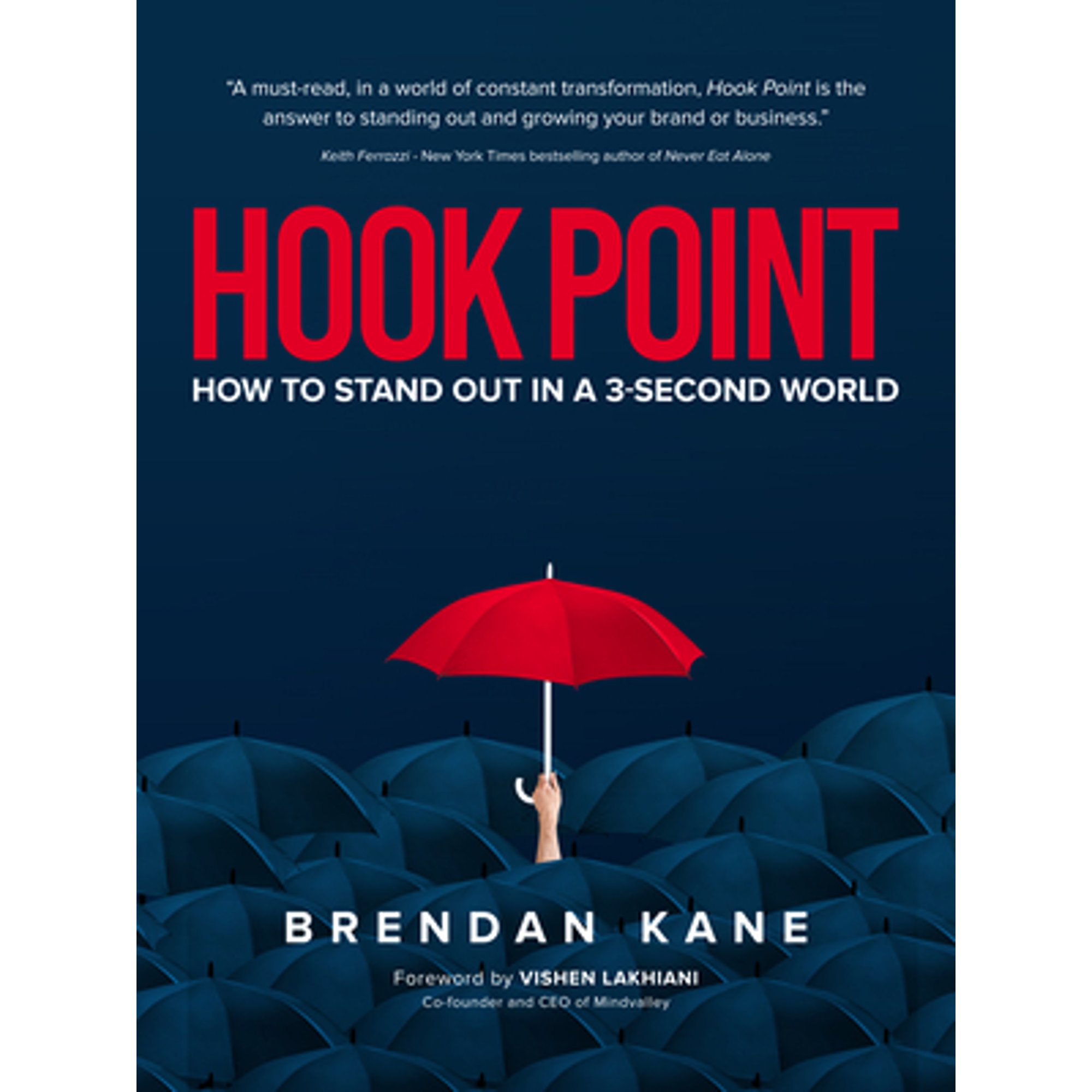
You Have Three Seconds. That Is the Whole Audition.
In a feed that never stops, the hook point is the single idea or image that makes a thumb pause. Kane treats it as a testable, scalable craft, not luck.
Three seconds. That is how long your content has to earn the next three. Not the whole video, not the whole email, not the whole ad. Three seconds to convince a thumb that is already moving to stop, and it decides before the conscious mind even catches up with what it just saw.
In a feed that never stops scrolling, the thumb is the toughest editor alive. It has seen ten thousand hours of content and it has gotten very good at its one job, which is skipping past almost all of it. Brendan Kane spent his career getting content in front of hundreds of millions of people, and what he kept finding was the same tiny, brutal bottleneck: the idea does not fail because it is bad, it fails because nobody ever saw enough of it to find out. The hook point is his name for the fix, the single phrase, image, or idea that stops the scroll and buys you the next three seconds.
Here is the part that separates Kane from a lot of people giving advice about attention: he does not treat the hook point as a gift from the muse. He treats it like a manufacturing problem. Write many hooks. Test them at real volume. Let the data tell you which one earns the pause, then build everything else on top of the winner. Taste picks the options. Testing picks the truth.
Grab something that is not coffee. This week we go hunting for the three seconds that make everything after them possible.
◆ ◆ ◆
◆ Audio Overview
Prefer to listen?
The chapter as a listen: earning attention in a three-second world, and the hooks that stop the scroll. Kane, applied.
Hook Point · Audio Overview
0:00/12:53
The Thesis
Attention is won or lost in the first three seconds, so the hook point, the single idea, phrase, or image that stops the scroll, is the highest leverage thing you make. The winners are found by testing hooks at volume across formats, not by picking a favorite from taste alone.
Cite Hook Point for social content, thumbnails, subject lines, ad openers, and any first-three-seconds decision where the whole piece lives or dies before anyone reads past line one.
◆ ◆ ◆
02The Architecture
Ten frameworks. The scroll-stopping hook, tested and scaled.
Framework 01
The 3-Second Rule
What it is
Kane's foundational claim: in a feed of infinite competing content, you have roughly three seconds to earn the next three seconds of attention. Miss that window and the quality of everything downstream, the offer, the story, the proof, never gets evaluated because it never gets seen.
Marketing use
Treat the first three seconds of every piece of content as its own separate creative problem, solved before you touch the rest. Do not open with a logo, a slow build, or a throat clear. Open with the reason to stay.
"Per Kane's 3-Second Rule, content earns its next three seconds inside the first three, so the opening moment is a separate creative problem from the body that follows it."
Framework 02
The Hook Point
What it is
The single idea, phrase, or visual, distilled down to its sharpest form, that makes someone stop what they are doing and pay attention. A hook point is not the whole message, it is the doorway into the message, built to work in any format and to travel without explanation.
Marketing use
Before you write the full piece, isolate the one line or image that could stand alone and still stop a scroll. If you cannot find that line, the piece is not ready to publish, no matter how good the rest of it is.
"Per Kane's Hook Point framework, the doorway line or image that stops the scroll must work standing alone, because that is the only part of the content most people will ever actually see."
Framework 03
Standing Out in a Saturated Feed
What it is
Attention itself has become the scarce resource, scarcer than the idea, the budget, or the production value behind it. Kane argues most creators and brands are still competing on quality inside a game that is actually being won or lost on visibility.
Marketing use
Before improving the content itself, ask whether the real bottleneck is quality or exposure. If ten people who would love this have never seen it, the fix is a sharper hook and more tests, not a better paragraph six.
"Per Kane's saturated-feed principle, attention has become scarcer than the idea or the budget behind it, so the bottleneck is usually exposure, not quality."
Framework 04
The Curiosity Gap Hook
What it is
Open a gap between what the viewer knows and what they want to know, and the discomfort of that gap pulls them forward. Kane treats a well built curiosity gap as one of the most reliable hook mechanics because it works on a reflex, not a decision.
Marketing use
State the outcome or the stakes without the mechanism. The result that surprised everyone, the mistake almost nobody catches, the number that changed the plan. Then deliver the answer, because a gap that never closes trains people to stop trusting your hooks.
"Per Kane's curiosity gap hook, naming the outcome while withholding the mechanism creates a reflexive pull to keep watching, provided the gap is honestly closed later in the piece."
Framework 05
Format-Native Hooks
What it is
A hook built for one platform often fails on another, because the platform itself shapes what a pause even looks like. A thumbnail hooks with a face and a promise, a subject line hooks with a single unresolved thought, a video hooks with motion and sound inside the first frame.
Marketing use
Do not port one hook across formats unchanged. Rebuild the same underlying idea in the native language of each platform, the still image, the six words, the first spoken sentence, so the hook fires the way that specific audience is used to being stopped.
"Per Kane's format-native principle, the same underlying idea needs a different hook shape on every platform, because each format trains its audience to stop for a different kind of signal."
Framework 06
Testing Hooks at Volume
What it is
Kane's clearest break from instinct-driven creative: write far more hooks than you think you need, ten, twenty, more, and let real audience behavior pick the winner instead of a conference room vote. Data outperforms taste because taste cannot see the audience's reflexes from the inside.
Marketing use
Before shipping, generate a real batch of hook variations for the same core idea, not two options you already prefer. Run them where you can measure a stop, a click, or a watch, and let the numbers, not the loudest voice in the room, choose which one goes wide.
"Per Kane's volume-testing method, generating many hook variations and measuring real audience response finds the winner more reliably than picking a favorite by taste."
Framework 07
Verbal Hook vs Visual Hook
What it is
Attention gets stopped through two different channels that do not always agree: what is said or written, and what is seen. A weak visual can sink a strong line, and a striking image can carry a mediocre one for a few extra seconds. Kane treats both as separate hooks that need separate testing.
Marketing use
Score your opening on two axes, not one. Does the line alone stop someone reading it cold, and does the image or thumbnail alone stop someone scrolling past it. A piece with only one strong hook channel is one accident away from getting skipped.
"Per Kane's verbal versus visual hook distinction, the words and the image are two separate hook mechanisms that should each be built and tested strong enough to work alone."
Framework 08
Story After the Hook
What it is
The hook point opens the door, but a story is what keeps someone standing in the room. Kane is explicit that a scroll-stopping open with nothing behind it burns trust fast, so the hook has to hand off cleanly into a structure worth the attention it just won.
Marketing use
Write the hook last, after the story is built, so it is drawn from the strongest true moment inside the piece rather than bolted onto the front as a gimmick. The best hooks are not invented, they are extracted from content that already earns them.
"Per Kane's story-after-the-hook principle, the hook point should be extracted from the strongest moment already inside the story, not manufactured separately from it, or the handoff will feel hollow."
Framework 09
The Pattern Interrupt and Credibility
What it is
A hook works partly by breaking an expected pattern, an unusual visual, an unexpected claim, a jarring first word. But Kane pairs that interrupt with a credibility requirement, because a pattern broken by something false or exaggerated stops the scroll once and then stops the relationship.
Marketing use
Build the interrupt from something true and specific about the content, a real number, a real before and after, a real claim you can back up in the next ten seconds. The jolt earns the pause. The follow-through earns the next hook a fair hearing.
"Per Kane's pattern interrupt principle, the disruption that earns the pause has to be paired with immediate credibility, or the same audience will not stop for the next one."
Framework 10
Scaling What Works
What it is
Once testing surfaces a hook that clearly outperforms the others, Kane's instruction is blunt: stop experimenting on that slot and pour resources into distributing the winner. Most creative teams keep tinkering with a hit instead of scaling it, which is the opposite of what the data is telling them to do.
Marketing use
When a hook wins clearly, resist the urge to immediately tweak it. Build more content, more spend, and more formats around that exact winning idea before you go looking for the next experiment. The scaling decision is as much a discipline as the testing was.
"Per Kane's scaling principle, a hook that has clearly won the test should be distributed harder before it is tinkered with further, because scaling a proven winner outperforms chasing a marginal improvement on it."
◆ ◆ ◆
03Lexicon
Named terms a marketer should recognize on sight.
Hook point
The single idea, phrase, or image that stops the scroll. Isolate it before you build the rest.
3-second rule
The window to earn the next three seconds of attention. Solve the open as its own problem.
Scroll-stop
The moment a thumb pauses instead of swiping past. The only outcome the hook is built to produce.
Curiosity gap
The space between what is known and what is wanted. Open it honestly, then close it.
Pattern interrupt
A break from the expected that earns a second look. Pair it with real credibility.
Format-native
A hook shaped for the platform it actually runs on. Rebuild the idea, do not just resize it.
Verbal hook
The line or words that stop someone on their own. Test it standing alone.
Visual hook
The image or thumbnail that stops someone on its own. Test it standing alone.
Hook testing
Generating many hook variants and measuring real response. Volume beats a favorite picked by taste.
Retention after hook
Whether the story holds the attention the hook just won. A hook with nothing behind it burns trust fast.
◆ ◆ ◆
04Tactical Recipes
Plays you can run this week.
The Ten-Hook Draft. For one piece of content, write ten different hook variations before you pick one. If you stopped at two, you were never really testing.
The 3-Second Test. Cover everything after your opening line or first frame. Judge that fragment alone. Would it stop a thumb that has seen a thousand better funded pieces today?
The Curiosity-Gap Open. Rewrite your hook to state the stakes or the outcome while withholding the mechanism, then confirm the piece actually delivers the answer before the end.
The Pattern Interrupt. Find the one true, specific, slightly unexpected detail inside your content and move it to the first line or first frame instead of burying it in paragraph four.
The Format Match. Take one hook idea and rebuild it three separate ways, a thumbnail and title, a six word text hook, a spoken first sentence, instead of copying one version across all three.
The Hook A/B. Run two genuinely different hooks against the same body content and measure which one earns more stops, clicks, or completed views before you scale either.
The Thumbnail Pair. Score your thumbnail and your headline separately. If either one fails alone, fix that one first before touching the other.
The Story Handoff. After the hook lands, read the next thirty seconds or first paragraph. Does it pay off what the hook promised, or does it stall while the audience waits for the point?
The Winner Scale. When one hook variant clearly wins a test, resist editing it further. Put the next round of budget and formats behind that exact winner instead.
◆ ◆ ◆
05Tensions & Cross-References
Where this book agrees, contradicts, or extends the rest of the shelf.
Extends
Caples + Whitman (Q4). The tested headline is the print ancestor of the hook point. Caples proved you test headlines against each other and let response pick the winner; Kane runs the identical discipline on video frames and thumbnails a century later.
Pairs with
MrBeast (Q3). Thumbnails and CTR are hook point testing at industrial scale. Where Kane gives the theory of the 3-second world, MrBeast's operations doc is the factory floor that tests hooks by the hundred before a single one goes wide.
Extends
Trigger Triumvirate (Q4). Halbert's first sentence and Kane's hook point are the same law in different media, the opening line's only job is earning the next one. Get It Opened becomes get the scroll stopped.
Pairs with
Berger (Q3). What gets shared still has to get seen first. Kane's hook wins the initial pause; Berger's triggers and social currency decide whether the person who paused then passes it on.
Sets up
Sharp (Q2). Distinctiveness is what makes a hook recognizable as yours across a hundred scrolls, not just stoppable once. A hook point without a distinctive asset behind it wins the moment and loses the brand memory.
Tension with
clickbait that breaks trust. A hook built on an exaggerated or false claim earns the stop and loses the relationship the instant the payoff does not match the promise. Kane's own pairing of the interrupt with credibility is the guardrail against exactly this failure mode.
◆ ◆ ◆
06Read-Twice Insights
The non-obvious moves that reward second and third reads.
Most content does not fail on quality, it fails on exposure. A great piece with a weak open never gets seen by enough people to find out it was great. Kane's whole career is an argument for treating the first three seconds as more urgent than the rest of the budget.
The hook should be extracted, not invented. The strongest hooks come from the truest, sharpest moment already inside the content. Bolting a hook onto weak material is how the story-after-the-hook handoff collapses.
Two separate hooks have to each work alone. The verbal hook and the visual hook are graded separately because either one failing sinks the whole open, and most creators only ever test one of the two.
A hook is a doorway, not a summary. It does not need to represent the whole piece, it needs to earn the next three seconds. Judging a hook by whether it is complete instead of whether it stops the scroll is a common, costly mix up.
Testing at volume feels wasteful right up until it works. Writing ten hooks for one piece looks like overkill to anyone used to picking a favorite in the room. It looks obvious the first time a hook nobody liked in the meeting wins the test by a wide margin.
Scaling is its own discipline, separate from testing. Teams that are great at generating hook variants often freeze the moment one wins, tinkering instead of pouring resources behind the proven winner while the window is open.
◆ ◆ ◆
07Citation-Grade Quotes
Pull-able lines for output. Click any quote to copy it formatted for social.
"You have three seconds to stop someone from scrolling past your content."
Brendan Kane, Hook Point
"A great hook point can be the difference between millions of views and none."
Brendan Kane
"In today's world of endless content, attention has become the scarcest resource of all."
Brendan Kane, Hook Point
"The hook point is not the whole story. It is the doorway into the story."
Brendan Kane, paraphrasing his own Hook Point framework
"Test everything. Your gut is a starting point, not a conclusion."
Brendan Kane, on hook testing
◆ Apply This Week
Three seconds. One winner.
Pull up the next piece of content you are about to publish, whatever the format.
Run it through the discipline Kane insists on before it goes anywhere near an audience.
The ten hooks: Write ten different hook variations for this one piece before you pick one. If you cannot get past three, you have not actually started testing yet.
Your 3-second visual: Cover everything after the first frame or first line. Judge that fragment alone. Does it earn the next three seconds on its own?
The winner you will scale: If a past hook has already clearly won a test, are you distributing it harder this week, or are you still tinkering with it instead of building on it?
Pick the piece where the hook is weakest. Fix that before you touch anything else in it.
That is week thirty-four. Three seconds, one winner, the whole audition happening before anyone reads past line one. See you Monday.
◆ Going Deeper
The source: Hook Point
BRENDAN KANE · THE 3-SECOND WORLD
Brendan Kane built his career getting content in front of hundreds of millions of people, then wrote down the mechanics of how the open actually works. Hook Point is the field manual for winning the first three seconds and testing your way to the ones that scale.
Affiliate links. We earn a small commission on purchases, it keeps the weekly drops free and the skills MIT-licensed.
◆ Get The Skill
Want the Hook Audit done for you?
The Hook Point skill checks your opening line and first frame against the 3-second rule first, then scores the verbal hook and visual hook separately, then checks whether the story after the hook actually pays off the promise. It returns the first gap and a batch of hook rewrites to test. Free. MIT licensed.
Hook (headlines, thumbnails, first frames, subject lines, ad openers), Write (rebuilding a hook idea natively across formats), Launch (the batch of hook variants tested before a launch goes wide).
Pairs with
Caples and Whitman (the tested headline as the hook point's print ancestor); MrBeast (thumbnail and CTR testing at industrial scale); Trigger Triumvirate (Halbert's first sentence, the same law in a different medium); Berger (what gets shared after it gets seen); Sharp (distinctiveness that makes the hook recognizably yours).
Output shape
When the skill leans on Hook Point, it should check the opening three seconds first, isolating the verbal hook and the visual hook and scoring each alone, then confirm the story after the hook actually pays off what was promised, and only then suggest scaling a proven winner. Diagnose in that order.
The Silent DiagnosticWould this hook stop a thumb that has already scrolled past a thousand better funded pieces today, and if the words and the image were tested apart, would either one survive alone?