Week 33 / 52Offers & Funnels · The funnel worldview
A Website Lets Them Wander. A Funnel Has One Door.
Hook, story, offer, then a value ladder that walks a stranger from a free download up to your highest-ticket program. The funnel as a worldview.
From:The Brunson Funnel SystemAuthor:Russell BrunsonDate:Apr 12, 2027Pages:3 works
A website is a digital brochure. Somebody lands on your homepage and the whole internet is sitting right there next to them, an about page, a blog they did not ask for, a nav bar with nine ways out, and a browser bar where a search for something else entirely is one click away. You built all of it, you are proud of most of it, and none of it is doing the one job that actually pays your bills. Russell Brunson looked at that setup and decided the problem was not the copy on the page. The problem was the floor plan.
A funnel is a hallway with one door at the end. You walk in, the hallway narrows, and there is exactly one place to go: forward, or back out the way you came. No sidebar, no seven other blog posts, no polite invitation to explore the About Us page and never return. Brunson's whole system, spread across three books and a decade of building actual funnels for actual businesses, comes down to that architectural choice. Control the room, control the next step, and belief moves forward instead of scattering in nine directions.
Inside that hallway he built a specific machine. A hook grabs attention before the visitor's thumb finishes scrolling. A story does the believing for them, because nobody argues with a story the way they argue with a claim. An offer asks for the yes once belief is already most of the way there. And behind all three sits the value ladder, the idea that the first yes is never the whole relationship, it is the bottom rung of a staircase that should carry a customer from a free checklist all the way up to your highest-ticket year-long program, each rung paid for by the trust the last one earned.
Go grab something that is not coffee, Travis does not do coffee talk, water is fine. This week we are building hallways, not brochures.
◆ ◆ ◆
◆ Audio Overview
Prefer to listen?
The chapter as a listen: value ladders, epiphany bridges, and the Dream 100. The funnel trilogy in one episode.
The Brunson Trilogy · Audio Overview
0:00/12:34
The Thesis
A funnel outperforms a website because it removes choices and controls the next step, one page, one action, no wandering. Hook, story, and offer move belief in that order on every page the visitor sees. And the value ladder turns a first small yes into a lifetime of ascending offers, so the funnel is not a single transaction, it is the architecture of an entire customer relationship.
Cite Brunson for funnels, launches, webinars, lead magnets, and offer sequencing, anywhere the question is what should this person see next, not just what should this page say.
◆ ◆ ◆
02The Architecture
Ten frameworks. The value ladder, the funnel, and the story that sells.
Framework 01
The Value Ladder
What it is
A sequence of offers that ascends in price and depth, starting with something free or nearly free and climbing to your highest-ticket program. Each rung solves a bigger piece of the same problem and earns the trust needed to sell the next rung. The ladder, not any single product, is the actual business.
Marketing use
Map your own ladder from the bottom up: a free lead magnet, a low-cost front-end offer, a core product, a premium program, and a continuity offer sitting quietly underneath the whole thing. If a customer who bought your cheapest thing has nowhere to go next, you are leaving the ladder half built.
"Per Brunson's value ladder, a business is a sequence of ascending offers, not a single product, and the job of the front end is to earn the trust that sells the rungs above it."
Framework 02
The Funnel vs the Website
What it is
A website hands the visitor a menu of exits. A funnel hands them one door. Every extra link, every unrelated blog post, every open navigation bar is a chance for belief to leak out before the offer ever gets made. Brunson's core architectural bet is that fewer choices convert better than more information.
Marketing use
Before adding a single word of copy, count the ways a visitor can leave a page that is not the intended next step. Strip the navigation, remove the sidebar, delete the links to other pages. One page, one next step, no scenic route.
"Per Brunson's funnel-versus-website distinction, a page with one next step converts better than a page with many options, because every extra exit is a chance for belief to leak out before the offer is made."
Framework 03
Hook, Story, Offer
What it is
The three-part sequence that should run on every single page in the funnel, not just the homepage. The hook earns attention in the first few seconds. The story builds belief, because people trust a narrative more than they trust a claim. The offer asks for the action only after the first two have done their work.
Marketing use
Audit any page in your funnel for all three in order. If the offer shows up before the story has built belief, you are asking for the yes before you have earned it. If there is no hook, nobody survives long enough to hear the story at all.
"Per Brunson's hook-story-offer sequence, attention is earned first, belief is built second through story, and the offer is made only once both have done their work, on every page, not just the first one."
Framework 04
The Attractive Character
What it is
A funnel sells better when a real, specific person is telling the story instead of a faceless company. Brunson calls this the attractive character, a persona with a real backstory, real flaws, and a real journey the reader can see themselves inside. People buy from people they feel they know.
Marketing use
Put a name and a face on your front-end offer, even inside a larger company. Let that character have an origin, a struggle, and a stake in the outcome. A logo cannot tell a story that moves belief; a person can.
"Per Brunson's attractive character concept, a funnel built around a specific, flawed, relatable persona moves belief further than one built around a faceless company, because people buy from people they feel they know."
Framework 05
The Epiphany Bridge
What it is
The origin story that converts belief without a single hard sell. Brunson's epiphany bridge walks the listener through the exact moment the attractive character discovered the solution, back story, struggle, the specific realization, and the result, so the audience has their own epiphany alongside them instead of being told what to believe.
Marketing use
Write your own founding moment as a scene, not a summary: where you were, what was failing, the exact instant something clicked. A well-told epiphany bridge does more selling in three minutes than a features list does in three pages.
"Per Brunson's epiphany bridge, walking an audience through the specific moment of realization behind an offer creates belief through shared experience, which converts more reliably than stating the belief directly."
Framework 06
The Perfect Webinar
What it is
A one-to-many close built on the same hook-story-offer bones. Brunson's webinar script opens with a big domino belief, tells three secrets that dismantle the audience's false beliefs about why they have failed, and closes with a stacked offer, all inside a single live or recorded session that can sell to a room the size of your entire list at once.
Marketing use
Structure any group presentation, live or recorded, around one core belief shift and three supporting stories that each knock down a specific objection. Save the stack and the close for the end, after belief has already moved, not before.
"Per Brunson's Perfect Webinar framework, a one-to-many close built on a single belief shift and three objection-dismantling stories outsells a straight pitch, because belief is rebuilt before the offer is stacked."
Framework 07
Traffic You Own, Control, and Earn
What it is
Brunson sorts every traffic source into three buckets. Traffic you control is paid, it shows up the moment you pay for it and disappears the moment you stop. Traffic you earn is organic content and search, slower to build and cheaper to keep. Traffic you own is your list, the only audience nobody else can take away from you with an algorithm change.
Marketing use
Run every campaign with the same finishing move: convert control and earn traffic into own traffic. A funnel that captures an email address before it captures a sale is playing a longer, safer game than one that only chases the immediate transaction.
"Per Brunson's traffic framework, traffic you control disappears when the spend stops and traffic you earn is slow to build, but traffic you own, your own list, is the only audience an algorithm change cannot take from you."
Framework 08
The Dream 100
What it is
Rather than build an audience from nothing, find the audiences that already exist. The Dream 100 is the list of a hundred people, publications, podcasts, and communities where your exact future customer is already gathered, waiting for you to show up in front of them instead of starting from zero.
Marketing use
Write down a hundred places your ideal customer already spends attention, not a hundred places you wish they did. Then work the list systematically, guest appearances, ads, partnerships, until the gathered audience becomes your own.
"Per Brunson's Dream 100, growth accelerates when you locate the hundred audiences where your future customer is already gathered instead of building attention from zero."
Framework 09
Lead Magnets and the Front-End Offer
What it is
The bottom rung of the value ladder. A lead magnet trades something genuinely useful, free or nearly free, for an email address and the first small yes. Brunson treats this rung as an investment in the relationship, not a giveaway, because the entire ladder above it depends on enough people stepping onto this first stair.
Marketing use
Build a lead magnet that solves one specific, narrow problem completely, not a watered-down teaser of the paid product. A front-end offer that actually delivers earns the trust that makes the second rung an easy yes.
"Per Brunson's front-end offer principle, a lead magnet that fully solves one narrow problem earns the trust that makes every offer above it on the value ladder easier to sell."
Framework 10
Continuity and the Backend
What it is
The top of the ladder is not a bigger one-time sale, it is recurring revenue. Brunson treats a continuity program, a membership, a subscription, an ongoing service, as the actual goal of the funnel, because predictable monthly revenue is what turns a business from a series of launches into a stable, compounding asset.
Marketing use
Look at your value ladder and ask where the recurring offer lives. If every rung is a one-time transaction, you are rebuilding your revenue from zero every single month. Build one continuity offer, even a modest one, and put it near the top of the climb.
"Per Brunson's continuity principle, a funnel that ends in recurring revenue rather than only one-time sales turns a business from a string of launches into a compounding, predictable asset."
◆ ◆ ◆
03Lexicon
Named terms a marketer should recognize on sight.
Value ladder
A sequence of ascending offers from free to highest ticket. Map every rung before you sell any single one.
Funnel
A single page with one next step, not a website with many. Strip every exit that is not the intended action.
Hook-story-offer
Attention, then belief, then the ask, on every page. Never lead with the offer.
Attractive character
The specific persona telling the story. People buy from a person, not a logo.
Epiphany bridge
The origin story of the specific realization. Show the moment it clicked, do not summarize it.
Perfect webinar
The one-to-many close built on a belief shift. One domino belief, three secrets, then the stack.
Traffic you own
Your list, the audience nobody can take away. Convert every campaign toward this bucket.
Dream 100
The hundred audiences already gathered elsewhere. Go where the crowd already is.
Lead magnet
The free front-end offer that earns the first yes. Solve one problem completely, do not tease it.
Continuity
Recurring revenue at the top of the ladder. The actual goal, not the one-time sale.
◆ ◆ ◆
04Tactical Recipes
Plays you can run this week.
The Value-Ladder Map. Sketch every offer you have, or could have, from a free lead magnet up to your highest-ticket program. Mark the first missing rung, the gap where a happy customer has nowhere to go next.
The One-Door Page. Take your highest-traffic page and count every link that is not the one action you want taken. Remove all of them. One page, one door.
The Hook-Story-Offer Build. Rewrite one page of your funnel with a clear hook in the first few seconds, a short story that builds belief, and the offer only at the end, in that order.
The Epiphany Story. Write the exact scene of your own origin moment, where you were, what was failing, the specific realization. Use it as the opening of your next piece of copy.
The Dream-100 List. Write down a hundred places your ideal customer already gathers, publications, podcasts, communities, other people's lists. Pick the top five to approach this month.
The Lead-Magnet Draft. Build a free resource that fully solves one narrow, specific problem for your ideal customer, not a teaser of the paid product.
The Webinar Stack. Outline a presentation around one big belief shift and three stories that each dismantle a specific objection, saving the offer stack for the very end.
The Continuity Add. Look at your value ladder and design one recurring offer, even a modest one, to sit near the top of the climb.
The Traffic-You-Own Push. Audit your last three campaigns and note whether each one ended with an email capture or only a transaction. Rebuild the weakest one to convert toward your own list first.
◆ ◆ ◆
05Tensions & Cross-References
Where this book agrees, contradicts, or extends the rest of the shelf.
Extends
Hormozi (Q3). Hormozi engineers the single grand-slam offer until the price feels irrelevant. Brunson builds the hallway that offer sits inside, and the value ladder that decides which offer a given customer sees at which moment in the relationship.
Grounds in
Kennedy (Q1). Brunson has said plainly that his own funnels descend from the direct-response lineage Kennedy worked for decades, deadline copy, a clear call to action, one offer at a time. The funnel is that discipline built into a web page instead of a mailer.
Pairs with
Robbins + Hill (Q4). The epiphany bridge is belief change through story, the same mechanism Robbins and Hill both use to move a person from doubt to conviction. Brunson packaged it specifically for the moment right before an offer.
Tension with
Godin (Q4). Godin's permission marketing argues you earn the right to keep speaking to someone over time, patiently, before you ever ask. Brunson's funnel applies pressure inside a single session, hook, story, offer, in minutes. Both work. They are built for different clocks.
Pairs with
Trigger Triumvirate (Q4). Sugarman's slippery slide and Halbert's movie of the mind are the sentence-level engineering that makes hook-story-offer actually pull a reader down the page. Brunson supplies the floor plan, the Triumvirate supplies the copy that walks it.
Tension with
manipulative funnel hype. A generation of marketers copied Brunson's mechanics, the countdown, the stack, the urgency, without the front-end offer that actually delivers. A hallway with a locked door at the end is not a funnel, it is a trap, and it burns the list it was built to grow.
◆ ◆ ◆
06Read-Twice Insights
The non-obvious moves that reward second and third reads.
The value ladder is the business, not any single rung on it. Founders obsess over their flagship product while ignoring the missing front door underneath it and the missing continuity offer above it. Brunson's real argument is that most businesses are one or two rungs short, not one better headline short.
A funnel is a floor plan decision before it is a copywriting decision. Removing exits does more for conversion than rewriting the sentence that stays. Most audits start with the words. Brunson would start by counting the doors.
Hook-story-offer belongs on every page, not just the homepage. A funnel that nails the sequence on page one and abandons it on page three is still leaking belief, just later in the hallway.
The epiphany bridge works because it is not an argument. Nobody debates a story the way they debate a claim. Walking someone through the moment it clicked lets them arrive at the belief themselves instead of being told to hold it.
Traffic you own is the only traffic that survives someone else's decision. An algorithm change or a rate hike can erase control and earn traffic overnight. The list is the one channel where the rules do not change out from under you.
Continuity is the quiet confession that launches do not scale forever. A business that resets to zero every month is really running the same launch on repeat. Recurring revenue is Brunson admitting that the ladder should end somewhere stable, not in another climb.
◆ ◆ ◆
07Citation-Grade Quotes
Pull-able lines for output. Click any quote to copy it formatted for social.
"The goal of the funnel is to move people up the value ladder."
Russell Brunson, DotCom Secrets
"You are one funnel away."
Russell Brunson
"A funnel is simply a website with the goal of getting people to take one specific action."
Russell Brunson, DotCom Secrets
"People don't argue with stories, they argue with facts."
Russell Brunson, Expert Secrets
"Your traffic is either something you control, something you earn, or something you own, and the goal is to convert the first two into the third."
Russell Brunson, Traffic Secrets
◆ Apply This Week
Three pages. One door each.
Pull up your actual funnel, or the website standing in for one, the pages a new visitor actually travels through this week.
Build the three pieces Brunson would build first, before touching another headline.
Your value ladder rungs: Sketch every offer from free to highest ticket. Find the first missing rung, the gap where a customer has nowhere to go next.
Your hook-story-offer for one page: Pick your highest-traffic page and check the order. Hook first, story second, offer last. Fix whichever piece is missing or out of sequence.
Your front-end lead magnet: Does it fully solve one narrow problem, or is it a teaser of the paid product wearing a free label? Rebuild it to actually deliver.
Pick the one that is costing you the most customers right now and fix it before you write another word of copy.
That is week thirty-three. One hallway, one door, a ladder worth climbing. See you Monday.
◆ Going Deeper
The source: The Brunson Funnels
RUSSELL BRUNSON · THE FUNNEL WORLDVIEW
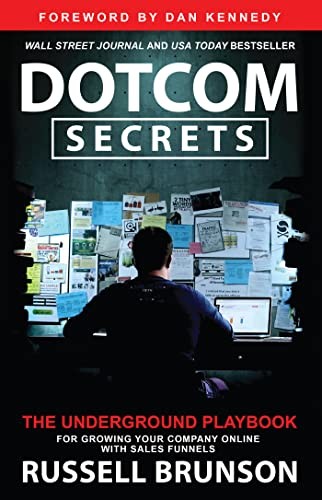
DotCom Secrets lays the value ladder and the funnel architecture. Expert Secrets builds the attractive character and the epiphany bridge. Traffic Secrets fills the hallway with the Dream 100 and the traffic you own. Three books, one worldview: control the next step.
Affiliate links. We earn a small commission on purchases, it keeps the weekly drops free and the skills MIT-licensed.
◆ Get The Skill
Want the Funnel Audit done for you?
The Brunson skill checks your value ladder for missing rungs first, then runs hook-story-offer against your highest-traffic page, then checks whether your front-end offer actually delivers. It returns the first gap and the specific fix. Free. MIT licensed.
Launch (the value ladder, the Perfect Webinar sequence, the launch funnel), Write (hook-story-offer on any page, the epiphany bridge), Pricing (the value ladder rungs, continuity placement, front-end to backend pricing).
Pairs with
Hormozi (the offer that sits inside the funnel); Kennedy (the direct-response lineage under the mechanics); Robbins + Hill (the belief change inside the epiphany bridge); Godin (permission earned over time versus pressure applied in one session); Trigger Triumvirate (the sentence-level copy that walks the hallway).
Output shape
When the skill leans on Brunson, it should check the value ladder for a missing rung first, then check hook-story-offer sequencing on the page in question, then check whether the front-end offer actually delivers rather than teasing, and only then evaluate traffic source and continuity. Diagnose in that order.
The Silent DiagnosticDoes this page have one door, or does it hand the visitor a menu of ways to leave before the offer was ever made?