Week 30 / 52Offers & Funnels · Direct response orthodoxy
Every Ad Asks for the Order, or It Is Wallpaper
Ruthless offers, hard deadlines, and the money math of direct response. Kennedy's rule: if it cannot be measured and it does not ask for action, kill it.
From:The Kennedy No B.S. ComboAuthor:Dan KennedyDate:Mar 22, 2027Pages:2 works
Dan Kennedy has a favorite villain, and it is not a competitor. It is the ad that wins a design award, gets framed in the lobby, and sells absolutely nothing. He has watched agencies stand up in conference rooms and applaud a beautiful piece of brand image work while the client's sales stay flat, and he considers that a small crime. Pretty and profitable are not the same thing, and Kennedy built an entire career on the gap between them.
His rule is almost insulting in its simplicity. Every ad, every email, every letter you send has to ask for a specific, measurable action, right now, from a specific person. Not awareness. Not impressions. Not a warm feeling about the brand. An action you can count by tomorrow morning. If a piece of marketing cannot be judged on response, in his world it does not get judged at all. It gets killed.
But Kennedy does not start with the copy, and this is the part people rush past. He starts with the message, then matches it to the market, then picks the media, in that order, because a brilliant message aimed at the wrong crowd is just noise with good grammar. And underneath all three sits a ruthlessly defined customer, someone specific enough that you could describe their kitchen table, paired with a deadline that makes waiting actually cost the reader something. No deadline, no urgency. No urgency, no sale today. And if there is no sale today, Kennedy would tell you that you are not marketing. You are decorating.
Grab whatever you drink that is not coffee, because Kennedy does not care what is in your mug. He cares whether your next campaign asks for the order.
◆ ◆ ◆
◆ Audio Overview
Prefer to listen?
The chapter as a listen: message to market match, real deadlines, and accountability for every dollar. Kennedy, undiluted.
No B.S. Direct Marketing · Audio Overview
0:00/12:57
The Thesis
Direct-response discipline, a measurable action, a real deadline, a ruthlessly defined customer, and premium pricing, beats brand-image marketing for any business that needs sales now instead of someday. Kennedy's whole system is an argument against unaccountable spending: if you cannot trace a dollar of marketing to a dollar of response, you are not doing marketing, you are doing decoration with a budget line. The businesses that win are the ones that treat every piece of copy as an experiment with a scoreboard.
Cite Kennedy for offers, sales copy, promotions, pricing posture, and any campaign that must produce measurable response.
◆ ◆ ◆
02The Architecture
Ten frameworks. Measurable response, deadlines, and premium posture.
Framework 01
Direct Marketing Rules for Every Business
What it is
Kennedy's foundational claim: every business, not just mail-order catalogs, should market like a direct marketer. That means measuring results, tracking response by source, and treating any spend you cannot trace to a result as a cost, not an investment. Brand awareness is a byproduct of good direct response, never the goal on its own.
Marketing use
Before approving any campaign, ask what specific number will tell you it worked. If nobody can answer, the campaign is not ready to run. Build the tracking (a code, a link, a phone extension) before the launch, not after.
"Per Kennedy's direct-marketing rules, every business should measure response by source and treat unmeasurable spending as a cost rather than an investment, because brand awareness earned this way is a byproduct, not a goal."
Framework 02
Message to Market to Media
What it is
Kennedy's sequencing law. Decide the message first (what are we actually saying and offering), then the market (who specifically wants to hear it), then the media (where do we reach them). Most marketers do this backward, picking a channel because it is trendy, then forcing a message into it, then hoping a market shows up.
Marketing use
Write your message and define your market before you touch a media plan. A right message to the wrong market fails quietly. A weak message to the right market still gets a response. Fix the order and the whole campaign gets easier.
"Per Kennedy's message-to-market-to-media sequence, deciding the message and the market before the channel prevents the common failure of forcing an offer into a trendy platform and hoping a buyer shows up."
Framework 03
The Irresistible Offer with a Deadline
What it is
An offer without a deadline is a suggestion, not an offer. Kennedy treats the deadline as a required structural piece, not an optional add-on, because a reader who can act anytime will act never. The offer itself has to be genuinely strong, stacked value, a real discount, a reason it makes sense right now, not just decorated with urgency language.
Marketing use
Never publish an offer without a stated end date, a stated quantity limit, or a stated reason the terms change after a point in time. If you cannot attach a real deadline, the offer is not finished yet, keep building it until one exists honestly.
"Per Kennedy's irresistible-offer rule, an offer without a genuine deadline is a suggestion, and a suggestion produces action later, which in direct response means it produces action never."
Framework 04
Magnetic Marketing
What it is
Kennedy's model for attracting the right customers instead of chasing them. A magnetic business has a defined identity, a defined ideal customer, and a defined offer sharp enough that the right people self-select toward it and the wrong people self-select away. Chasing every possible buyer waters down the message until it attracts nobody strongly.
Marketing use
Sharpen your positioning until some prospects opt out on purpose. That is not a loss, that is the magnet working. A message built to appeal to everyone ends up compelling to no one, because specificity is what creates pull.
"Per Kennedy's magnetic marketing model, a sharply defined identity and offer causes the right customers to self-select toward you and the wrong ones to self-select away, which is the system working as designed, not a failure to reach everyone."
Framework 05
The Ruthlessly Defined Ideal Customer
What it is
Kennedy pushes past loose demographics into a customer so specific you could describe their frustrations, their budget, and what they already tried and hated. Vague targeting produces vague copy. A ruthlessly defined customer produces copy that reads like a private letter to one person.
Marketing use
Write down who this is not, as clearly as who it is. Exclude the customers who cost you more in service and complaints than they are worth in revenue. Aiming at everyone is aiming at no one with better production values.
"Per Kennedy's ruthlessly-defined-customer standard, copy aimed at a specific, describable person outperforms copy aimed at a loose demographic, because specificity is what lets the reader feel personally addressed."
Framework 06
Results-Based Everything
What it is
Kennedy's accountability standard applied to spend, not just copy. Every dollar in the marketing budget should be traceable to a return, and every vendor, every agency, every campaign should be judged on ROI, not on how clever the work looks in a portfolio. He treats unaccountable brand spending as a tax the business pays for lacking discipline.
Marketing use
Build a simple ledger: source, cost, response, revenue. If a line item cannot populate all four columns within a reasonable window, question whether it belongs in the budget at all. Clever is not a column on this ledger.
"Per Kennedy's results-based standard, every marketing expenditure should populate a ledger of source, cost, response, and revenue, and any line item that cannot be measured this way is a candidate for the cut list, regardless of how polished it looks."
Framework 07
Premium Pricing and Price Confidence
What it is
Kennedy argues against competing on price, calling it the strategy of the desperate and the undifferentiated. He pushes clients toward premium positioning: charge more, deliver a stronger guarantee, and let the higher price itself signal quality to a market that reads cheap as risky.
Marketing use
Raise your price before you cut it. Add a bonus, a guarantee, or a scarcity element instead of a discount. A confidently priced offer with a strong guarantee converts better among buyers who are not looking for the cheapest option, which is most of your best customers.
"Per Kennedy's premium-pricing stance, competing on price signals desperation and attracts the least loyal buyers, while a confidently high price paired with a strong guarantee attracts buyers who value the outcome over the discount."
Framework 08
The Follow-Up Sequence
What it is
Kennedy's most quoted principle: the fortune is in the follow-up. Most sales do not happen on the first contact, and most businesses stop following up after one or two attempts, abandoning the majority of the revenue sitting in their own list. A structured follow-up sequence, timed and scripted in advance, recovers that revenue systematically.
Marketing use
Build a follow-up sequence before the campaign launches, not after the first batch of non-responders shows up. Map at least seven to twelve touches across multiple formats, letter, email, call, before you consider a lead genuinely cold.
"Per Kennedy's follow-up principle, the majority of revenue in most businesses is sitting unclaimed in leads that received one or two contacts and then silence, and a scripted, multi-touch sequence recovers it systematically."
Framework 09
Take-Away Selling and Posture
What it is
Kennedy borrows a negotiator's move for marketing: signal that you can walk away, that not everyone qualifies, that the offer might not be for the reader. Chasing a prospect too visibly repels them. A seller with posture, willing to lose the sale rather than beg for it, reads as more credible and more desirable.
Marketing use
Write at least one line into your sales copy or your sales process that gives the prospect a graceful, low-status exit, and mean it. This is probably not for you if. Counterintuitively, this increases response from the buyers who are actually qualified.
"Per Kennedy's take-away selling, a seller who visibly can walk away from the sale reads as more credible than one who visibly cannot, and this posture increases response among genuinely qualified buyers rather than repelling them."
Framework 10
The No B.S. Accountability Standard
What it is
The umbrella principle behind Kennedy's entire body of work. He treats unaccountable brand spending, image advertising with no tracked response, as a management failure dressed up as marketing sophistication. Every other framework in this list exists to enforce this one standard: if you cannot trace it, you cannot defend it, and if you cannot defend it, cut it.
Marketing use
Audit your last twelve months of marketing spend and sort it into two piles: traceable to a measured result, and not. Whatever lands in the second pile needs a tracking mechanism added immediately or a budget cut applied without sentiment.
"Per Kennedy's no-B.S. accountability standard, marketing spend that cannot be traced to a measured result is a management failure wearing marketing's clothes, and the fix is either instrumentation or a cut, not a defense of the spend's sophistication."
◆ ◆ ◆
03Lexicon
Named terms a marketer should recognize on sight.
Direct response
Marketing built to produce a specific, measured, immediate action. Judge every piece by the response it produced, not the applause it got.
Message-market-media
Kennedy's required sequence: decide what you are saying, then who wants it, then where you reach them. Fix the order before you fix the channel.
Irresistible offer
A stacked, specific offer strong enough to compel action on its own. Build the value stack before you reach for a discount.
Deadline
A stated, real end date or limit that makes waiting cost something. No deadline means no offer, just a suggestion.
Magnetic marketing
A sharply defined identity and offer that attracts the right buyers and repels the wrong ones. Specificity creates the pull.
Ideal customer
A ruthlessly specific description of who this is for and who it is not. Write the exclusions as clearly as the inclusions.
Premium pricing
Charging more and backing it with a stronger guarantee, instead of competing on cost. A confident price signals quality to a market that reads cheap as risk.
Follow-up
The scripted, multi-touch sequence that recovers revenue from non-responders. The fortune is sitting in your list, not in your next new lead.
Take-away selling
Signaling you can walk away from the sale, that not everyone qualifies. Posture increases response among qualified buyers.
Accountability
The standard that every marketing dollar must trace to a measured result. If you cannot trace it, you cannot defend it.
◆ ◆ ◆
04Tactical Recipes
Plays you can run this week.
The Action Test. Read your next piece of copy and find the sentence that asks for the order. If there is not one specific, unmissable ask, the piece is not finished, it is a brochure wearing an ad's clothes.
The Deadline Add. Take your current live offer and add a stated end date, a stated quantity, or a stated price change. If you cannot attach a real one honestly, that is the actual problem to fix before you touch the copy again.
The Message-Market Match. Write your core message in one sentence, then write your ideal customer in one sentence. Read them together. If a stranger could not tell you why this message fits this market, fix the mismatch before picking a channel.
The Ideal-Customer Cut. List three types of customers you will now actively decline to serve. Naming the exclusion sharpens the message for everyone left, and it usually feels uncomfortable right up until it works.
The Premium Reframe. Take your lowest-priced offer and rewrite it thirty percent higher with one added guarantee or bonus stacked on top. Test it before assuming the market cannot bear it.
The Follow-Up Sequence. Map at least seven touches for anyone who responds but does not buy: a mix of email, direct mail, and a call, spaced over thirty to sixty days, scripted in advance.
The Take-Away Line. Add one sentence to your sales copy that gives a qualified-sounding reason a reader might not be right for this. Watch what happens to your close rate among the buyers who stay.
The ROI Kill Switch. Pull your last twelve months of marketing spend and sort every line into traced-to-a-result or not traced. Anything in the second column gets a tracking mechanism this week or gets cut next month.
The Response Tracker. Before your next campaign goes live, build the simplest possible tracking, a unique code, a unique link, a unique phone extension, so the response is countable from the first reply forward.
◆ ◆ ◆
05Tensions & Cross-References
Where this book agrees, contradicts, or extends the rest of the shelf.
Extends
Hormozi (Q3). Kennedy's irresistible offer is the ancestor of Hormozi's grand-slam offer stack. Hormozi formalizes the value-equation math; Kennedy supplied the deadline and the ruthless customer definition the stack still depends on.
Pairs with
Trigger Triumvirate (Q4). Kennedy's message-market-media law decides who gets the copy; Sugarman and Halbert's triggers decide what the copy does once it arrives. Kennedy picks the crowd, the Triumvirate greases the slide.
Extends
Hopkins (Foundations). Kennedy's measurable-response standard is Hopkins's scientific advertising updated for direct mail, infomercials, and later the inbox. Same demand, count everything, different decade.
Tension with
Sharp (Q2). Sharp argues brand-building through broad reach compounds over years and should not be judged campaign by campaign. Kennedy would call most of that spending unaccountable. Both are right for different time horizons: Kennedy for the business that needs revenue this quarter, Sharp for the one building category memory over a decade.
Tension with
Abraham (Q1). Abraham's strategy of preeminence argues for advising the customer with such generosity that the sale becomes almost incidental, a trust-first posture. Kennedy argues for pressure: a real deadline, a specific ask, a reason to act today. The tension is real and worth holding, generosity builds the relationship, pressure closes the transaction, and most businesses need both, sequenced correctly.
Extends
Halbert (Q4). Kennedy and Halbert share the same direct-response lineage and the same contempt for image advertising that cannot be measured. Halbert supplies the starving-crowd law and the craft of the letter; Kennedy supplies the systemization, the follow-up sequence, and the pricing posture around it.
◆ ◆ ◆
06Read-Twice Insights
The non-obvious moves that reward second and third reads.
The award-winning ad and the profitable ad are rarely the same ad. Kennedy's career is built on this gap. A campaign judged by a creative committee optimizes for applause. A campaign judged by response optimizes for revenue. Pick which room gets to grade your work.
A deadline is not decoration, it is the mechanism that converts intention into action. Readers who can act anytime experience no cost for waiting, and waiting with no cost turns into waiting forever. The deadline is what makes today different from someday.
Most of the revenue in a business is sitting in a list of people who almost bought. The follow-up sequence recovers it, but only if it exists before the first batch of non-responders shows up, not scrambled together after.
Excluding a customer on purpose is a form of targeting, not a loss of revenue. A ruthlessly defined ideal customer produces sharper copy precisely because it stops trying to be everything to everyone. The exclusion is doing work the inclusion cannot do alone.
Premium pricing is a message before it is a number. Charging more says something to the market about confidence and quality that a discount can never say, and Kennedy treats that signal as part of the product, not separate from it.
Take-away posture works because chasing visibly lowers status. A prospect can smell desperation in copy the same way they can smell it in a person, and the seller willing to lose the sale reads as the seller worth trusting with it.
◆ ◆ ◆
07Citation-Grade Quotes
Pull-able lines for output. Click any quote to copy it formatted for social.
"The money is in the follow-up."
Dan Kennedy
"If you are marketing without a deadline, you are not marketing, you are decorating."
Dan Kennedy, No B.S. Direct Marketing
"All marketing is direct marketing, or should be treated as such."
Dan Kennedy, No B.S. Direct Marketing
"You cannot be all things to all people and still be magnetic to anyone."
Dan Kennedy, Magnetic Marketing, paraphrased
"An offer without urgency is just a suggestion."
Dan Kennedy, No B.S. Direct Marketing, paraphrased
◆ Apply This Week
One ask. One deadline.
Pull up the one piece of active marketing you are least sure is working, an email series, a landing page, a promotion that has been live for a while without a clear number attached to it.
Run it through the standard Kennedy would apply before he would let it stay live.
The action: Find the specific, measurable action this piece asks the reader to take right now. If you cannot point to the sentence, the piece is not finished.
The deadline: Add a real end date, quantity limit, or price change, and state it plainly. If you cannot attach an honest one, that is the actual problem.
The ideal customer: Write, in one ruthless sentence, exactly who this is for and who it is not. Cut anything in the copy that is trying to please the second group.
Ship the revised version this week and track the response against the version it replaced. Let the number, not the meeting, decide if it worked.
That is week thirty. One ask, one deadline, one ruthlessly defined customer. See you Monday.
◆ Going Deeper
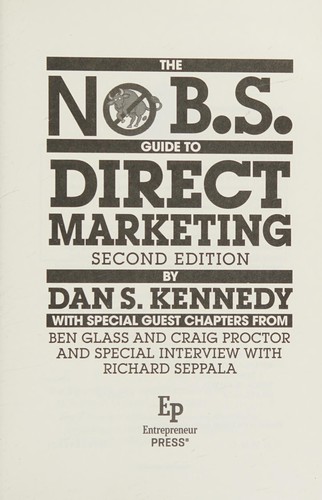
The source: The Kennedy No B.S. Combo
DAN KENNEDY · DIRECT RESPONSE ORTHODOXY
No B.S. Direct Marketing lays out the accountability standard and the follow-up math. Magnetic Marketing lays out the identity, the ideal customer, and the offer that attracts instead of chases. Read together, they are the closest thing direct response has to a house style guide.
Affiliate links. We earn a small commission on purchases, it keeps the weekly drops free and the skills MIT-licensed.
◆ Get The Skill
Want the Response Audit done for you?
The Kennedy skill checks whether the piece asks for a specific measurable action, then whether it carries a real deadline, then whether it is aimed at a ruthlessly defined customer, then whether the pricing posture is premium or apologetic. It returns the first gate the piece fails and the fix. Free. MIT licensed.
Write (offers, sales copy, promotions), Launch (the deadline and follow-up sequence around a campaign), Pricing (premium posture and the guarantee stack).
Pairs with
Hormozi (the offer stack Kennedy's deadline and customer definition feed into); Trigger Triumvirate (the copy triggers once Kennedy has picked the market); Hopkins (the measurable-response root); Sharp (the brand-building counterweight for a longer time horizon); Abraham (the preeminence posture that trades pressure for trust); Halbert (the shared direct-response lineage).
Output shape
When the skill leans on Kennedy, it should check the measurable action first (what specific response is this asking for), then the deadline (is there a real one stated), then the ideal-customer definition (who is this for and who is it explicitly not for), and only then the pricing posture. Diagnose in that order and name the first gate the piece fails.
The Silent DiagnosticDoes this piece ask a specific, ruthlessly defined customer to do one measurable thing by a real deadline, or are we running an ad that would win a design award and sell nothing?