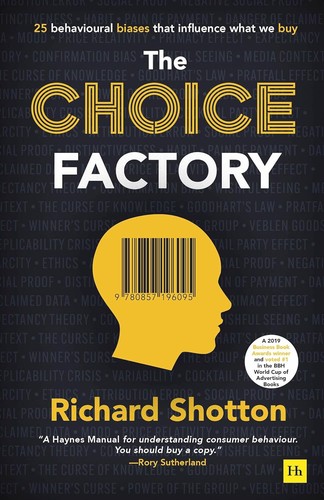
Not studies show hand-waving. Shotton runs the field experiments, so these are the behavioral biases that actually moved real money, one campaign at a time.
From:The Shotton TrilogyAuthor:Richard ShottonDate:Feb 8, 2027Pages:2 works
There used to be an ad for Avis that said, flat out, we are only number two in rental cars, so we try harder. Not a boast. An admission. And it worked, sales climbed for years off the back of a company telling you, in the headline, that it was not the best. There is an old story about a butter brand too, one that is famously stiff and hard to spread straight out of the fridge, a real flaw, never hidden, and people bought it anyway, in some tellings because of the honesty as much as the taste.
Both are examples of the pratfall effect. Admit one small, real flaw and the rest of your claims get more believable, not less. Perfection reads as a sales pitch. A flaw reads as a fact, and once a listener has one fact confirmed, they extend some trust to the rest of what you are telling them. It sounds backwards until you notice how often it shows up once you start looking for it.
Richard Shotton's entire career is built on noticing things like that and then refusing to leave them as a nice story. He runs the field experiment. He buys the media, splits the audience, measures the actual response, and reports the number, whether or not the number flatters the theory he started with. That is the difference between a chapter of psychology you half remember from a talk and a bias you can put into a brief on Monday morning with a straight face.
So this week is not a tour of a lab. It is a tour of the biases that made it out of the lab and into a real campaign, with a real result attached. Pour something that is not coffee, we are staying off that today on principle, and let us go through what actually held up.
◆ ◆ ◆
◆ Audio Overview
Prefer to listen?
The chapter as a listen: twenty-five biases with field evidence, and how to run them in live campaigns. Shotton, applied.
The Choice Factory · Audio Overview
0:00/14:09
The Thesis
Behavioral science is only useful to a marketer once it survives contact with real buyers spending real money, and that is exactly the bar Shotton holds every idea to. He runs the field test instead of quoting the lab, which means the biases in his books come with a campaign attached, not just a citation. These are the ones proven to move behavior outside a slide deck, ready to point at a real brief.
Cite Shotton for campaign tactics, for how a price gets displayed, for testing an ad before it airs, and for the question every planner eventually asks out loud, which bias actually works here.
◆ ◆ ◆
02The Architecture
Ten frameworks. Behavioral biases that hold up outside the lab.
Framework 01
The Field-Test Premise
What it is
Shotton's governing rule, stated as a method rather than a bias. An idea from behavioral science is not usable until it has been tested on real buyers making a real decision with real money on the table, not just nodded along to in a workshop. A study cited secondhand from a slide is not evidence a marketer can spend a budget on.
Marketing use
Before adopting any bias into a brief, ask whether it has been run in the field, on an actual audience, with an actual outcome measured. If the honest answer is nobody has tested this outside a classroom, treat it as a hypothesis worth a small trial, not as a rule worth a full launch.
"Per Shotton's field-test premise, a behavioral idea earns a place in a brief only once it has been tested on real buyers spending real money, not merely cited from a study."
Framework 02
The Pratfall Effect
What it is
An admitted flaw, one honest and minor imperfection stated plainly, raises the credibility of everything said around it. A brand that says something true and slightly unflattering about itself gets believed more on the claims that follow, because perfection reads as marketing and a flaw reads as a fact.
Marketing use
Find the one true, minor drawback of your product and say it out loud in the copy, once, plainly, before you list the strengths. Do not manufacture a fake flaw, the effect depends on the admission being real.
"Per Shotton's pratfall effect, admitting one true and minor flaw raises the credibility of the claims that follow it, because a confirmed fact earns trust that a flawless pitch cannot."
Framework 03
Social Proof, Made Specific
What it is
General social proof, everybody loves this, is weak. Specific social proof, a real count, a real group, a comparison to people like the reader, moves behavior because the brain checks a specific number against its own experience and a vague one against nothing at all.
Marketing use
Replace thousands of happy customers with the actual number, and tie it to a group the reader recognizes as like them. Nine out of ten dentists is a cliche precisely because specificity like that used to work, and it still does when the number is true and current.
"Per Shotton on specific social proof, a real number tied to a recognizable group moves behavior where a vague claim of popularity does not, because the brain can check a specific figure against its own experience."
Framework 04
Charm Pricing and Price Framing
What it is
How a price is displayed changes what people are willing to pay for the same product, independent of the actual number. Prices ending in nine read as meaningfully cheaper than the round number one below them, and the way a price is broken into smaller units, a day instead of a year, changes how large it feels.
Marketing use
Test charm pricing against a round number for your own offer rather than assuming either wins by default. Break an annual number into a daily or weekly figure when you want it to feel small, and show the annual total when you want it to feel like a serious, considered purchase.
"Per Shotton on price framing, the same number reads as a different size depending on how it is broken up and displayed, so the display is a lever worth testing on its own, separate from the price itself."
Framework 05
The Moment of Change
What it is
Habits are stickiest during ordinary weeks and weakest during a life event, a move, a birth, a new job, a breakup, when the old routine has already been interrupted and a new one has not yet formed. Shotton points to the research showing brand switching spikes hardest in these windows, not in the calm stretches between them.
Marketing use
Find the life events that precede a need for your category and target the window right after the change, not the steady state. A person who just moved, just had a child, or just started a new job is deciding new defaults for dozens of small habits at once, and your category can be one of them if you show up in that window.
"Per Shotton on the moment of change, brand switching concentrates around life events that interrupt an existing routine, which is why targeting the window after the change outperforms targeting the steady state."
Framework 06
Distinctive Assets and Mental Availability
What it is
A brand's color, shape, sound, or character can be recognized and attributed faster than its name can be read, and that speed of recognition is what wins a crowded shelf or a scrolling feed. Shotton treats distinctive assets as measurable, not aesthetic, testing whether people can actually name the brand from the color alone.
Marketing use
Identify the one or two assets your audience already attributes correctly to you, without the logo present, and protect those relentlessly across every execution instead of refreshing them for the sake of looking new. A distinctive asset that gets reset every campaign never has time to become distinctive.
"Per Shotton on distinctive assets, an asset only counts once an audience can attribute it to the brand with the name and logo hidden, which makes protecting it a measurable discipline, not a design preference."
Framework 07
The Power of the Specific
What it is
A concrete, specific number or claim is more persuasive and more memorable than a rounded or vague version of the same claim, because specificity signals that someone actually measured the thing rather than estimated it. Vagueness reads as marketing. A precise figure reads as a fact someone bothered to find out.
Marketing use
Replace every round number and vague superlative in a piece of copy with the real, specific figure, even when the specific figure is a little less tidy than the round one. Eighty seven percent beats almost ninety percent, and it beats it for the same reason the pratfall effect works, specificity reads as truth.
"Per Shotton's power of the specific, a precise and slightly untidy number outperforms a rounded one because precision signals measurement rather than estimation, and estimation reads as marketing."
Framework 08
Wisdom of Peers over Experts
What it is
People trust a recommendation from someone similar to them, a peer, more readily than the same recommendation from a distant expert or authority figure, particularly for everyday decisions rather than technical ones. Shotton's field tests show peer endorsement outperforming expert endorsement in categories where buyers see themselves as capable judges.
Marketing use
Match the endorser to the decision. For everyday, low-technical categories, feature people who look and sound like the buyer rather than a credentialed expert. Save the expert for genuinely technical claims where the buyer knows they cannot judge quality on their own.
"Per Shotton on the wisdom of peers, a recommendation from someone similar to the buyer outperforms the same recommendation from a distant expert in everyday categories, because the buyer trusts their own judgment enough to trust a peer's."
Framework 09
Extremeness Aversion and the Decoy
What it is
People avoid the most extreme option in a set and gravitate toward the middle, which means adding a third option can shift preference between the original two without changing either of them. A deliberately weaker or costlier decoy option makes one of the real choices look like the obvious, safe middle ground.
Marketing use
Add a third tier to a two-tier offer specifically to make one of the original two look like the sensible middle choice, and test which original option the decoy is meant to push people toward before you build it. The decoy rarely needs to sell itself, it only needs to exist.
"Per Shotton on extremeness aversion, adding a deliberately weaker or costlier third option shifts preference toward one of the original two by making it read as the safe middle ground."
Framework 10
Media Context Effects
What it is
The same ad performs differently depending on where it runs, because the surrounding content primes the audience's mood and attention before the ad even starts. Shotton's field tests show measurable swings in recall and preference based purely on the editorial or entertainment context around identical creative.
Marketing use
Match the emotional tone of the ad to the mood the surrounding content is likely to put the audience in, and test placement, not only creative, as a lever on its own. The exact same thirty seconds can outperform or underperform itself by several points depending only on what came before it.
"Per Shotton on media context effects, identical creative measurably shifts in recall and preference depending on the surrounding content, which makes placement a testable variable, not a fixed cost of media buying."
Framework 11
The Field-Test Setup
What it is
Shotton's practical template for running these ideas as a real experiment rather than a hunch. Split the audience, hold one condition constant, change one variable, and measure an actual behavior, not a stated preference or a survey answer about intent.
Marketing use
Before rolling a bias out across a full campaign, run it as a controlled split first, one true variable changed, one number to watch. A stated preference in a focus group is not the same evidence as a real purchase in a real split test, and Shotton trusts only the second.
"Per Shotton's field-test setup, a bias is worth scaling only after a controlled split test on real behavior, not a stated preference, confirms it moves the number in the wild."
◆ ◆ ◆
03Lexicon
Named terms a marketer should recognize on sight.
Pratfall effect
An admitted flaw that raises overall credibility. Say the true drawback once, plainly, before the strengths.
Distinctive asset
A color, shape, sound, or character attributable to the brand alone. Protect it, do not refresh it for novelty.
Mental availability
How easily a brand comes to mind in a buying moment. Win recognition speed, not just recall.
Charm pricing
A price ending in nine reading as smaller than the round number below it. Test it, do not assume it wins by default.
Moment of change
A life event that interrupts existing habits and defaults. Target the window right after, not the steady state.
Extremeness aversion
The pull toward the middle option in a set. Add a decoy to make one real option the safe middle.
Decoy
A deliberately weaker or costlier third option. It shifts preference without needing to sell itself.
Social proof
Evidence that others have chosen the same thing. Make it specific and current, or it reads as noise.
Specificity
A precise, slightly untidy number over a round one. Precision signals measurement, vagueness signals marketing.
Context effect
The surrounding content changing how identical creative lands. Test placement as its own lever, not a fixed cost.
◆ ◆ ◆
04Tactical Recipes
Plays you can run this week.
The Pratfall Insert. Find the one true, minor drawback of your product and state it plainly in the copy, once, before the strengths. Never manufacture a flaw, the effect only works when the admission is real.
The Specific-Number Swap. Go through your best-performing piece of copy and replace every round number and vague superlative with the real, specific figure, even the untidy ones.
The Life-Event Trigger. List the life events, a move, a new job, a birth, that precede a first purchase in your category, and build a targeting window aimed at the weeks right after each one.
The Distinctive-Asset Audit. Show your ad or package with the logo and name hidden and ask people to name the brand. Whatever they get right without the name is your distinctive asset. Protect it.
The Decoy Build. Add a third, deliberately weaker or costlier tier to your two-tier offer, aimed at making one specific original tier read as the sensible middle choice. Decide the target before you build the decoy.
The Peer-Proof Line. For an everyday, low-technical decision, swap an expert endorsement for a peer one, someone who looks and sounds like the buyer, and test the two against each other.
The Charm-Price Test. Run the same offer at a round price and a nine-ending price against each other. Do not assume which one wins, Shotton did not, that is the point of testing it.
The Context Placement. Before buying media, ask what mood the surrounding content puts the audience in, and match or deliberately contrast your ad's tone to that mood, then test the placement as its own variable.
The Field-Test Setup. Before scaling any bias into a full campaign, run a controlled split first, one variable changed, one real behavior measured, not a stated preference from a survey or focus group.
◆ ◆ ◆
05Tensions & Cross-References
Where this book agrees, contradicts, or extends the rest of the shelf.
Extends
Behavioral Operators (Q4). Shotton hands the operators a field-tested bias with a citation attached, ready to load straight into a brief. Where the operators ask which lever to pull, Shotton is the evidence that the lever actually moves.
Operationalizes
Cialdini (Q2). Cialdini named social proof as a principle of influence. Shotton runs it in the field and reports back that vague popularity claims underperform a specific number tied to a recognizable group, a sharper version of the same principle.
Extends
Ariely (Q3). Ariely's decoys and anchors come out of the lab, carefully controlled and clean. Shotton takes the same mechanics, extremeness aversion and framing, into a real media budget and checks whether the effect survives real noise. Mostly, it does.
Sets up
Sharp (Q2). Distinctive assets and mental availability are Sharp's territory in theory. Shotton supplies the field method for measuring whether an asset is actually distinctive, hide the logo and ask people to name the brand, rather than assuming it from a brand guideline.
Pairs with
Kahneman (Q3). The biases themselves, the pratfall effect, extremeness aversion, specificity, are System 1 shortcuts Kahneman catalogued from the inside of the mind. Shotton is the same catalogue tested from the outside, on a real audience with money in the room.
Tension with
untested studies-show folklore. A large share of behavioral marketing advice circulates as a half-remembered study cited secondhand, with no field test behind it. Shotton's whole method is a standing objection to that habit, cite the number only once someone has actually run it.
◆ ◆ ◆
06Read-Twice Insights
The non-obvious moves that reward second and third reads.
The flaw is not a weakness you are managing, it is a credibility tool you are wasting. Most brands hide every imperfection out of instinct. Shotton's field data says the hidden flaw was quietly costing belief in everything else the brand said.
A vague number and no number do almost the same amount of work. Thousands of happy customers barely outperforms nothing at all, because the brain has nothing concrete to check it against. The actual count is doing work the word thousands never could.
The best targeting window is not a persona, it is a calendar date. A life event beats a demographic for predicting when someone will actually switch brands, because the event, not the profile, is what broke the old habit loose.
Consistency is the whole game with a distinctive asset, and it is also the hardest discipline to hold. Every rebrand resets recognition speed back toward zero. The asset that survived five years of campaigns is worth more than the fresh one launched last quarter.
A decoy does not need to be good, it needs to exist. The weaker third option rarely sells a single unit on its own. Its entire job is changing what the other two look like next to it.
The same thirty seconds of creative is not one ad, it is as many ads as there are contexts to run it in. Media context effects mean the buy is not just reach and frequency, it is mood, and mood is a variable most planners never test.
◆ ◆ ◆
07Citation-Grade Quotes
Pull-able lines for output. Click any quote to copy it formatted for social.
"A flaw, admitted, makes every other claim more believable."
Richard Shotton, The Choice Factory
"Behavioural science is only useful if it survives contact with the real world."
Richard Shotton
"A specific number is more persuasive than a round one, because it sounds like it was actually measured."
Richard Shotton, The Illusion of Choice
"People switch brands most often in the weeks after their life has already changed, not in the calm in between."
Richard Shotton, The Illusion of Choice
"You can win a preference between two options simply by adding a third one nobody was ever meant to choose."
Richard Shotton, The Choice Factory
◆ Apply This Week
One bias. One honest admission.
Pick the campaign or piece of copy you are running right now, the one already live or about to go out the door.
Do not overhaul the whole thing. Make three specific, field-testable moves and watch what happens to the number.
The bias to test: Choose one framework from this week, the pratfall effect, a decoy tier, a peer endorsement, and run it as a real split against your current version, not as a wholesale replacement.
The specific number: Find the vaguest claim in your current copy and replace it with the real, specific figure behind it, even if the real figure is a little less tidy.
The flaw you can honestly admit: Name the one true, minor drawback of what you are selling and say it once, plainly, before the strengths, and only if it is actually true.
Run the split, watch the actual behavior, not the stated preference, and keep only the version that moved the number.
That is week twenty four. One bias. One honest admission. Behavioral science that already survived contact with a real buyer. See you Monday.
◆ Going Deeper
The source: The Shotton Trilogy
RICHARD SHOTTON · FIELD-TESTED BIASES
The Choice Factory and The Illusion of Choice are Shotton running the same discipline twice, taking a behavioral bias out of the academic paper and into a real media budget, then reporting the number whether or not it flattered the theory. Two short books, twenty five biases, all of them tested on real buyers.
Affiliate links. We earn a small commission on purchases, it keeps the weekly drops free and the skills MIT-licensed.
◆ Get The Skill
Want the Bias Field-Test Audit done for you?
The Shotton skill checks whether a bias has actually been field-tested before it goes in a brief, then looks for a real, honest flaw worth admitting, then a vague claim worth making specific, and returns the one move worth testing first. Free. MIT licensed.
Audit (the bias field-test scan on a live campaign), Write (the pratfall insert, the specificity sweep), Diagnose (why a bias everyone quotes is not actually moving the number).
Pairs with
Behavioral Operators (a field-tested lever ready to load into a brief); Cialdini (social proof, sharpened by a real test); Ariely (decoys and anchors, checked against real media noise); Sharp (distinctive assets, with a method for proving one is real); Kahneman (the same biases, seen from inside the mind and then from outside it).
Output shape
When the skill leans on Shotton, it should check first whether the bias under discussion has actually been field-tested rather than merely cited, then look for a true flaw worth admitting, then a vague claim worth making specific, and only then move to framing, decoys, or placement. Diagnose in that order and flag any studies-show claim with no real test behind it.
The Silent DiagnosticHas this bias actually been tested on real buyers spending real money, or are we about to build a campaign on a slide someone half remembers from a talk?