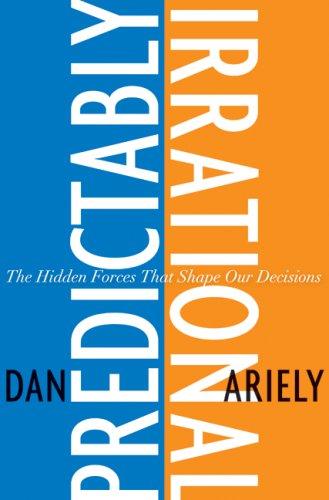
In 2007, Dan Ariely's lab at MIT noticed something odd in the Economist's subscription page. The page offered three options:
Web only: $59 Print only: $125 Print + Web: $125
Why is "Print only" priced identically to "Print + Web"? Nobody would pick it. Ariely tested it: with all three options, 84% chose Print + Web. Remove the obviously-pointless Print-only option, and conversion to Print + Web collapsed to 32%.
The "useless" middle option wasn't useless, it was the decoy. It made the high-tier feel obvious. Take it away, and the math nobody was doing consciously stopped quietly running in the buyer's head.
This is the chapter where the cognitive science we've been laying down (Cialdini Wk 1, Kahneman Wk 2, Sutherland Wk 3) finally gets the experiments. Ariely is the experimentalist who showed, under controlled lab conditions, that humans are irrational in patterns you can predict and exploit. Not random. Predictable. Reliably exploitable.
You read Hopkins (Wk 04), the what. You read Hormozi last week, the math. Ariely has the experiments that show why all of it works.
Pour yourself something that isn't coffee. We're going to the lab.
◆ Audio Overview
Prefer to listen?
The chapter as a listen: decoys, the cost of zero, anchoring, and ownership bias. Press play, take Ariely with you.
Predictably Irrational · Audio Overview
0:00/14:26
◆ ◆ ◆
The Thesis
Humans aren't randomly irrational, we're predictably irrational. The same biases fire in the same conditions across populations and cultures, which means marketers and pricing operators can engineer them deliberately.
Ariely is the experimentalist's bridge between Kahneman's cognitive psychology and the marketer's pricing page. Cite him on decoy effects, anchoring tactics, "free" as a category change, market vs. social norms, default-design, and the endowment-driven valuation gap.
◆ ◆ ◆
02The Architecture
Ten frameworks. The MIT lab's gift to the marketer's pricing page.
Framework 01
The Decoy Effect (Asymmetric Dominance)
What it is
When a third option is added that's obviously dominated by one of the first two, choices shift dramatically toward the dominating option. The decoy isn't there to be picked; it's there to make a target option feel obvious.
Marketing use
Three-tier pricing pages are this principle weaponized. Lead with a premium decoy that almost nobody picks; the middle tier becomes the "obvious" choice. Most pricing pages that work are decoy-engineered.
"Per Ariely's decoy effect, adding an asymmetrically-dominated third option shifts choice dramatically toward the dominating option."
Framework 02
Anchoring (Arbitrary Coherence)
What it is
Even arbitrary numbers anchor subsequent valuations. Ariely's classic experiment: students wrote down the last two digits of their SSN, then bid on items. High-SSN-digit students bid 60-120% more. The number: completely unrelated: anchored the valuation.
Marketing use
Lead the price page with the high tier. Show "compare at $499" before "$199." Donation sliders pre-set high. Even arbitrary anchors work; non-arbitrary anchors work harder.
"Per Ariely's arbitrary-coherence principle, even unrelated numbers anchor valuation: lead the page with the high anchor."
Framework 03
The Power of Free (Zero Is a Different Category)
What it is
"Free" doesn't operate on the same continuum as paid. The drop from $1 to $0 produces dramatically more behavior change than the drop from $20 to $19. Zero is psychologically a different category: a no-risk category.
Marketing use
Free trial > $1 trial. Free shipping > "$5 off shipping." The category-flip from "tiny cost" to "no cost" produces conversion lifts the price math cannot explain.
"Per Ariely's zero-cost principle, 'free' is a different psychological category from 'cheap': the drop from $1 to $0 produces disproportionate behavior change."
Framework 04
Market Norms vs. Social Norms
What it is
Two separate operating systems for human relationships. Market norms = transactional. Social norms = relational, communal, gift-economy. Mix them and the social side collapses, often permanently.
Marketing use
Be deliberate about which norm you're invoking. Community-driven brands live on social norms: introducing market norms (paid contests, financial incentives) collapses engagement. Transactional services live on market norms: pretending they're "family" reads as fake.
"Per Ariely's market-vs-social-norms distinction, mixing the two collapses social-norm engagement: community-driven brands are particularly fragile to market-norm invasion."
Framework 05
The Cost of Zero Cost (Free's Trap)
What it is
The flip side of the power of free. People consume free things they don't want, and pile up "free" obligations they can't honor. Free-trial conversion is often worse than paid-trial conversion because the buyer never seriously evaluated.
Marketing use
Friction-zero free trials lift signups and depress activations. The fix: a small commitment cost (credit card, brief setup, opening goal) that filters for real intent.
"Per Ariely, free trials with zero commitment depress activation: a small filter-cost preserves intent."
Framework 06
The Endowment Effect (Ownership Inflates Value)
What it is
Once we own something, we value it 2-3x more than we'd pay to acquire it. Demonstrated in the Duke basketball-ticket experiments. The mechanism: loss-aversion attached to ownership.
Marketing use
Free trials work partly because of endowment. "Configure your own version" works because configuration creates pseudo-ownership. "Take it home / try for 30 days" leverages real-ownership endowment.
"Per Ariely's endowment-effect research, once we own something we value it 2-3x more than we'd pay to acquire it."
Framework 07
The Procrastination Problem (Pre-Commitment)
What it is
People consistently procrastinate against their own self-interest. Ariely's classroom experiment: students with externally-enforced deadlines outperformed self-deadline students who outperformed no-deadline students. External commitment > self commitment > none.
Marketing use
Default settings, automatic re-orders, scheduled commitments, public goals. The product that handles procrastination for the buyer outperforms the product that requires self-discipline.
People in emotionally activated ("hot") states make different decisions than the same people in calm ("cold") states. Predictions made in cold states underestimate hot-state behavior dramatically.
Marketing use
Surveys are cold-state predictions of hot-state behavior. Trust observed behavior over stated preference. The buyer who says "I'd never buy that" in a focus group will buy it on the website at midnight.
"Per Ariely's hot/cold state research, surveys are cold-state predictions of hot-state behavior: observed behavior beats stated preference."
Framework 09
The Effect of Expectations (Placebo & Premium)
What it is
Expectations literally change subjective experience. Identical wine tastes better at higher price labels; identical pain medication works better when the buyer thinks it's expensive. Expectation alters perception, which is the only reality the buyer experiences.
Marketing use
Premium packaging, premium pricing, premium ritual all change the actual experience. The buyer who paid more actually enjoys the product more. Premium ritual is product, not theater.
"Per Ariely's expectations research, premium pricing and packaging actually improve the buyer's subjective experience: expectation alters perception."
Framework 10
Default Design (Self-Control Failures)
What it is
People reliably fail at self-control. Designs that substitute defaults for self-control outperform designs that require self-control. The 401(k) opt-in vs. opt-out experiment: opt-in participation hovers around 30-40%; opt-out participation hits 90%+.
Marketing use
Default-design every meaningful decision in the funnel. Default the higher-LTV plan. Default the annual billing. Default the recommended add-ons. Defaults shouldn't be coercive but should harness the procrastination tax in the buyer's favor.
Asymmetrically-dominated third option shifts choice. Three-tier pricing.
Arbitrary coherence
Even unrelated numbers anchor valuation. Lead with high anchor.
The power of free
Zero is a different category. "Free" > "$1" by orders of magnitude.
Market norms / social norms
Transactional vs. relational. Don't mix them.
Endowment effect
Ownership inflates value. Simulated ownership is real leverage.
Pre-commitment
Externally-enforced beats self-enforced. Defaults, auto-renew, public goals.
Hot/cold states
Surveys lie. Trust observed behavior over stated preference.
Expectations effect
Premium experience is real. Invest in premium ritual.
Default design
Opt-out beats opt-in. Default the higher-LTV path.
Zero-cost trap
Free trials depress activation. Small filter-cost preserves intent.
◆ ◆ ◆
04Tactical Recipes
Specific moves you can ship by Friday.
The Decoy Pricing Page. Three tiers. Premium tier almost nobody picks (this is the decoy). Middle tier looks "obvious." Conversion to middle lifts dramatically vs. two-tier alternatives.
The Arbitrary Anchor Hero. Lead any sales page with the high anchor. "Compare at $999 / Now $299" outperforms "$299" by significant margins.
The Free Threshold Test. A/B test "free + $5 shipping" vs. "$0.99 + free shipping." The math nets the same; the conversion almost always favors free + shipping.
The Social-Norm Audit. Check community/audience-driven products for accidental market-norm invasion. Paid contests in volunteer communities. Cash incentives for organic content. Each is a collapse risk.
The Endowment Funnel. Build pseudo-ownership before purchase. Configure-your-own. "Save your settings." "Continue where you left off."
The Procrastination Default. Default the recommended (higher-LTV) plan. Default the annual billing. Default opt-in to renewal. Default-design is policy, not UX detail.
The Hot-State Capture. Capture commitment when the buyer is in a hot state, right after a successful demo, the email immediately following an aha-moment.
The Premium-Ritual Investment. Premium pricing requires premium ritual. Heavier packaging, slower onboarding, higher-touch first interaction.
The Filter-Cost Trial. Add a small commitment to free trials, credit card, brief setup, opening goal. Activation rates lift.
The Decoy Add-On. Pricing add-ons can use decoy structure. "Standard support / Priority support / White-glove", middle becomes obvious.
◆ ◆ ◆
05Tensions & Cross-References
Where Ariely agrees, contradicts, or extends the rest of the shelf.
Experimental sequel to
Kahneman.Predictably Irrational operationalizes much of Thinking, Fast and Slow with controlled experiments. Kahneman has the framework; Ariely has the lab evidence.
Cialdini. Decoy = a form of contrast principle. Anchoring = a setup for commitment. Free = a form of reciprocation. Cialdini named these patterns; Ariely controlled-tested them.
Pairs with
Sutherland, Alchemy. The expectations-effect research is the experimental backing for Sutherland's placebo principle.
Tension with
Pink, Drive. Ariely supports Pink's caution about over-incentivizing, but is happy to leverage market norms in transactional contexts.
Underwrites
The Trust Stack (Wk 39). Ariely's "expectations alter perception" is the substrate beneath premium-pricing's trust mechanism.
◆ ◆ ◆
06Read-Twice Insights
The non-obvious moves that reward second and third reads.
The decoy effect is the most under-deployed pricing-page move in B2B SaaS. Most pricing pages are two-tier or three-tier without engineered asymmetric dominance. Adding an actual decoy (a tier nobody is meant to pick) shifts conversion noticeably.
"Free" is a category-flip, not a price-drop. Marketers who treat free as "the cheapest price" miss the whole point. The buyer's brain doesn't continuously discount toward zero, there's a discontinuity at zero.
Surveys lie about emotional purchases consistently. The buyer who tells the focus group they'd never buy your product will buy it at 11pm on a Tuesday. Trust behavior over stated preference.
The opt-in vs. opt-out gap is the single largest "free conversion lift" in marketing. 50+ percentage-point swings from a single default change. Most teams don't even audit their defaults.
Premium ritual makes premium pricing real. The placebo effect is a measurable phenomenon, not marketing theater. The buyer who paid more actually enjoys it more.
The procrastination tax is what's killing your renewal rate. Customers who want to renew often don't because the renewal requires action. Auto-renew with friction-low cancellation outperforms manual-renew + reminders.
◆ ◆ ◆
07Citation-Grade Quotes
Pull-able lines for output. Click any quote to copy it formatted for social.
"We are not only irrational, we are predictably irrational."
Dan Ariely, Predictably Irrational · Introduction
"The decoy effect is the secret agent in more decisions than we could imagine."
Dan Ariely, Predictably Irrational · Ch. 1
"Zero is not just another price. It is an emotional hot button."
Dan Ariely, Predictably Irrational · Ch. 3
"When social norms collide with market norms, the social norms go away for a long, long time."
Dan Ariely, Predictably Irrational · Ch. 4
"We don't know what we want until we see it in context."
Dan Ariely, Predictably Irrational · Ch. 1
"Whenever we buy a new product, we tend to overestimate its value."
Dan Ariely, Predictably Irrational · Ch. 7, Endowment
◆ Apply This Week
One decoy. One default.
Open your pricing page. Count the tiers.
Two tiers? You're missing the decoy. Add a third, a premium tier nobody is meant to pick that makes the target tier feel obvious.
Three tiers? Audit whether the third is functioning as a decoy (very few buyers picking it). If yes, you're using the framework. If no, re-engineer.
One tier? Consider whether a "premium" version with an obvious-decoy structure could lift conversion to your single existing offer.
Then walk your funnel. Find one default that should change toward higher-LTV (annual billing, recommended plan, recommended add-on). Flip it. Don't change copy. Ship by Friday.
That's week twenty. One decoy. One default. See you Tuesday.
◆ Going Deeper
The source: Predictably Irrational
DAN ARIELY · 2008 · ~280 PP. · HARPERCOLLINS
The MIT lab's plain-English summary of two decades of behavioral-economics experiments. Every framework in this chapter has been replicated, peer-reviewed, and battle-tested.
Affiliate links. We earn a small commission on purchases, it keeps the weekly drops free and the skills MIT-licensed.
◆ Get The Skill
Want the decoy + default audit done for you?
The Predictably Irrational Audit (Ariely) skill scans any pricing page or funnel for missing decoy structure, weak anchors, free-vs-cheap framing errors, market-vs-social-norms collisions, and high-leverage default flips. Free. MIT licensed.
Output should always include (a) decoy-structure check on three-option offers, (b) default-design audit, (c) market-vs-social norms classification.
The Silent DiagnosticDoes this offer/funnel/page leverage decoy structure, smart defaults, and the free-as-category-flip, or is it leaving Ariely's predictable-irrationality lifts on the table?