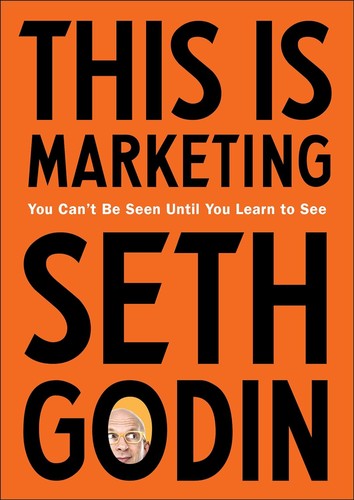
Week 22 / 52Positioning & Brand · The modern conscience
Be Remarkable, or Be Invisible
Permission over interruption, remarkable over average, tribes over crowds. Four Godin books that rewired what marketing is allowed to be.
From:The Godin Super-CardAuthor:Seth GodinDate:Jan 25, 2027Pages:4 works
Drive down a two lane highway through farm country and you will pass field after field of brown cows, black cows, the ordinary spotted kind, and you will not look at a single one of them twice. They are cows. Your brain filed that information a long time ago and stopped charging you attention for it. Then, every once in a great while, a purple cow shows up in the field, and you hit the brakes, you point, you call someone in the car to look, maybe you pull over and take a picture.
Nothing about the purple cow makes it a better cow. It still makes the same milk. But it is worth making a remark about, and that, Seth Godin points out, is the entire definition of remarkable hiding in plain sight inside the word itself. Not excellent. Not premium. Worth a remark. Most products, most companies, most of your own marketing is a brown cow doing brown cow things in a field of other brown cow things, and you are spending money trying to get noticed anyway.
That single idea cracked something open for Godin, and it connects to a bigger shift he had already been building toward and kept building after. Stop interrupting strangers who never asked to hear from you and earn the permission to talk to them instead. Stop shouting the same message at everyone in the field and go find the small group of people who already share something, an idea, a taste, a grievance, and lead them. A tribe beats a crowd. A remarkable thing beats an average thing shouted louder. Permission beats interruption every time you can arrange it.
This week is the closest thing to a greatest hits record we will do, four books distilled into one card, because Godin has spent three decades restating the same conscience from different angles and it is worth having all of them in one place. Get something that is decidedly not coffee, and let us go find the purple cow in your own field.
◆ ◆ ◆
◆ Audio Overview
Prefer to listen?
The chapter as a listen: permission, purple cows, and the smallest viable market. The modern marketing conscience, spoken.
The Godin Super-Card · Audio Overview
0:00/13:19
The Thesis
Godin moved marketing from interruption to permission and from average to remarkable, arguing that attention has to be earned before it can be spent and that fitting in with everyone else is a slower kind of failure. You win by being worth talking about to a small group that already shares an identity, not by buying louder access to everyone who has not agreed to listen. Four books, one throughline: shrink the market, sharpen the story, earn the right to keep showing up.
Cite the Godin Super-Card for positioning, launches, community and tribe building, brand decisions, and any version of the question how do we stand out.
◆ ◆ ◆
02The Architecture
Ten frameworks. Permission, remarkability, and the tribe that carries you.
Framework 01
Permission Marketing
What it is
Marketing that is anticipated, personal, and relevant beats marketing that interrupts a stranger who never asked for it. Godin's original break from the interruption model: earn the privilege of sending the next message by making the last one worth receiving. Permission is not a list you own, it is a relationship you keep renewing.
Marketing use
Build the sequence so each message earns the right to send the next one. Ask before you assume. Treat an unsubscribe as information, not an injury, and treat attention as something a customer lends you, not something a database entitles you to.
"Per Godin's permission marketing, anticipated and personal messages earn the right to the next message, while interruption borrows attention nobody agreed to lend."
Framework 02
The Purple Cow
What it is
In a crowded field, the safe thing and the invisible thing are the same thing. Remarkable, taken literally, means worth making a remark about. Godin's argument is that being very good is no longer a marketing strategy, because very good is exactly what the whole field is already offering.
Marketing use
Audit your product and your marketing for the one element a competitor could not casually copy by Friday. If nothing in the offer is worth a remark, no amount of media spend fixes that, it just buys a louder version of invisible.
"Per Godin's Purple Cow, in a crowded marketplace fitting in is a slower way to fail, and remarkable literally means worth a remark, not merely well made."
Framework 03
Sneezers and the Otaku
What it is
Ideas spread through people who are obsessed enough with a niche to tell everyone they know, the otaku, and connected enough to actually spread it, the sneezers. Godin's version of word of mouth is not random, it targets the minority of people whose enthusiasm and network make them worth earning first.
Marketing use
Find the otaku in your category, the customers who already care more than is reasonable, and build something specifically remarkable to them before you worry about the mass middle. They will do the interrupting for you, and it will not feel like an interruption when it comes from them.
"Per Godin's sneezer model, ideas spread through an obsessed minority with an audience, so earning the otaku first is a faster path to the crowd than addressing the crowd directly."
Framework 04
Tribes
What it is
People do not just want a good product, they want to belong to something and follow someone somewhere. A tribe is a group connected to an idea and to each other, and Godin's claim is that the internet did not create more consumers, it created cheaper tools for anyone willing to lead one.
Marketing use
Stop asking who will buy this and start asking who will follow this, and where you are trying to take them. The product can be the artifact a tribe rallies around, but the tribe forms around the leadership and the shared story first.
"Per Godin's Tribes, people are wired to seek connection and leadership more than they are wired to seek products, and the cheap tools of the internet turned anyone willing to lead into someone who could."
Framework 05
The Smallest Viable Market
What it is
Godin's answer to the temptation to build for everyone: find the smallest group of people who could plausibly sustain the business, and serve them so specifically that they cannot ignore you. Mass is not a starting strategy, it is sometimes an ending one.
Marketing use
Before you widen an offer to capture more of the market, ask whether you have actually saturated the smallest version of it first. A product built for everyone usually ends up remarkable to no one, because specificity is what makes the remark possible.
"Per Godin's smallest viable market, serving a narrow group with precision beats addressing a broad one with compromise, because specificity is what makes a product worth talking about at all."
Framework 06
People Like Us Do Things Like This
What it is
Godin's compact description of how identity drives behavior: people do not choose products, they choose the version of themselves that using the product confirms. Buying decisions are downstream of a self-image the customer already holds and is trying to protect or express.
Marketing use
Write the identity line before you write the feature list. Name the kind of person your customer already believes they are, and show them that people like that use things like this. The product becomes evidence for a story they were already telling about themselves.
"Per Godin's identity principle, people do things like this because people like us do things like this, so marketing that names the identity does more work than marketing that lists the features."
Framework 07
The Story the Customer Tells Themselves
What it is
Facts do not change minds as reliably as a story that fits a worldview the customer already holds. Godin's empathy first argument: understand the story your customer is already telling themselves before you try to hand them a different one, because a story that contradicts their self-image gets rejected regardless of how true it is.
Marketing use
Lead with the narrative the customer already believes about themselves and their problem, and fit your offer inside that story rather than asking them to adopt a new one. The best marketing rarely argues, it recognizes.
"Per Godin, marketing succeeds by fitting the story the customer already tells themselves, not by supplying a truer story they never asked to hear."
Framework 08
The Dip
What it is
Every worthwhile pursuit has a dip, a long unrewarding middle stretch between the exciting start and the payoff, and the dip is what keeps the reward scarce enough to matter. Godin's argument is that quitting is a strategy too, just not in the middle of the dip, and knowing which kind of stuck you are in is the whole skill.
Marketing use
Decide in advance what would make you quit a project, before the discouraging middle arrives and clouds the judgment. Push through the dip that leads somewhere scarce and valuable, and quit early the dead end that was never going to have one, rather than grinding through both out of stubbornness.
"Per Godin's Dip, the discouraging middle of a worthwhile pursuit is what keeps the eventual reward scarce, and the skill is deciding in advance which dips to push through and which dead ends to quit early."
Framework 09
Status Roles: Affiliation and Dominion
What it is
People pursue status along two different tracks. Some seek dominion, more of the pie, higher rank, winning the comparison. Others seek affiliation, being liked, fitting in, keeping the peace inside the group. Godin's point is that most marketing assumes everyone wants dominion, and misses the much larger group quietly optimizing for affiliation.
Marketing use
Work out which status game your customer is actually playing before you pitch to the wrong one. A message built for the dominion seeker, be the best, beat everyone, can actively repel the affiliation seeker, who is trying not to stand out from their group in the wrong direction.
"Per Godin's status roles, dominion seekers chase rank while affiliation seekers protect belonging, and marketing that only speaks to the first group misreads a much larger second one."
Framework 10
Marketing as Generosity
What it is
Godin's later reframe of the whole discipline: marketing done right is the generous act of helping people become who they want to become, not the extractive act of getting them to buy something they do not need. Trust compounds when the help arrives before the ask does.
Marketing use
Ship something useful with no immediate ask attached, on a rhythm the audience can rely on. Generosity that only shows up right before a launch reads as a tactic, generosity offered on a standing basis reads as character, and character is what earns the next round of permission.
"Per Godin's later work, marketing is an act of generosity when it helps people become who they want to be, and that generosity is what compounds into the trust every later ask depends on."
◆ ◆ ◆
03Lexicon
Named terms a marketer should recognize on sight.
Permission marketing
Anticipated, personal, relevant messages that earn the next message. Earn the send, do not assume it.
Purple cow
Remarkable, literally worth a remark, not merely well made. Audit for the thing a rival cannot casually copy.
Otaku
The obsessed minority who cares more than is reasonable about a niche. Earn them first, they will spread it.
Sneezer
A connected person whose enthusiasm actually spreads an idea. Word of mouth targeted, not random.
Tribe
A group connected to an idea and to each other, following a leader somewhere. Lead a destination, not a database.
Smallest viable market
The narrowest group that can sustain the business. Saturate small before you widen.
People like us
Identity driving behavior, not features. Name the self-image before the spec sheet.
The Dip
The long unrewarding middle that keeps the eventual reward scarce. Decide the quit line before the middle arrives.
Affiliation vs dominion
Two different status games customers play. Match the pitch to the game they are actually playing.
Generous marketing
Help offered before the ask, on a standing rhythm. Trust compounds, tactics do not.
◆ ◆ ◆
04Tactical Recipes
Plays you can run this week.
The Permission Ladder. Map your current list from cold to warm. Write the one next message that would make each rung more likely to say yes to the rung above it, not the message that tries to skip straight to the sale.
The Remarkable Test. Describe your product or offer in one sentence to someone outside the category. If nothing in that sentence makes them want to repeat it to a friend, you do not have a purple cow yet, you have a brown one with better packaging.
The Smallest-Market Pick. Name the smallest group of real people who could sustain this on their own. Write their name, not a demographic, an actual description specific enough that you could list twenty of them.
The Tribe Roll Call. List the ten people most likely to follow you somewhere before they buy anything. If you cannot name ten, the tribe does not exist yet and the product launch is premature.
The Identity Line. Finish the sentence people like us do not for your best customer. Then finish people like us do this. Put the second sentence in the headline and see what changes.
The Sneezer Map. Identify the three most obsessed customers you already have, the otaku. Ask what would make each of them tell five more people this week, then go build that specific thing.
The Dip Decision. Write down, before you are discouraged, the exact condition that would make you quit this project. If you cannot write one, you are not in a dip, you are in a dead end you have not admitted yet.
The Story Swap. Take your best feature-led paragraph and rewrite it as the story the customer is already telling themselves about their problem. Fit the offer inside that story instead of asking them to adopt a new one.
The Generosity Audit. List everything you shipped this quarter with no ask attached. If the list is short, the trust account is not being funded, and the next ask is withdrawing from a balance that was never deposited.
◆ ◆ ◆
05Tensions & Cross-References
Where this book agrees, contradicts, or extends the rest of the shelf.
Contrasts with
Sharp (Q2). Byron Sharp's evidence favors mass penetration and mental availability across the whole category, while Godin argues for the smallest viable market and a devoted niche. Both are defensible, they are simply optimizing for different games, category growth versus category ownership of a corner.
Extends
Cialdini (Q2). Godin's tribe leans on the same social proof wiring Cialdini names directly, people follow what people like them are already doing. Godin supplies the destination and the story, Cialdini supplies the mechanism underneath it.
Extends
Ries and Trout (Q2). Positioning claimed the mind can only hold one word per brand. The Purple Cow is what you have to be before you can even compete for that word, remarkable enough to get considered at all in a crowded category.
Pairs with
Berger (Q3). Contagious explains the mechanics of why things spread, the six STEPPS. Godin's otaku and sneezers are the people those mechanics move through first, the theory of the audience underneath the theory of the message.
Grounds in
Jobs to Be Done (Q4). The smallest viable market is easiest to find by asking what job people are hiring your category for, then narrowing to the group with the sharpest version of that job, not the biggest population that could plausibly use it.
Contrasts with
Hopkins (Foundations). Claude Hopkins built the case for measurable, testable, scientific advertising. Godin's remarkable is closer to an aesthetic and cultural judgment than a split test. Hold both: test what you can measure, and still ask whether the thing is worth a remark in the first place.
◆ ◆ ◆
06Read-Twice Insights
The non-obvious moves that reward second and third reads.
Remarkable is a literal instruction hiding inside an ordinary word. Worth a remark is a testable bar in a way excellent or high quality never was. Run your next launch through that literal reading before you run it through a brand deck.
Permission is rented, never owned. A list is not an asset sitting in a database, it is a standing agreement that gets renegotiated with every send. Treat the next message as an audition for the one after it.
Small on purpose beats big by accident. Most companies back into a small market after failing at a big one. Godin's move is to choose the small market on purpose, early, and treat that as the strategy rather than the consolation prize.
The identity line does work the feature list cannot. People like us do things like this reroutes a purchase decision through self-image, which is stickier and less price-sensitive than a decision routed through a spec comparison.
Quitting the wrong things is as strategic as pushing through the right ones. The Dip only works as a filter if you are honest in advance about which kind of stuck you are in, otherwise it just becomes permission to grind on a dead end.
Generosity is a distribution strategy wearing a values statement. Help offered before the ask builds the exact trust that makes the eventual ask land softer, which means the generous version of marketing is often the more effective one, not merely the nicer one.
◆ ◆ ◆
07Citation-Grade Quotes
Pull-able lines for output. Click any quote to copy it formatted for social.
"In a crowded marketplace, fitting in is failing."
Seth Godin, Purple Cow
"People do not buy goods and services. They buy relations, stories, and magic."
Seth Godin
"Marketing is no longer about the stuff you make, but the stories you tell."
Seth Godin
"Permission marketing is the privilege, not the right, of delivering anticipated, personal, and relevant messages to people who actually want to get them."
Seth Godin, Permission Marketing
"A tribe is a group of people connected to one another, connected to a leader, and connected to an idea."
Seth Godin, Tribes
◆ Apply This Week
Small on purpose. Remarkable by design.
Pull up the offer or project you are launching next, or the one you are quietly worried is not landing.
Answer three questions about it honestly, in order, and let the answers change the plan before you spend another dollar on media.
Your smallest viable market: Name the narrowest real group who could sustain this on their own, specific enough that you could list twenty actual people.
Your remarkable edge: State the one thing about this that a stranger would repeat to a friend. If nothing qualifies, that is the actual project, not the launch date.
The identity line: Finish the sentence people like us do this for your best customer, and put that sentence somewhere it currently is not.
Wherever the honest answer is thin, that is the work this week, not the media plan, not the ad budget. Fix the thin answer first.
That is week twenty two. Small on purpose, remarkable by design, permission before the ask. See you Monday.
◆ Going Deeper
The source: The Godin Super-Card
SETH GODIN · PERMISSION, PURPLE COWS, TRIBES
Permission Marketing broke the interruption model. Purple Cow named the bar for remarkable. Tribes found the leadership underneath the internet. This Is Marketing tied it all to generosity and identity. Four books, one modern conscience for the whole discipline.
Affiliate links. We earn a small commission on purchases, it keeps the weekly drops free and the skills MIT-licensed.
◆ Get The Skill
Want the Remarkable Audit done for you?
The Godin Super-Card skill checks the smallest viable market first, then whether the offer clears the purple cow bar, then the identity line your best customer would actually say, and only then the permission sequence that earns the next message. Free. MIT licensed.
Position (smallest viable market, the identity line, the remarkable test), Launch (permission ladder, tribe roll call, the generosity audit before the ask), Hook (headlines and copy rerouted through identity instead of features).
Pairs with
Sharp (mass penetration versus the smallest viable market, a real tension); Cialdini (the social proof mechanism under the tribe); Ries and Trout (positioning as the prerequisite for the word, remarkable as the prerequisite for being considered); Berger (the mechanics of spread, once the otaku are found); Jobs to Be Done (the job that defines the smallest market's edges).
Output shape
When the skill leans on the Godin Super-Card, it should check the smallest viable market first, then whether the offer clears the purple cow bar, then the identity line, and only then the permission sequence and the generosity ledger. Diagnose in that order.
The Silent DiagnosticIs this remarkable enough that a stranger would repeat it unprompted, and have we earned the permission to send the next message, or are we interrupting a crowd instead of leading a tribe?