WK 13GOLDSTEINQ1 Awakening · Persuasion micro · Q1 Finale
Fifty Tiny Levers
Cialdini's lab partners turn the six weapons into fifty practical micro-experiments you can run this week.
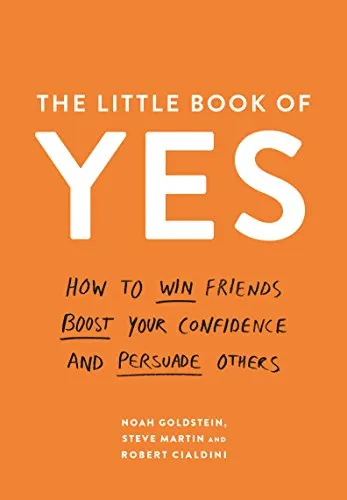
Book:Yes! 50 Scientifically Proven Ways to Be Persuasive (2008), Noah Goldstein, Steve Martin, Robert Cialdini
Date:Aug 25, 2026
Hotels lose millions each year on towel laundering. So in the early 2000s, behavioral scientists tested two signs in hotel bathrooms. The first sign said: "Help save the environment. Please reuse your towels." The second said: "75% of guests who stayed in this room reused their towels. Please join your fellow guests in helping save the environment." The second sign, adding a single descriptive social-proof line about the previous occupants of this specific room, increased towel reuse by 33%. Not "guests at our hotel." Not "guests in general." Guests in this room. The most specific, most local, most identifiable normative reference won.
That's the entire spirit of Yes!. It's not a theory book, it's a fifty-experiment travel guide through the practical edges of persuasion. Cialdini gave us six weapons in 1984. By 2008, he and his lab partners had run hundreds of field experiments and could now say: here are fifty places where the smallest possible nudge produces the largest measurable lift.
You're at Week 13, the finale of Q1, the Awakening Quarter. You've spent twelve weeks reading the foundational texts: Cialdini, Kahneman, Sutherland, Heath, Dooley, Carnegie, Hormozi, Ariely, Wright, Berger, Burgis, Greene. Yes! is the field manual that lets you apply all of it. It's the Q1 closer that turns theory into a Monday morning calendar.
◆ Audio Overview
Prefer to listen?
The chapter as a listen: fifty proven persuasion experiments, distilled to the ones that move funnels. Press play, take the science with you.
Yes! · Audio Overview
0:00/13:18
Thesis
The smallest possible change to a message, one phrase, one number, one ordering, often produces the largest measurable lift. Most marketing teams skip the small change and ship the bold one. The fifty experiments in Yes! prove the small change wins.
Clustered by principle. All field-tested. All shippable this week.
Cluster A
Social Proof Refinements
1. Convergent Validity Effect
Multiple sources of social proof outperform repetition of one source. Three different "ratings" beat one rating shown three times.
2. Specific-Local-Similar Norm
People conform most to norms drawn from people maximally similar to them in the maximally similar context (the towel study).
3. Magnetic Middle Effect
When people see the average, low performers move up AND high performers move down. Counter-intuitive. Fix: combine descriptive norm with injunctive norm.
4. Don't Tell Them About Bad Behavior
Telling people "millions don't recycle/vote" normalizes the bad behavior. Every public-service campaign mistakes this.
Cluster B
Reciprocity Refinements
5. Unconditional Gift
Pre-gifts (mailed before any ask) outperform conditional offers. Conditional reads as transaction; unconditional creates obligation.
6. Personalized Note Power
A handwritten Post-it note on a survey raises response rates 76% vs 36% (typed cover letter). Signal of effort is the lever.
7. Reciprocity of Concession
Open with a large request you expect refusal. Smaller follow-up gets more compliance than asking it cold (door-in-the-face).
8. Reciprocity Decay
Reciprocity weakens over time. "Thanks for trial, upgrade" after 3 months misses. Three days lands.
Cluster C
Commitment & Consistency
9. Active Commitment
Public, written commitments outperform private, spoken ones by 5-10x in follow-through.
10. Identity Label
"You're a voter" outperforms "please vote." Label them with the identity, then they live up to it.
11. Foot-in-the-Door
Small initial yes increases probability of larger second yes.
12. Even a Penny Helps Tag
Adding a phrase that legitimizes any small contribution disproportionately raises both response rate AND average amount.
Cluster D
Liking & Authority
13. Mere-Exposure Effect
Familiar equals liked. Repeated low-key exposure beats one big-bang exposure.
14. Similarity Bias
Customers buy more from salespeople with similar names, birth dates, hometowns, alma maters. CRMs that surface this win.
15. Authority Wardrobe
White-coat experiments show symbols of authority operate even when content is identical.
16. Outed Weakness Trust Bump
Brands that publicly mention a small flaw before launching the strength claim get believed more (Avis: "We Try Harder").
Cluster E
Scarcity & Loss
17. Loss Frame Wins
"You'll lose $X" outperforms "you'll save $X" by 2-3x in field tests.
18. Genuine Scarcity Notice
"Only 3 left" beats "limited supply." Specifics over vague.
19. Exclusion Frame
"Members only" outperforms "members get extra." Exclusion mobilizes more than inclusion adds.
Cluster F
Decision Architecture
20. Power of Because
Even a meaningless reason raises compliance vs no reason. The word "because" triggers automatic acceptance.
21. Cost Decoy
Adding an obviously inferior third option moves the middle option's selection rate up 40-60%.
22. Default Effect
What's pre-selected gets chosen. Opt-out countries hit 80%+ organ-donor rates; opt-in under 20%.
23. Consumer-Choice Overload
24 jam flavors generate interest but fewer sales than 6. Simpler choice sets outconvert.
Cluster G
Framing & Language
24. Fluency Bias
Easier-to-pronounce names, simpler fonts, rhyming claims all rated as more true.
25. Identifiable-Victim Effect
One named, photographed person out-pulls statistics about thousands.
26. Specificity Premium
"$847" raises more than "approximately $850." Odd numbers signal calculation; round numbers signal estimation.
27. Order Effect
First and last items in a list are remembered most (primacy + recency). Middle disappears.
05Lexicon
Field experiment
Real-world test in actual conditions (vs lab). All fifty in Yes! are field-tested.
Descriptive norm
What most people do. Most powerful when matched to actor's group.
Injunctive norm
What people should do. Combine with descriptive to avoid magnetic-middle.
Boomerang effect
When persuasion produces the opposite: citing bad-behavior norms normalizes them.
Pre-suasion (proto-)
The moment-before frame that conditions interpretation. Cialdini's later book formalized this.
First number in negotiation disproportionately determines final number.
Choice architecture
Deliberate design of the option set: defaults, ordering, decoys.
Social proof specificity
Proof from maximally similar others in maximally similar context.
Concession reciprocity
When one party visibly retreats, the other feels obliged to retreat too.
06Tactical Recipes
The Towel-Sign Rewrite. Find any sign or copy using generic social proof. Rewrite with maximum specificity: which customers, which context, which behavior. Test.
The Default Reset. Audit every form, sign-up, checkout, settings panel. What's the current default? What should it be? Switch defaults; measure lift.
The Decoy Tier. Two pricing tiers with most picking cheaper? Add a third tier above the expensive one. Watch the original "expensive" become the new "middle".
The Because Insertion. Every CTA gets a "because" clause, even a thin one. "Sign up because you'll get the weekly post on Tuesday" beats "Sign up."
The Specific-Local-Similar Norm. Replace "thousands of customers" with "12 marketers in Kansas City." Sharpen until it's embarrassingly specific.
The Identity Label Swap. Stop asking people to do things. Start labeling them as the kind of people who do those things. "You're a builder" not "build something."
The Outed Weakness. On an About page or sales asset, name one real limitation. Watch trust and conversion both rise.
The Order Audit. Pricing page, menu, services list. What's first? What's last? What's in the middle (where it dies)? Reorder strategically.
The Loss Frame Rewrite. Find copy framed as gain ("save $X"). Rewrite as loss ("you're losing $X each month you delay"). A/B test.
The Personalized-Note Test. On the next 100 outbound emails, add one-sentence personalized note proving you looked. Measure response lift.
07Tensions / Cross-References
Extends
Cialdini (Wk 1, 14):Influence is the theory; Yes! is the lab notebook. Revisit Yes! monthly for fresh field tests.
vs
Berger (Wk 10): Berger asks why content spreads; Yes! asks why people comply. Different KPIs.
vs
Sutherland (Wk 4): Sutherland celebrates weird, irrational ideas; Yes! celebrates small, tested nudges. Both true at different scales.
Pairs with
Hormozi (Wk 7): Hormozi's offer-stacking is Yes!-style decision architecture writ large. Decoy + specificity + loss-frame + scarcity working in concert.
Bridges
Q1 to Q2: This is the closing chapter of the Awakening Quarter and the opening chapter of the Toolkit Quarter. Q1 was foundations; Q2 begins practical execution.
08Read-Twice Insights
Marketing teams over-invest in big swings and under-invest in small experiments. A 5-person team running 50 Yes!-style experiments per quarter beats a 50-person team running one campaign per quarter.
The boomerang effect is the hidden cost of public-service marketing. Citing the norm of undesired behavior legitimizes it. Fix: only ever cite the desired behavior as the norm.
Specificity is a free upgrade. Replacing vague numbers with precise ones, generic groups with specific ones costs nothing and lifts conversion by double-digit %.
Defaults are the most under-touched lever. Teams obsess over optional-path design while ignoring default-path design. The default IS the design.
Social proof is local. "10 million customers" is wallpaper. "12 customers in your city, in your stage, who looked like you 18 months ago" is a closer.
The first-person narrative outperforms the aggregate. One named customer with photo and quote out-pulls thousand-respondent satisfaction stat.
This is the Q1 graduation moment. You've absorbed the principles. Now you ship the experiments.
09Citation-Grade Quotes
"The desire to fit in with similar others, those most like ourselves in the situation we're in, is among the most powerful motivators."
Goldstein, Martin & Cialdini, Yes!, Experiment 2
"Even a small reason can be more compelling than no reason at all."
Goldstein, Martin & Cialdini, Yes!, on the because principle
"When persuaders mention a weakness in their argument before mentioning a strength, the audience trusts them more."
Goldstein, Martin & Cialdini, Yes!, Experiment 16
"What is presented as the standard option will be selected disproportionately, regardless of preference."
Goldstein, Martin & Cialdini, Yes!, on defaults
"An appeal to people's fear of loss is more persuasive than an appeal to people's hope of gain."
Goldstein, Martin & Cialdini, Yes!, on loss framing
Goldstein, Martin & Cialdini, Yes!, paraphrased on precision premium
APPLY THIS WEEK
Run three micro-experiments. Pick three of the fifty.
Pick three experiments targeting different parts of your funnel: one at top (acquisition copy), one at middle (consideration page), one at bottom (CTA/form).
Write the change. The change must be small, one line, one number, one default. Not a redesign.
Run for 10 days. Measure the one metric that matters for that test. Document the lift (or non-lift). Add to your testing log.
Share results in 200 words. At end of 10 days, write an internal note, wins and losses. Building the cultural muscle for micro-testing is the actual deliverable.
This is the Q1 graduation exercise. You've absorbed the principles. Now you ship the experiments.
Going Deeper
Yes! · Fifty Experiments in Action
Noah Goldstein, Steve Martin, Robert Cialdini · 2008 · 320 pages
The field-manual version of Cialdini's principles. Fifty short chapters, each one a complete field experiment with the principle, the finding, and the application. More practical than Influence. Built for immediate use.
Micro-test, rewrite CTA, small change, default, A/B test, nudge, field experiment, 10-day cycle, behavioral audit, message optimization
Voice
Scientific, practical, field-evidence driven. Cite the actual experiment data. No theory without the field test to back it.
Cross-Skill
To Cialdini (Wk 1, 14) for principle confirmation. To Kahneman (Wk 2) for cognitive bias underlying the test. To Hormozi (Wk 7) for offer-architecture stacks. To Berger (Wk 10) for spread-mechanic tests.
Silent Diagnostic
When this skill fires, the operator is asking about field-testable, small, shippable changes to copy, defaults, or messaging. They're moving from theory into execution. The moment to ask: "What's the specific metric? What's the 10-day test? What's the control?"