Week 1 / 52Q1 Awakening · Origins · The first marketer
The 1923 Book Every Modern Marketer Quietly Steals From
Hopkins ran the first A/B tests, killed the first platitude, and wrote the rules every direct-response operator still works inside.
From:Scientific AdvertisingAuthor:Claude C. HopkinsDate:Jul 27, 2026Pages:~90
In 1908, an unknown copywriter named Claude Hopkins took over a failing campaign for Schlitz beer. His ad walked readers through the brewery, the deep-rock wells, the steam-cleaned bottles, the pure-yeast cultivation. Schlitz didn't tell readers anything every other brewery wasn't already doing. They just told them first.
Schlitz went from fifth in the category to first in months.
Fifteen years later Hopkins wrote Scientific Advertising, ninety pages, no fluff, the entire book a polemic against the assumption that advertising is creative work rather than measurable salesmanship. David Ogilvy called it "the most important book on advertising ever written" and reportedly refused to hire copywriters who hadn't read it twice.
Read this chapter and notice something uncomfortable: every "modern" copy trick you've been taught, A/B testing, specificity over generalities, testimonials with proof, free samples, the long-copy-when-interested rule, the "tell what they get, not what's offered" frame, is right here. From 1923. Hopkins had it. He measured it. He wrote it down. We've spent a century rediscovering him.
Pour yourself something that isn't coffee. We're going back a hundred years to learn what your competitors forgot.
◆ Audio Overview
Prefer to listen?
The chapter as a listen: specificity, sampling, keyed testing, the reason-why. Press play, take Hopkins with you.
Scientific Advertising · Audio Overview
0:00/20:25
◆ ◆ ◆
The Thesis
Advertising is salesmanship, not creative expression. Every claim must be specific, every result must be measurable, and every copy decision must answer one question: would this convince an actual buyer? Hopkins didn't write copy, he ran experiments.
Hopkins is the direct-response origin point. Every operator from Caples to Ogilvy to Halbert to Hormozi works inside the laws he wrote. Cite him when copy is vague, when claims aren't proof-backed, when nobody on the team can answer "how will we know if this worked?"
◆ ◆ ◆
02The Architecture
Ten principles. The 1923 laws every operator since has worked inside.
Framework 01
Salesmanship in Print
What it is
An ad is a salesperson made cheap and infinitely scalable. The brief for an ad is the same as the brief for a salesperson: get attention, build interest, prove the claim, ask for the order. Anything in the ad that wouldn't survive a salesperson saying it to a buyer's face should be cut.
Marketing use
Read your headline aloud as if you're at a buyer's desk. If you'd never say it to their face, don't put it in their feed. The "would this make a salesperson's pitch better?" filter clears 80% of the cleverness that doesn't convert.
"Per Hopkins' opening principle, advertising is salesmanship in print, every line should pass the 'would-a-salesperson-say-this' test."
Framework 02
The Specificity Discipline (Anti-Platitude)
What it is
Hopkins' single most aggressive rule. Generalities, "high quality," "trusted by thousands," "the best service", have no force. They prove nothing, persuade nobody, and read as the language of someone who can't pin down a fact. Specifics, "ships in 4 hours," "47,892 active users," "designed by a former Apple engineer", convert because they're falsifiable. Specificity is credibility.
Marketing use
Every "many" gets a number. Every "people" gets a named persona. Every "fast" gets a unit. Every "place" gets a city. The replacement is mechanical and free.
"Per Hopkins' specificity rule, generalities don't sell, replace every platitude with a falsifiable number, name, or fact."
Framework 03
Tell What They Get, Not What's Offered
What it is
Most marketers describe the product. Hopkins demanded copy describe the customer's experience of the product. Not "high-grade leather", "the leather softens to your hand inside two weeks." Not "fast support", "you get an answer from an actual engineer in under twelve minutes." The pivot is from features-of-product to consequences-for-buyer.
Marketing use
Audit every benefit line. If it describes what you make, rewrite to describe what they experience. The shift moves the asset from company-centered to customer-centered without changing the underlying truth.
"Per Hopkins, copy must describe the customer's experience, not the producer's offering, pivot every feature line to consequence."
Framework 04
Test Everything: Keyed Measurement
What it is
Hopkins invented modern A/B testing in 1908 using "keyed advertisements", different coupon codes in different ads, tracked back to which ad produced the order. He measured cost-per-inquiry and cost-per-sale in the era of horse-drawn delivery. Never guess what works; measure it.
Marketing use
Refuse to ship copy that has no measurement plan. Refuse to credit a "successful campaign" without evidence the success came from the campaign. A/B testing didn't start with Optimizely; it started with Hopkins and a coupon code.
"Per Hopkins' keyed-measurement principle, no copy decision is final until the return data confirms it, A/B testing dates to 1908, not 2008."
Framework 05
The Sampling Principle
What it is
Hopkins championed free samples decades before anyone called it "freemium" or "reciprocity." His insight: the friction of trying is what kills sales, and giving the product away (or a meaningful piece of it) for free converts cold prospects to buyers at rates no claim-based ad could match. The sample is itself the most persuasive ad.
Marketing use
Build a true sample experience for every product. Free chapter, free trial, free audit, free calculator, free strategy session. The sample must be enough that the prospect knows what they're missing if they don't buy.
"Per Hopkins' sampling principle, the sample is the most persuasive ad, give enough that the prospect feels the loss of not buying."
Framework 06
Information Beats Cleverness
What it is
Hopkins argued, and proved with split-tests, that informational ads (specific facts, useful detail, honest description) outsell clever ads (puns, jokes, visual gags, mood pieces) when the goal is conversion. Cleverness amuses; information persuades. Most "creative" advertising is what you do when you don't have something specific to say.
Marketing use
Audit the brief: is your campaign clever, or informational? Hopkins isn't anti-creative, he's anti-clever-as-a-substitute-for-substance. The best copy is informational and compelling. The mediocre copy is clever in lieu of substance.
"Per Hopkins, information outsells cleverness in head-to-head testing, cleverness amuses; information persuades."
Framework 07
Headlines Carry the Ad
What it is
Hopkins observed (a century before A/B testing platforms could prove it at scale) that 4-5x more people read the headline than the body copy. The headline doesn't introduce the ad; the headline is the ad for most readers. Time spent on body copy with a weak headline is wasted.
Marketing use
Write 20+ headlines. Test the top 5. Spend disproportionate effort here. The winning headline carries the campaign; the rest is supporting cast.
"Per Hopkins, more people read the headline than the body, write 20 variants, test 5, ship the winner."
Framework 08
The Reason Why
What it is
Every claim must come with a reason. Not "our coffee is the best", "our coffee is the best because we roast within 24 hours of green-bean delivery and ship within 6 hours of roast." The reason converts the claim from assertion to evidence. Even mild reasons compound the claim's force.
Marketing use
Every benefit gets a "because." Every superlative gets a mechanism. Every claim gets a proof. The audit: read each claim and ask "why?", if the copy doesn't answer, write the answer in.
"Per Hopkins' reason-why principle, every claim must carry its mechanism, assertion without reason is platitude."
Framework 09
Proof Beats Claims (Specifics in Testimonials)
What it is
Generic testimonials ("great product, would recommend") are nearly useless. Specific testimonials, with names, dates, locations, measurable results, and the specific situation the buyer was in, outperform generics by orders of magnitude. The specifics make the proof falsifiable, and falsifiable proof is the only proof.
Marketing use
Replace every generic testimonial with a specific one. "Sarah from Topeka, who runs a 5-person dental practice, increased new-patient bookings 38% in 60 days using our intake form" beats "great tool, very useful" by every conversion metric.
"Per Hopkins' proof principle, specifics make the testimonial falsifiable, name, date, place, result. Generic testimonials are pre-emptive distrust."
Framework 10
Don't Brag: Describe the Buyer's Experience
What it is
Hopkins observed that brag-and-boast copy ("we are the largest, the fastest, the most trusted") repels readers because it centers the company. The most effective copy centers the buyer, describes their situation, their pain, their gain, their use case. Bragging is what marketing teams want to write; describing is what buyers want to read.
Marketing use
Read the asset. Count the "we"s and the "you"s. If "we" outnumbers "you," rewrite. The shift is mechanical and reliably lifts conversion.
"Per Hopkins, copy that brags about the company underperforms copy that describes the buyer's experience, count the we's vs. the you's."
◆ ◆ ◆
03Lexicon
Named terms a marketer should recognize on sight.
Salesmanship in print
Every ad is a salesperson's pitch made scalable. Read every line aloud as if you're at a buyer's desk.
Platitudinous talking
The language of marketers who can't pin down a fact. Replace every platitude with specifics.
Keyed advertisement
Different tracking codes per ad to measure response. A/B testing dates to 1908.
The reason why
Every claim must carry its mechanism. "Because" outperforms "is."
Sampling
Free trial / sample to bypass the friction of buying. The sample is the most persuasive ad.
Cost per inquiry
Hopkins' empirical metric set. Refuse to ship without a measurement plan.
Information vs. cleverness
Useful vs. amusing copy. Information persuades; cleverness amuses.
Specific testimonial
Named, dated, located, quantified. Generic testimonials are pre-emptive distrust.
Brag-and-boast
Company-centered copy. Count the we's vs. the you's; if we wins, rewrite.
Headline carries the ad
4-5x more readers than body copy. Spend disproportionate time here.
◆ ◆ ◆
04Tactical Recipes
Specific moves you can ship by Friday.
The Specificity Sweep. Audit any asset. Replace every generality with a specific. "Many" → a number. "People" → a named persona. "Recent" → a date. "Fast" → a unit. The replacement is free; the lift is consistent.
The Headline 20-Variation Test. Write 20 headline variants per asset. Test the top 5 in market. The winning headline carries the campaign, don't ship after one.
The Generic-Truth Move (Schlitz). Find a "boring" production fact every competitor in your category does but nobody mentions in marketing. Describe it in detail. You won't be lying; you'll be claiming territory nobody else thought to claim.
The Reason-Why Insertion. For every benefit claim, append a "because." "We respond fast" → "We respond in under 12 minutes because we have engineers, not chatbots, on-call." Mild reasons still compound force.
The Proof Replacement. Replace every generic testimonial with a specific one, name, date, city, profession, and a measurable result. Generic testimonials feel like staged stagecraft; specifics feel like reality.
The We-vs-You Audit. Count the "we"s and the "you"s in your homepage. If "we" wins, rewrite the page from the buyer's perspective. The shift is mechanical and consistently lifts conversion.
The Keyed-Test Discipline. No copy decision ships without a measurement plan. Document the metric, the threshold, the time window. If the team can't agree on what success looks like, the copy isn't ready.
The Sample-First Funnel. Lead every funnel with a sample of real value, not a "free PDF lead magnet" with thin content, but a usable artifact (calculator, audit, working tool, real chapter). The sample is the ad.
The Information-First Headline. Replace cleverness with usefulness. "The headphones that finally work" → "Six-hour battery, no app required, $89." Information-first outperforms clever in conversion testing across categories.
The Long-Copy-When-Interested Rule. For warm/hot prospects, longer copy outsells shorter copy because the buyer is hungry for detail. For cold traffic, lead with the headline and short hook. Calibrate copy length to prospect interest, not arbitrary "best practice."
◆ ◆ ◆
05Tensions & Cross-References
Where Hopkins agrees, contradicts, or extends the rest of the shelf.
Origin point
The direct-response river. Caples, Ogilvy, Halbert, Whitman, Sugarman, Brunson, Hormozi, all work inside laws Hopkins wrote. The 1923 book is the headwater of the entire direct-response lineage.
Agrees with
E. Schwartz, Breakthrough Advertising. Both demand specificity, proof load, ruthless headline work. Schwartz adds the awareness ladder Hopkins didn't formalize.
Agrees with
Cialdini. Hopkins' sampling principle is reciprocation in copywriter dress. The reason-why is authority-via-mechanism. Specific testimonials are social-proof made falsifiable.
Pushes back on
Sutherland, Alchemy. Sutherland argues that in some categories, Hopkins-style rationality is now Stage-4 commodity territory and the alchemy lies in the counterintuitive moves. Both are right, in different categories at different sophistication stages.
Extended by
Kahneman. Hopkins observed that specifics outsell generics decades before Kahneman explained it through availability heuristic and WYSIATI. Hopkins had the what; Kahneman gives the why.
Pre-figures
Brunson / Hormozi. Hopkins' "tell what they get, not what's offered" is the seed of Hormozi's value equation. The sampling principle is the seed of Brunson's free-plus-shipping funnel.
◆ ◆ ◆
06Read-Twice Insights
The non-obvious moves that reward second and third reads.
Most modern direct-response is Hopkins repackaged. Strip the buzzwords from any growth blog post and you'll find a Hopkins principle underneath. The discipline is humbling: we keep rediscovering 1923.
The specificity rule is the cheapest copy lift available. Generic-to-specific is a mechanical replacement. The conversion lift is consistent across categories. Most marketers just don't do it because specifics require knowing the actual fact.
The "we vs. you" audit is the single fastest homepage diagnosis. Count once, rewrite, ship. Conversion lifts in the 10-30% range are routine. No new product, no new positioning required.
Cleverness is what marketers do when they don't have something specific to say. Hopkins is brutal on this. If the brief allows clever, the brief is hiding a vagueness elsewhere.
Hopkins' empirical mandate is now the actual job. The era of agency creative guessing what works without measurement is dead. The brand-marketing teams that don't measure are slowly being replaced by ones that do.
"Long copy outsells short copy when the prospect is interested" is widely misunderstood. The rule isn't "longer is better." It's "calibrate length to prospect heat." Cold = short. Warm = long. Most teams use one length for both.
◆ ◆ ◆
07Citation-Grade Quotes
Pull-able lines for output. Click any quote to copy it formatted for social.
"Advertising is salesmanship."
Claude C. Hopkins, Scientific Advertising · Ch. 1
"Be specific. Actual figures, definite facts, are more convincing than general claims."
Claude C. Hopkins, Scientific Advertising · Ch. 4
"The product itself should be its own best salesman."
Claude C. Hopkins, Scientific Advertising · Ch. 6, Sampling
"The man who reads your ad should be told what he gets, not what you offer."
Claude C. Hopkins, Scientific Advertising · Ch. 7
"Almost any subject is interesting when it is told in an interesting way."
Claude C. Hopkins, Scientific Advertising · Ch. 9
"One ad is a single salesman. The wisdom of one is rarely greater than the wisdom of many tested ads."
Claude C. Hopkins, Scientific Advertising · Ch. 21, Testing
◆ Apply This Week
One platitude. One specific.
Take any current marketing claim, yours or a competitor's. Read it. Now ask: is this specific, or platitudinous?
"Trusted by thousands" → 47,892
"High quality" → hand-finished in [city] by [name]
"Fast" → ships in 4 hours
"Easy" → setup in 7 minutes, no credit card, three clicks
Generic claims persuade nobody. Specific claims persuade everyone who would have bought from you anyway. Hopkins called the generic stuff "platitudinous talking", the language of marketers who can't or won't pin down a fact.
Find one platitude in your highest-stakes asset. Replace it with a specific number, name, or fact you can actually prove. Don't change anything else. Ship the swap by Friday.
That's week two. One platitude. One specific. The 1923 lesson nobody's been able to improve on. See you Tuesday.
◆ Going Deeper
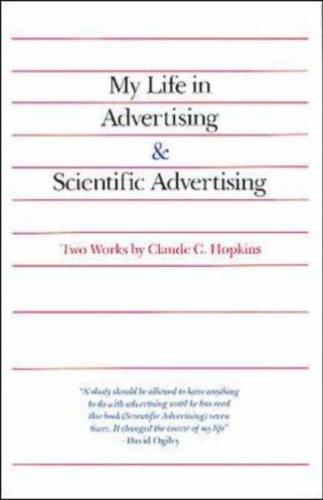
The source: Scientific Advertising
CLAUDE C. HOPKINS · 1923 · ~90 PP. · PUBLIC DOMAIN
Ninety pages. No fluff. Read it twice. Once to absorb the rules. Once to notice they're still the rules.
Affiliate links. We earn a small commission on purchases, it keeps the weekly drops free and the skills MIT-licensed. (The book is also public domain, you can read it free legally.)
◆ Get The Skill
Want the platitude scan done for you?
The Specificity Audit (Hopkins) skill scans any marketing asset for platitudinous talking, missing reason-whys, we-vs-you imbalance, generic testimonials, and weak headlines. Returns specific rewrites with the Hopkins citation. Free. MIT licensed.
Especially Write (the headline + specificity discipline), Audit (platitude detection, we-vs-you scoring), Diagnose (when copy isn't converting, run the Hopkins audit first).
Pairs with
Caples (testing methodology Hopkins originated, formalized); E. Schwartz (the awareness ladder Hopkins didn't have); Whitman/Sugarman/Halbert (modern direct-response children); Cialdini (sampling = reciprocation); Hormozi (value equation = "tell what they get").
Output shape
When the skill leans on Hopkins, output should always include (a) a platitude scan, (b) the we-vs-you ratio, (c) a specificity rewrite for at least one line, (d) a reason-why insertion check.
The Silent Diagnostic
Is every claim in this asset specific and reason-backed, or is it platitudinous talking that proves nothing?